Agents, voice and social capital: what comes after AI that responds
From iRTE 2026, in Beijing, Rodrigo Terron examines how AI agents transform task execution and the value of human connections. The article covers social capital, conversational AI, autonomy and trust, as well as infrastructure and opportunities for Brazilian entrepreneurs.

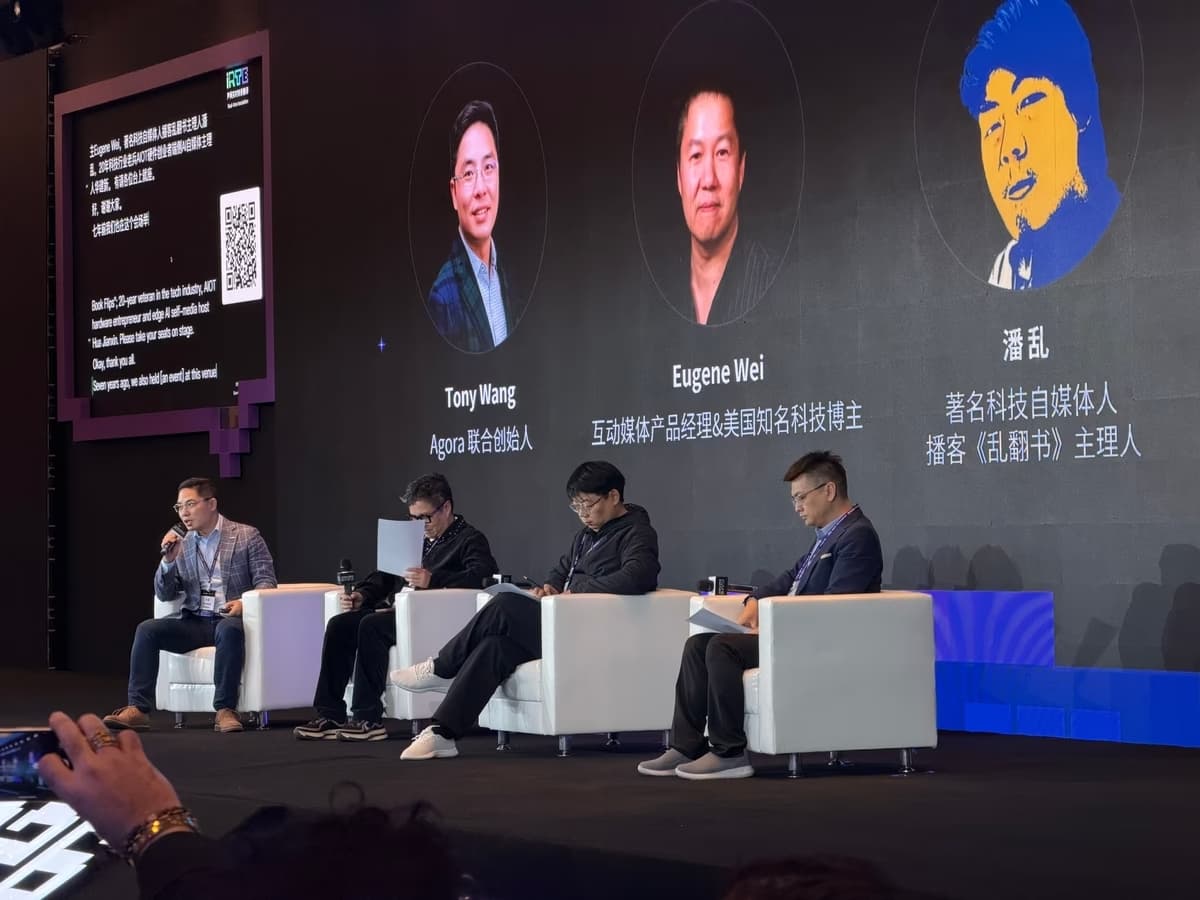
From iRTE 2026, in Beijing, a reflection on what changes when agents start acting on our behalf, and why trust and community gain importance in this transition.
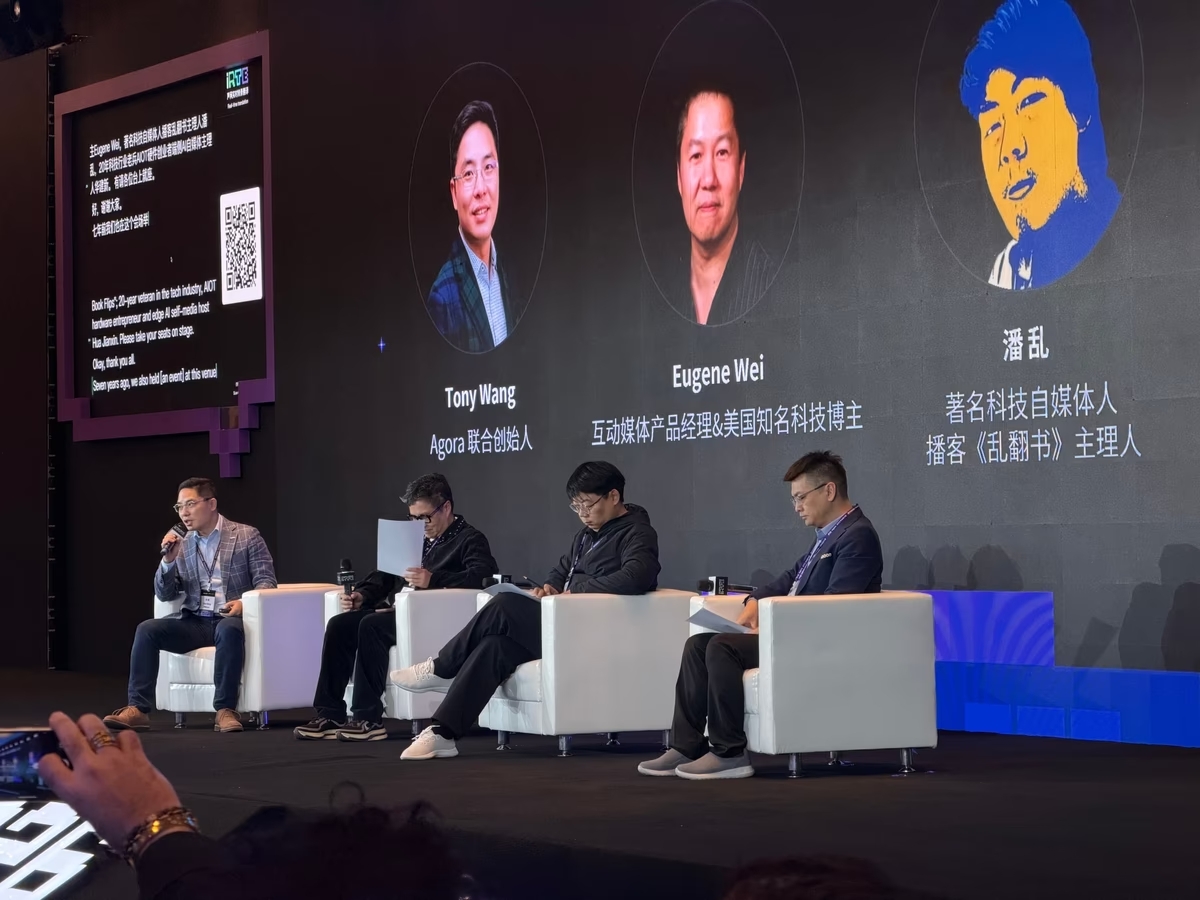
I'm in Beijing, China, attending iRTE 2026, an event by Agora that brings together more than 7,000 people around artificial intelligence and real-time interaction. In the panel on personal agents, Tony Wang, co-founder of Agora, raised a provocation that stayed with me: if my agent can talk to thousands of people, what still makes a relationship valuable?
“What will be the next scarce resource?”
Tony Wang, co-founder of Agora. Translated from English, during the panel.
He used the hypothesis of an agent that reaches out to thousands of people on LinkedIn and compared it to the gesture of someone personally writing a message. The provocation opens up a discussion on social capital: the trust we build, the commitment between people and the value of a relationship that continues after the first introduction.
My bet is that we will express more goals in natural language and delegate larger parts of execution. Voice can accelerate this shift. Along with this capability, we will need to think more carefully about the work we want to automate and the relationships we want to cultivate.
What a connection becomes worth
In response, Eugene Wei pointed out that the principle of removing friction has guided much of digital product building. Yet certain efforts also bring people closer together. Mutual commitment and the work of doing something together help form communities. Eliminating all friction cannot be the only criterion.
This perspective interests me a lot. We can use AI to organize a meeting, retrieve the context of a conversation and prepare a presentation. The time saved can create space to listen better to a person, follow through on a commitment or contribute to a problem they are facing.
At the same time, if we multiply messages without paying attention to context, we also multiply the effort for whoever has to receive them. Being able to reach someone and building a relationship with that person are different steps. Having a name on a list still says little about what we can do together.
That's how I look at social capital in this scenario: relationships that allow us to learn, ask for help, contribute and build with trust. Technology can help bring people closer. The value of that closeness depends on what we do with it.
When we built the Shawee community in Silicon Valley, bringing people together came before expanding the commercial offering. Meetups with developers created space to share knowledge and get to know the ecosystem. This experience helps me look at today's discussion: tools can facilitate first contact, but building a relationship still requires participation and contribution.
What changes when conversation becomes the interface
The panel also discussed the next access point to technology: phones, glasses, earbuds and devices capable of understanding the environment. The question that interests me is how much of our context a system can perceive and what it can do with that.
A person might show a part while explaining a problem or correct a piece of information mid-sentence. The interaction combines speech, image and intent. Designing for this requires understanding how people talk and work.
The official program brings these fronts together: conversational AI, multimodality, infrastructure, applications and devices. The debate covers the full experience.
An AI needs to know when to stop talking
In a conversation, we need to interrupt, go back to a point or correct a piece of information. The system needs to accommodate this without forcing us to start all over again.
If the AI takes too long, it feels like the connection dropped. If it responds too soon, it cuts off the explanation. If it talks over a correction, the person loses control of the conversation.
Agora works on this layer with features for handling interruptions, noise reduction, echo cancellation and connections to different models. These are capabilities stated by the company, to be evaluated in each application.
For those building with it, a test is worthwhile: interrupt the AI, change a piece of data and ask it to continue. Repeat with noise and a worse connection. Does the task reach completion?
From service to execution
Imagine someone wanting to reschedule a technical visit. They explain the reason, state their available times and add a note about building access. An assistant can point them to where to find the form. An agent connected to the operation can check the schedule, verify conditions, present options and, after confirmation, register the change.
The conversation meets data, rules and tools capable of producing a result.
The system needs to know which record to check, what it can change, when to ask for confirmation and how to act if the schedule isn't available. It needs to distinguish an intention from an authorization, and an attempt from a completed action.
It's in this transition that I see a great opportunity for entrepreneurs. Deeply understanding a process can be more valuable than adding yet another generic AI feature. Whoever understands a business's exceptions can see where a task gets stuck and what needs to happen for it to be completed.
The agent needs to earn the next permission
Allowing AI to change a commitment, send a proposal or take on an obligation creates a relationship of responsibility greater than just asking for a suggestion.
I believe in autonomy built in stages. The agent observes, suggests and prepares an action for review. In well-defined tasks, it gets permission to execute. The results help decide where to expand that permission and where to keep a person involved.
This trust depends on something very concrete: being able to understand what happened. Did the agent consult the right information? Was the change recorded? Was there a failure? Was the case forwarded to someone with enough context to continue?
A calm-sounding response can hide incomplete information. The product needs to make uncertainty visible and know how to ask for help.
Infrastructure is also part of the experience
Agora, Inc. is a company listed on Nasdaq under the ticker API. The group brings together the operations of the Agora brand, focused on the global market, and Shengwang, focused on the Chinese market. Its track record in real-time communication helps explain its presence in this conversation about AI.
The experience depends on communication, model latency, data queries and the systems that execute the tasks.
For the user, everything appears as a single experience. If a query gets stuck or they have to repeat the story to another person in charge, the task remains difficult.
There's also the operational cost to consider. I would track the cost per task resolved, rework and the quality perceived by those who used it. That's how a technical possibility starts turning into a sustainable business.
The space I see for Brazil
Looking at what's happening here raises a practical question: which problems in our context can we solve better with these capabilities?
There's room in customer service, education, commerce and internal routines. A team can reduce the effort of consulting scattered information. A student can get support to practice a conversation. A company can better organize the path between a customer's request and delivery. Each situation requires testing language, data, consent and boundaries in the context where the product will be used.
Bringing together those who understand these problems with those who can build is part of the work of NewHack, a Brazilian AI and startup community, and the proposal behind AI House Brasil, an initiative connecting Brazil's AI ecosystem. Agora is the first sponsor of AI House Brasil and NewHack's institutional strategic partner. This relationship brings our ecosystem closer to a global infrastructure and conversational AI company.
To me, this partnership makes sense by creating the conditions to learn, experiment and build. It's also an application of the discussion on social capital: bringing together people, knowledge and infrastructure around problems worth solving. The value needs to show up in the work we manage to do together.
I leave this discussion in Beijing with two questions: what task will someone be able to trust your product with from start to finish? And what will we do with the time and capacity this technology frees up?
I want to see this capability lead to better products and more people able to build. I also want it to expand the space for relationships that need our presence. The next phase of AI can talk and act better and better. It's up to us to decide what's worth doing with it and who we want to build with.
Account by Rodrigo Terron and NewHack, expanded with context and information from external sources.
Translated from the Brazilian Portuguese original · Read the original

OPC is the new startup
The One Person Company (OPC) model is gaining ground as artificial intelligence and AI agents advance, expanding a single person's capacity to develop products and run businesses. This article examines the opportunities and limits of this format, including costs, human oversight and the challenges of winning customers and growing.