

Google Could Win the AI War Without the Best AI
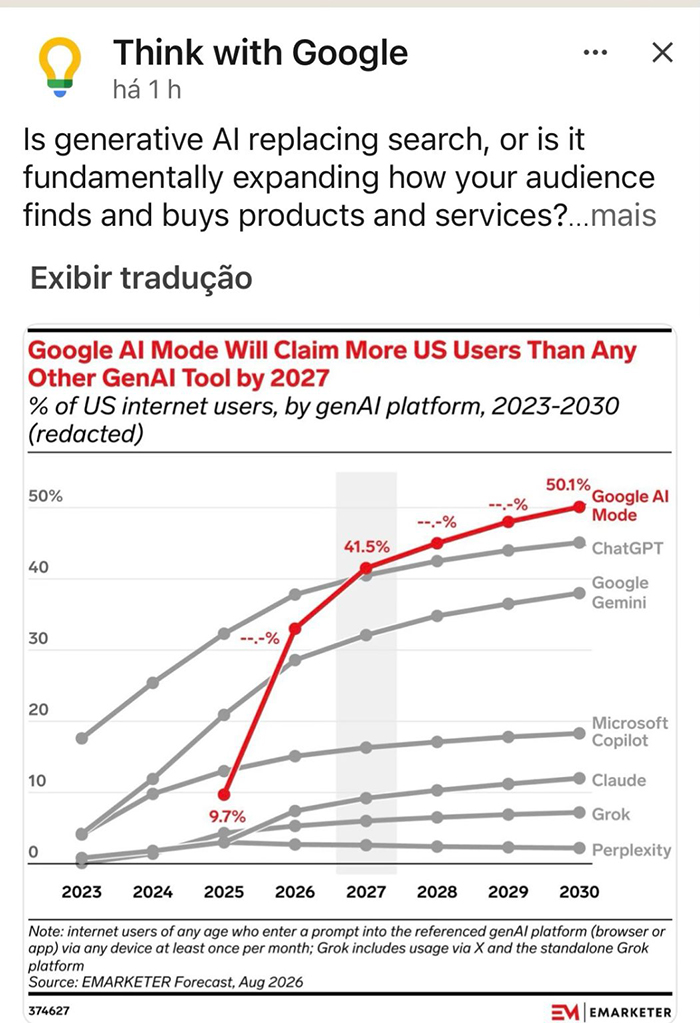
In the US, Google AI Mode is projected to jump from 9.7% of internet users in 2025 to 41.5% in 2027 and 50.1% in 2030. It would overtake ChatGPT in monthly reach.

- Reading
- 2 min
And that might not even be the most important news.
Think with Google published a projection from eMarketeer that deserves every CMO's attention.
In the US, Google AI Mode is projected to jump from 9.7% of internet users in 2025 to 41.5% in 2027 and 50.1% in 2030. It would overtake ChatGPT in monthly reach.
Attention: monthly reach, not share of queries, preference, or purchase volume. The same user may turn to several AIs.
But the message is powerful.
Google doesn't need to convince the world to download a new tool. It just needs to turn its search infrastructure into an answer infrastructure. The distribution it built over two decades becomes its weapon in the AI era.
And this is already happening. AI Mode has surpassed 1 billion global users, according to Google. The questions asked there are, on average, three times longer than traditional searches.
Do you see the shift?
Someone who types “best laptop” leaves few clues. Someone who describes budget, purpose, preferences, and constraints hands the machine a purchase brief.
That's where a new economic power is born: not just showing options, but ranking preferences.
The thing is, reach isn't influence. And influence isn't conversion.
Google may lead distribution while ChatGPT remains decisive in certain journeys. Other models may win extremely high-value niches. There won't necessarily be a single winner for every question.
In Brazil, a study by Conversion, a Brazilian digital marketing consultancy, and Opinion Box, a Brazilian market research firm, found that among consumers who already use AI, 55% said they abandoned a brand after a negative review or lack of recommendation; 69% changed their opinion about a brand or product after hearing from the machine.
These numbers don't represent all Brazilians. But they signal something marketing departments still underestimate: AI already interferes with commercial reputation.
That's why the debate over whether “SEO is dead” is too small.
The relevant question is different: when a consumer describes what they need, does your brand show up in the answer? Is it recommended? Why? Who takes its place?
The next big marketing battle won't be just about traffic, clicks, and ads. It will be about having a share in the decisions machines help build.
Whoever has an algorithmic strategy, a structure for generating findable content with the right answers at the right time, will prevail.
The era of the link isn't over. But the era of recommendation has begun.
Sources: EMARKETER/Think with Google (Aug. 2026); Alphabet; Conversion/Opinion Box (2026).
Translated from the Brazilian Portuguese original · Read the original