Meta's Muse Ember ties on price with GPT-6 Luna and Claude Haiku 5.5 in the race for cheap agents

- Reading
- 7 min
- Tables
- 1
Muse Ember, launched by Meta on November 10, 2026, charges the same entry price as GPT-6 Luna and Claude Haiku 5.5, but the three diverge on the cheap context limit and the cost above it.
Cheap models for agents: the new tug-of-war
On November 10, 2026, Meta introduced Muse Ember 1.0, a small model built for the work AI agents repeat all day long: tool calls, coding subtasks, routing, data extraction, and long document parsing. Simon Willison, on his blog, described the launch as Meta's entry "into the Claude Haiku/GPT Luna category": the segment of models designed not to solve the world's hardest question, but to run in a loop, thousands of times a day, without blowing the budget.
This distinction matters to anyone building agents in production because an agent's real cost rarely comes from the expensive model called once per session to plan. It comes from the cheap model called hundreds of times to execute each step: reading a chunk of a document, deciding which tool to use, extracting a field, formatting a response. Swapping that execution model for a cheaper one without losing quality is the most direct cost lever an engineering team has today, and that's exactly where Muse Ember comes in, competing head-on with GPT-6 Luna (OpenAI) and Claude Haiku 5.5 (Anthropic).
The selection criterion here isn't "which model is smarter" in the abstract. It's which one combines the lowest cost per task with the context limit and price adjustments your agent actually uses day to day. That's what the table below tries to make clear, with the numbers Willison published based on the official announcements.
Price, context limit, and efficiency side by side
| Criterion | GPT-6 Luna | Muse Ember 1.0 | Claude Haiku 5.5 |
|---|---|---|---|
| Limit before price adjustment | 272,000 tokens | 200,000 tokens | 100,000 tokens |
| Input up to the limit | $0.10/M | $0.10/M | $0.10/M |
| Input above the limit | $0.20/M | $0.30/M | not disclosed |
| Input cache up to the limit | $0.01/M | $0.004/M | not disclosed |
| Input cache above the limit | $0.02/M | $0.012/M | $0.05/M |
| Output up to the limit | $0.50/M | $0.50/M | $0.50/M |
| Output above the limit | $0.75/M | $1.50/M | $2.50/M |
| Maximum supported context | up to 1 million tokens | up to 1 million tokens | up to 1 million tokens |
| Configurable reasoning levels | not disclosed | 6 (minimal, low, medium, high, xhigh, max) | not disclosed |
| Position on the efficiency frontier (Artificial Analysis) | not disclosed | on the Pareto line; highest score per cost of the entire leaderboard, according to Meta | not disclosed |
What each number in the table really means
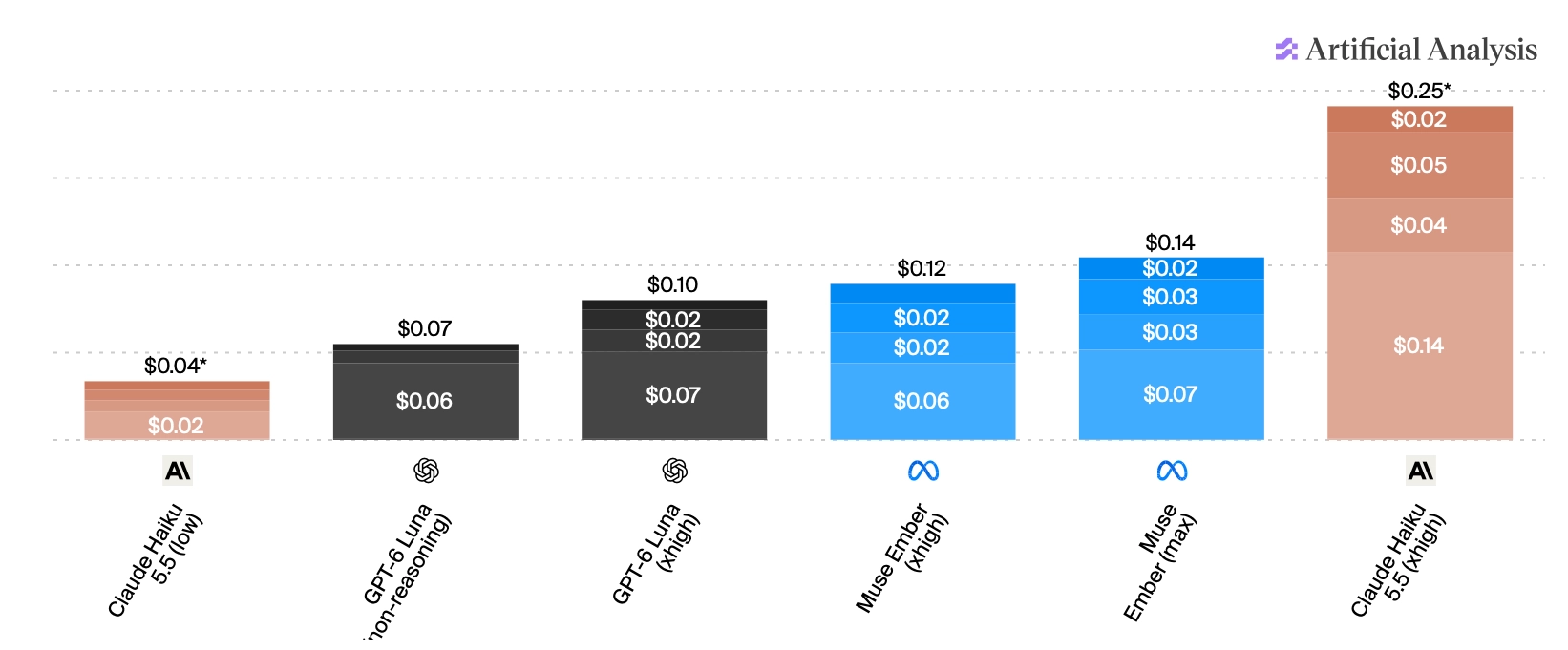
In the short-prompt range, all three models charge exactly the same: $0.10 per million input tokens and $0.50 per million output tokens. It's this tie in entry-level pricing that justifies talking about the three as direct competitors, rather than as products in different categories.
The difference shows up in the context limit before the price adjustment. Claude Haiku 5.5 is the first to raise its price, right at 100,000 tokens. Muse Ember holds out twice as long, 200,000, before getting pricier. GPT-6 Luna goes further still, up to 272,000 tokens at the full price. For an agent that processes few documents per call, this changes nothing; for one that does long document parsing (precisely one of the uses Meta cites for Ember), it's the difference between paying the entry price or already falling into the expensive bracket.
Above the limit, looking at the output price, which weighs more in agent tasks because every action or generated response consumes output tokens, Ember sits literally in the middle of the three: $0.75 per million for Luna, $1.50 for Ember, $2.50 for Haiku 5.5. This is what Willison meant when he wrote that, taking the context limit into account, "Ember is priced between the other two."
Meta describes the model itself this way, in the announcement:
[...] our smallest and most efficient model designed for complex reasoning execution and the work agents repeat all day: tool calls, coding subtasks, routing, extraction, and long document parsing.
Meta AI, in the Muse Ember announcement
Beyond price, Willison turns to the Intelligence Index vs. Cost per Task chart from Artificial Analysis, an independent organization that measures model performance. On that chart there's a "Pareto line": the point beyond which you can only gain in one dimension (intelligence or cost) by giving up the other. According to Meta, Ember sits exactly on that line, and more: it would be the model with the best score per dollar of the entire Artificial Analysis leaderboard, not just the small-model category.
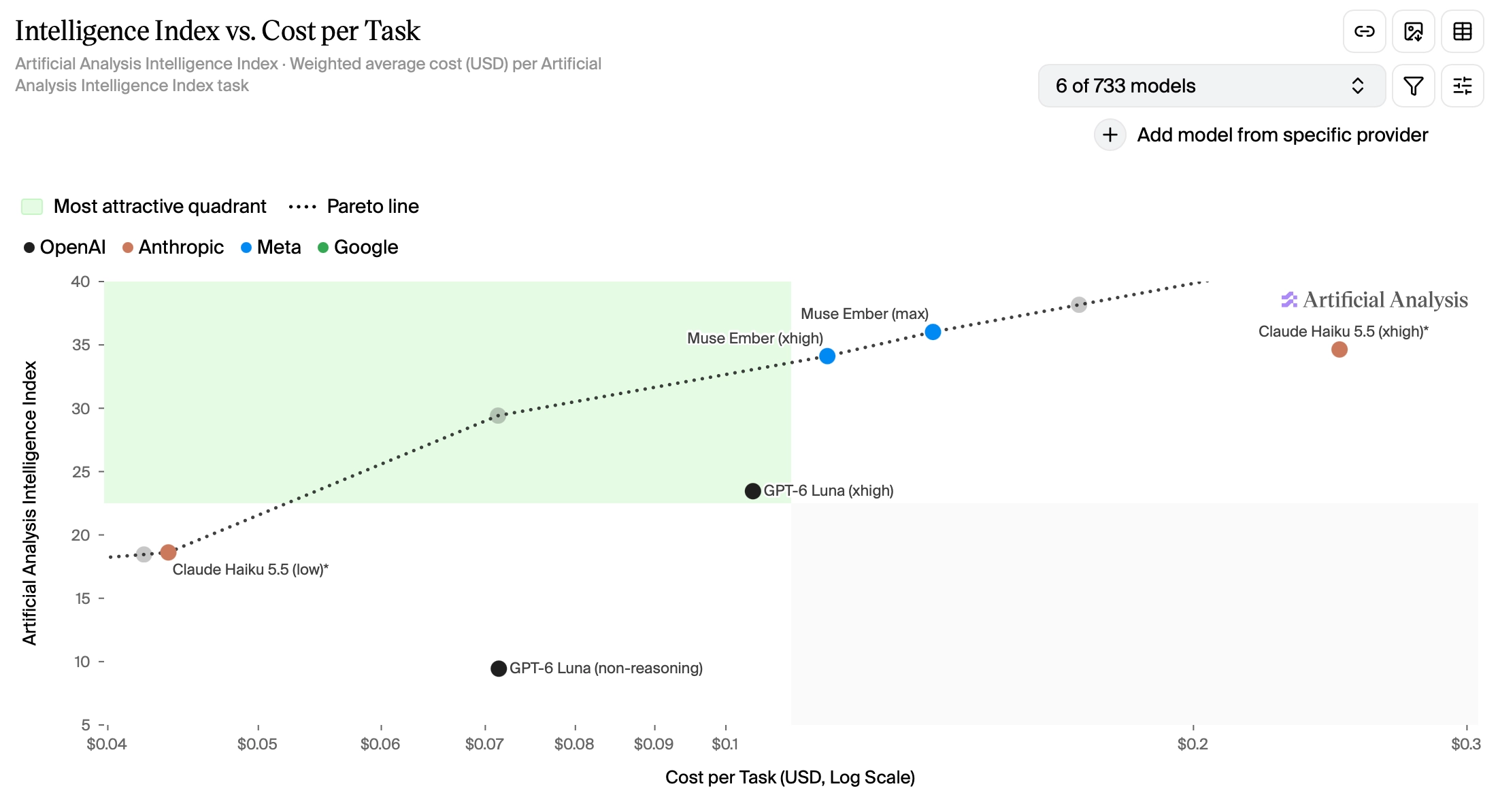
It also sits on the efficiency frontier of the full Artificial Analysis leaderboard: no model scores higher for less per task.
It's worth noting this is a claim from Meta itself, repeated by Willison, not an independent test of his own. Willison himself points out a curious detail in the chart: the gray dot right in the middle of the efficiency area is GPT-6.1 Terra (low), a different model unrelated to GPT-6 Luna, which he admits he hadn't been following closely until then.
To test Ember in practice, Willison used his personal, recurring benchmark: asking a model to draw, in SVG, "a pelican riding a bicycle." Since Ember has six configurable reasoning levels (minimal, low, medium, high, xhigh, and max), he ran the test on all six, generating six different pelicans.
The result wasn't what one might expect: the "high" level failed to return a complete SVG, and visual quality didn't cleanly track with higher reasoning levels ("max" wasn't necessarily the best of all). As a price reference, Willison compared the pelicans generated by Ember with those from Muse Wonder, Meta's own larger model that costs 40 times more than Ember, and found the quality comparable between them.

To put into context just how cheap these small models are, it's worth citing the contrast of the day: Claude Fable 5.2, another launch from that same November 10, 2026, charges $8 per million input tokens and $40 for output, 80 times the $0.10/$0.50 floor of Ember, Luna, and Haiku 5.5. That's the price gap between a frontier reasoning model and a model built to run in a loop inside an agent.
Verdict by use case
Small team running many tool calls in production, on a tight budget: Muse Ember is the most defensible bet. It ties the competitors on entry-level price, has, according to Meta, the best score per dollar of the entire Artificial Analysis leaderboard, and its six reasoning levels give fine-grained control to cut costs on simple subtasks without switching models.
Product already in production that regularly processes long documents (above 200,000 tokens per call): GPT-6 Luna has the edge here. It holds out for more tokens at the full price (272,000 versus Ember's 200,000) and, when the price rises, output remains the cheapest of the three ($0.75 versus $1.50 and $2.50).
Team already integrated into the Anthropic stack (Claude API, MCP tools from the Claude ecosystem): Claude Haiku 5.5 avoids switching vendors and keeps the same entry price as its competitors, even though the source doesn't detail the input cost above 100,000 tokens, which is worth confirming before migrating long-context workloads to it.
Prototyping and proofs of concept that shouldn't exceed a few thousand tokens per call: the three tie on entry price, so the choice becomes a matter of ecosystem, SDK, and orchestration tools the team already knows, not cost.
Heavy, non-repetitive reasoning task (planning a complex agent, not executing its steps): none of the three is the right product. This article's comparison is about the cheap execution model; for frontier reasoning, the reference Willison cited on the same day is Claude Fable 5.2, 80 times more expensive.
What still can't be claimed
Willison didn't run a systematic quality benchmark on real tool calling with the three models: his only test was the pelican on a bicycle in SVG, which measures instruction-following and vector generation, not actual agent performance with real tools. The source also doesn't disclose Claude Haiku 5.5's input price above 100,000 tokens, nor the full methodology behind Artificial Analysis's Intelligence Index vs. Cost per Task, cited as an external reference and not audited by him.
There's also no information in the source about whether Muse Ember is distributed as open weights or only through Meta's paid API, which significantly changes the math for anyone considering self-hosting the model. Finally, none of the sources received included an image URL from iMasters's own library or an official video from a verified channel, so this article has no embedded media in the body.
Translated from the Brazilian Portuguese original · Read the original
Claude Fable 5.2 adjusts its own code depending on who the prompt defines as the owner
Anthropic documentation, published on November 10, 2026, shows that a single sentence about code ownership changes the rate of duplicate unification from under 10% to about 50% in the model's internal tests.