

AI Laptop Label Hides What Actually Matters for Developers
Creative Bloq's criticism of the inflated 'AI laptop' term applies to developers too: the name on the label says nothing about NPU, GPU, or memory, and that's what decides whether the hardware runs your workload.

Creative Bloq's criticism of the inflated 'AI laptop' term applies to developers too: the name on the label says nothing about NPU, GPU, or memory, and that's what decides whether the hardware runs your workload.
If you've been comparing laptops over the past two years, you've noticed: the plain names disappeared. Every launch now comes with "AI" tacked onto the end, whether the hardware justifies it or not. Journalist Paul Hatton, from Creative Bloq, recently wrote about the fatigue of reviewing machine after machine with this label and feeling like it doesn't mean anything consistent. I agree with his frustration, but I want to bring this criticism into the territory of readers of this site, who choose hardware thinking about running models, not running Photoshop.
The problem isn't the hype, it's the generic label
Hatton cites the case of the Acer Nitro V 16 AI: he ran ComfyUI, generative background fill in Photoshop, and video effects with NVIDIA Broadcast on the machine and described the result as "fast, responsive, and totally reliable." His conclusion is interesting because it's neither cynical nor dazzled: he still thinks the "AI" label is used in an inflated way across the market, but acknowledges that, in this specific case, the machine delivered.
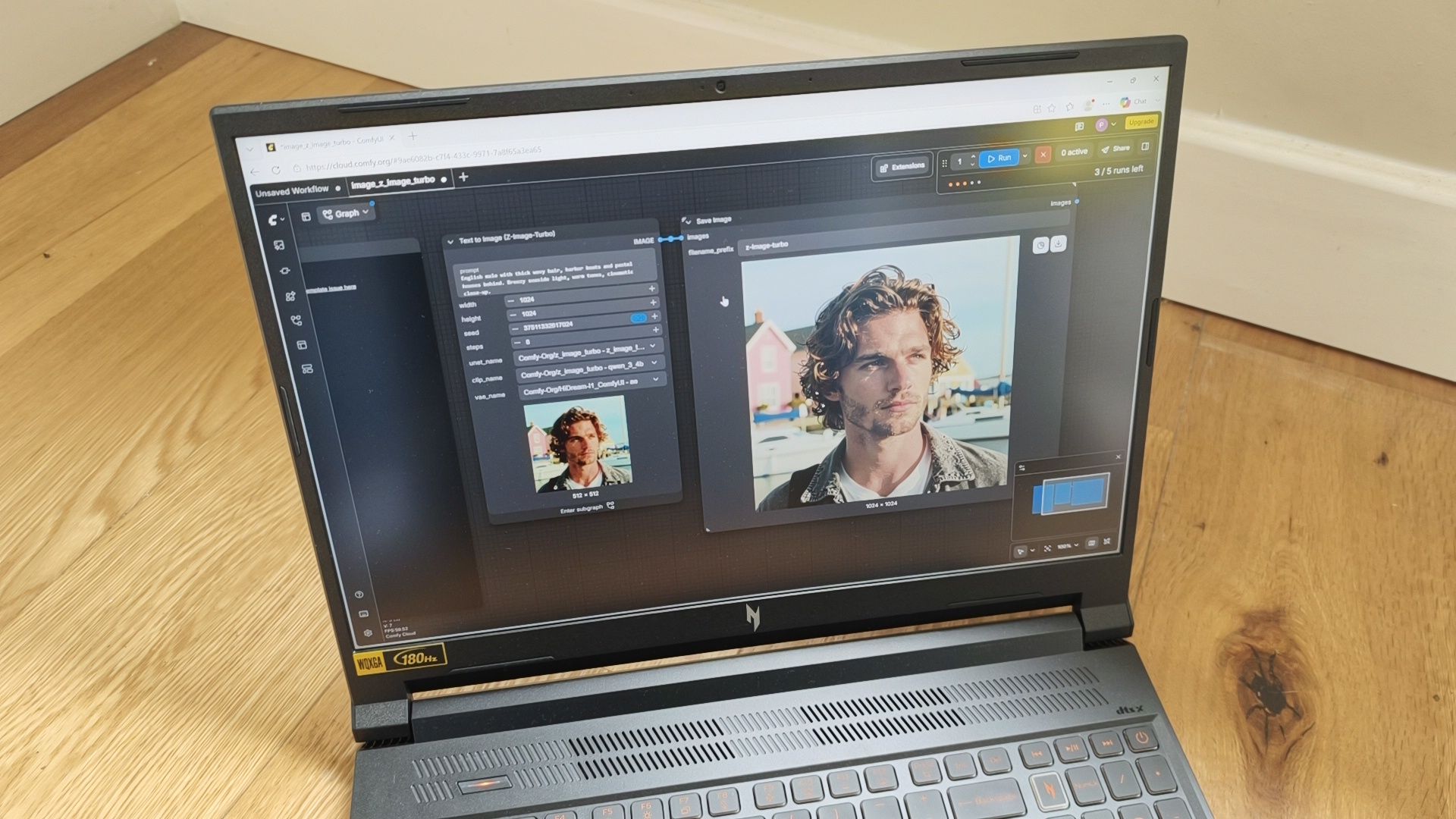
The detail he doesn't separate out, and that changes everything for developers, is that the three tasks he tested (ComfyUI, Photoshop's generative fill, NVIDIA Broadcast) run on the GPU, not the NPU. NVIDIA Broadcast, specifically, is an app that runs on the Nvidia GPU: it's the graphics card hardware doing the heavy lifting, not the Neural Processing Unit that gives the "AI PC" category its name. In other words: the Nitro V delivered because it has a decent GPU, not because it has a better NPU than any other laptop with the same badge.
NPU, GPU, and memory aren't the same thing, and the label treats them as if they were
Here's the distinction that the "AI laptop" label erases, and that decides whether your machine can handle what you want to run:
- NPU (Neural Processing Unit): a dedicated, low-power chip designed for light, continuous background tasks, like background blur in video calls, live transcription, and the features of Microsoft's Copilot+ PC, a category Microsoft ties to using a dedicated NPU to enable those features. Great for battery life, poor for heavy loads.
- GPU: this is what runs ComfyUI, Stable Diffusion, light training, and anything on CUDA. If your workload is generative, the GPU (and its VRAM) is the bottleneck, not the NPU.
- Unified memory / RAM: on Apple Silicon and on some Snapdragon chips with a shared memory architecture, it's memory bandwidth that limits how much model you can load locally, more than the built-in NPU.
If you want to run a local model with llama.cpp or Ollama, most runtimes today still don't make meaningful use of the NPU: the real bottleneck is the GPU/VRAM or unified memory bandwidth. A laptop with an "AI" badge and a powerful NPU, but a weak integrated GPU and 16GB of RAM, will choke trying to load a 13B model in Q4, while a machine with no badge at all, but with an RTX 4070 and 32GB, runs it fine. The label doesn't tell you this, and it's exactly this information that decides the purchase.
The counter-argument: sometimes the badge is a useful shortcut
It's fair to acknowledge the side Hatton captures well: a manufacturer that bets on the "AI" narrative also tends to add a discrete GPU and more RAM to the configuration, because it needs to back up the marketing with some benchmark that looks good in a demo. In that sense, the badge works as an indirect signal (not always reliable, but not always empty either) that the config goes beyond the generic minimum. The mistake isn't Nvidia or Acer selling capable hardware; it's the entire market copying the label without copying the configuration behind it, creating a huge range of products with the same name and completely different capabilities.
The analogy I use to explain this to those coming from the creative side (my most frequent audience) is the same one that applies here: calling every laptop an "AI laptop" is like calling every campaign a "data-driven campaign" just because someone opened an Excel spreadsheet. The name becomes noise, and noise forces whoever is deciding to read the spec sheet anyway, which puts the label back in the place of pure marketing.
The parallel exaggeration: promises without metrics are also a dev problem
In the same piece, Hatton cites Ian Dean's interview with Nikola Todorovic, co-founder of Flow Studio (an AI filmmaking company partnered with Autodesk), who stated that AI "can cut production costs by 95%" and will "fix a broken film industry." It's the same inflation pattern: a round number, no methodology, no stated baseline. The same warning applies to anyone reading a laptop or model benchmark: a cost-reduction or performance-gain claim that doesn't say what was measured, on what hardware, and against what baseline isn't data, it's a slogan. Treat this kind of number with the same distrust you'd give an LLM benchmark published only by the vendor itself.
What to check in practice before buying
Ignore the product name and go straight to the spec sheet: NPU TOPS (only matters if you're going to use native operating system features, like Windows Studio Effects or Recall); GPU model and VRAM (matters if you're going to run image or video generation, or train something locally); RAM amount and type, and whether it's unified or not (matters for how much model you can load and at what quantization). None of these three answers are in the laptop's name; they're in the spec table, which is the only reliable source until the market (or some independent body) standardizes what "AI laptop" should actually mean.
Translated from the Brazilian Portuguese original · Read the original