Adobe tests AI that turns photos into 3D scenes and creates characters through conversation


- Reading
- 5 min
At the 2026 edition of Adobe Max, the company showed experimental prototypes that turn photos into navigable scenery, create characters through interview, and automate group retouching. None of them have become a product yet.
On November 11, 2026, during Adobe Max, Adobe presented a batch of "sneaks": experimental prototypes of generative AI that have no release date or guarantee of becoming a product, but that signal where the company is pulling its creation tools. Those who followed the event saw four projects that treat photo, character, sound, and retouching as raw material manipulable through conversation, instead of traditional layers and sliders, according to a report from The Verge.
None of the four are in Creative Cloud or Firefly today. They are proofs of concept that Adobe publicly tests every year at Max, and historically only a fraction of them end up becoming an official feature. Even so, the pattern behind the four projects matters for product designers: the bet is to turn a complex editing flow into something conversational and exploratory, not just faster.
Project Screen Test: you interview the character before using it
Instead of describing an AI character only through a text prompt, Project Screen Test lets the creator talk to it, as in a video call, to build the personality gradually. The flow starts with basic traits ("anxious, shy, weird") and a voice, chosen from presets, described in text, or submitted as a reference audio.
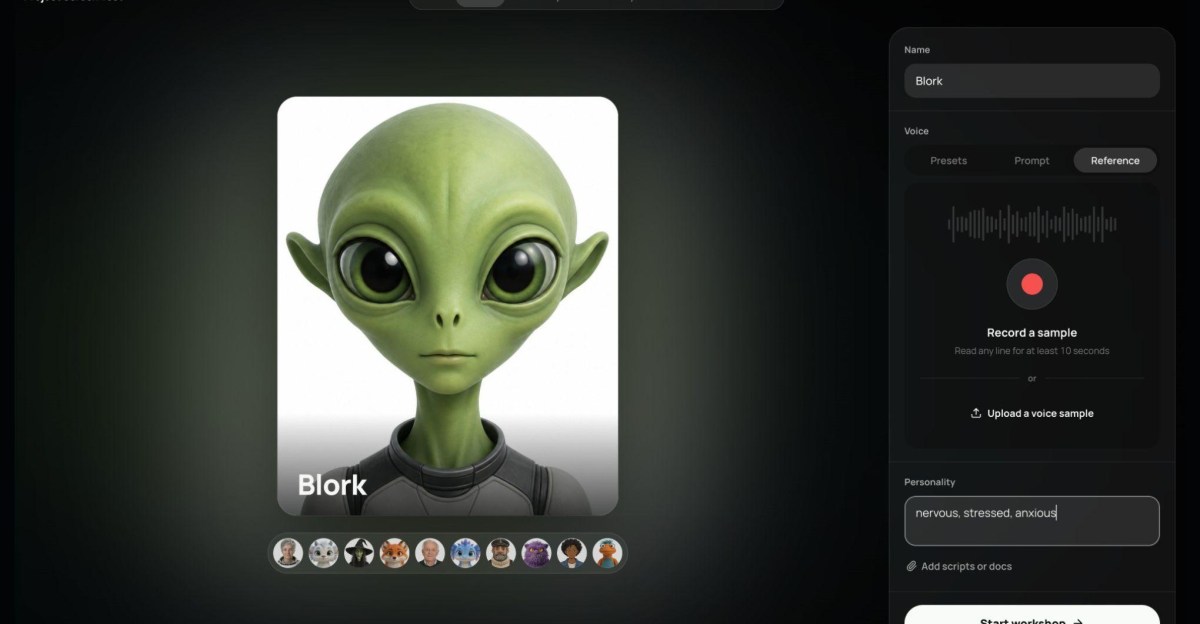
From there, the creator expands the persona by asking about background, temperament, goals, fears, and even movement quirks, as if conducting a casting interview. A "Personality" tab allows manually adjusting any trait generated during the conversation. In the end, the system generates animated screen tests of the character in scenarios described by the user.
For those designing conversational AI products, characters, or automated support, the interesting takeaway isn't video generation itself, but the interface pattern: building a persona through supervised dialogue, with manual control at the end, instead of a single prompt that produces a closed result. It's a discovery path worth observing outside the context of video.
Project Sight Span: the photo becomes a scene you can explore
Project Sight Span takes a flat image (photo, painting, or illustration) and turns it into a navigable 3D environment, filling in with AI whatever would be outside the original frame, including behind the initial point of view. According to The Verge, the generated space appears pixelated during navigation, but resolution is restored once the user settles on the final angle.
The tool preserves artistic style and details such as tattoos and facial features even when the framing changes aggressively. The report compares it to Apple's Spatial Reframing feature, only "on steroids": the camera can be repositioned much more freely, at the cost of the result looking less and less like a photo and more and more like a reconstructed scene.
For product design, this is fertile ground and also a warning sign. Fertile because it opens the way for moodboards and visual prototypes explored in depth from a single reference; a warning sign because it blurs the line between photography and synthetic scene right at the moment when product and marketing teams rely on "real" imagery as social proof.
Project Sound Bender and Project Rinse Repeat: interface as a decision canvas
The other two projects shown tackle less visible flows, but ones equally relevant for those thinking about interaction:
- Project Sound Bender lets the user describe a sound effect in text ("bubbling sci-fi cauldron noise") and automatically generates audio synced to a video. Then, a square canvas works like a color wheel: each corner carries a variation of the sound (dense bubbling, boiling rocks, high-pitched beeps, electric crackling), and dragging the cursor across the square blends these variations in real time while the user listens to the result.
- Project Rinse Repeat, built on top of Photoshop, copies an edit made manually (like removing acne from one person in a group photo) and applies the same adjustment logic to the other subjects in the image, adapting it to each face. The same idea works for adding shadows to products of different sizes and shapes in a marketing piece: the user adjusts one item manually and the system replicates the reasoning, not the pixel, across the rest, keeping everything natively editable in Photoshop.
In both cases, the product gain isn't generation itself, but the control interface: a spatial canvas instead of a numeric slider in Sound Bender, and replication of intent (not of a fixed result) in Rinse Repeat. These are clues on how to design AI tools that give a sense of professional precision without requiring a rewritten prompt for every adjustment.
What Adobe says about the logic behind this
Gautham Mysore, senior research scientist at Adobe, explained to The Verge the design reasoning common to all four projects:
Making these interactions more intuitive is also about giving experienced creatives more precise control.
Gautham Mysore, senior principal research scientist at Adobe
Sound Bender's sonic exploration capability and Sight Span's camera positioning are examples of how professionals could apply their judgment and refine a result more directly. That connection between creative intent and control is a big part of what we're exploring.
The point Mysore makes, worth noting for any generative AI tool roadmap, is that a low entry bar (talking, dragging a cursor, copying an edit) doesn't have to mean less fine control for those who already master the craft. The design challenge is delivering both things in the same interface.
What remains open
Adobe itself treats the four projects as "sneaks": prototypes that may never leave the demo stage, or that may feed into future versions of Creative Cloud and Firefly. The Verge's report notes that, given how central generative AI already is to the company's growth strategy, it's likely that at least part of these experiments will become an official feature, but there's no public timeline or launch confirmation for Brazil or any other market.
It also remains open what happens to stock libraries, image banks, and manual retouching workflows if tools like Sight Span and Rinse Repeat mature: The Verge's own report raises the possibility that, if good enough, these AIs could replace part of the work that currently sustains image and sound professionals. For product designers, the immediate lesson isn't to chase any of these specific features, but to observe the interaction pattern that Adobe is publicly testing before deciding what to actually launch.
Translated from the Brazilian Portuguese original · Read the original
Google open-sources TPU Sync code to synchronize cache and weights across TPUs
The TPU Sync library, now open-sourced under Apache 2.0, moves KV cache blocks and model weights between TPUs and promises to cut time to first token by up to 90% in long-context workloads.