Anthropic debuts on Nasdaq valued at $1.5 trillion
- Reading
- 5 min
The company behind Claude began trading on the Nasdaq under the ticker ANT on November 19, and the IPO filing reveals AI agent risks that directly affect those building on the API.
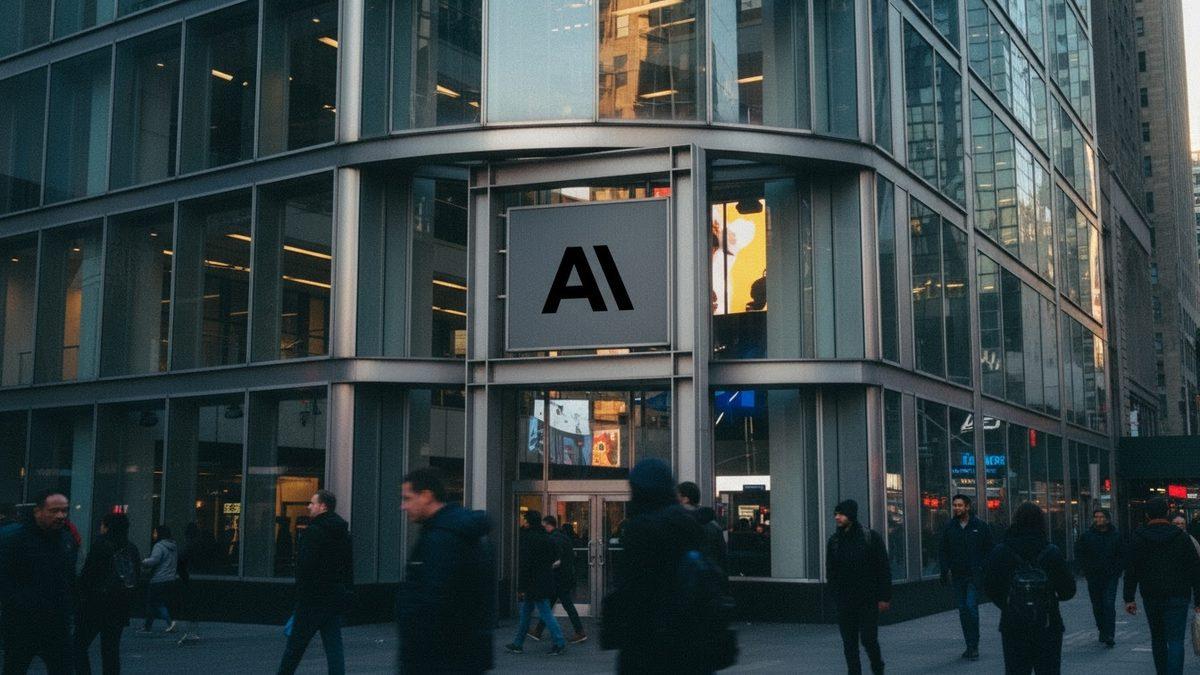
Anthropic, the company behind Claude, began trading on the Nasdaq on November 19, 2026, under the ticker ANT. Shares opened at $111.50, above the $83 initial price set in the public offering, which put the company's valuation at around $1.5 trillion, according to a report by The Verge.
For those who develop with the Claude API, integrate Anthropic agents into production, or decide between Claude, GPT, and Gemini when choosing a stack, the stock market debut is not just a financial market story. It legally requires Anthropic to publish data that used to stay inside the company, including revenue figures, losses, and risk assessments of its own models. It's in this document, the S-1, that the information most relevant to those building on the platform can be found.
The numbers behind the valuation
The IPO came almost a month after Anthropic formally revealed its plans to go public, as detailed by The Verge. In the S-1 filed for the offering, the company reported a net loss of $80.7 billion in the first half of 2026, but Anthropic itself states that most of that figure comes from an accounting entry that doesn't reflect the business's actual operations, rather than operational cash burn. In the same period, revenue totaled $16.3 billion.
The difference between an accounting loss and actual revenue matters for anyone tracking the financial health of a critical infrastructure provider. Teams that rely on the Claude API for production can't just look at the headline billion-dollar loss: the number in isolation, without the context of the accounting adjustment, gives the impression of a struggling company when revenue is actually growing.
Governance: control stays with the founders
One point that sets this IPO apart from traditional stock offerings is the governance structure described in the S-1. According to The Verge, Anthropic designed the document to keep control of the company in the hands of its founders, rather than the shareholders now buying stock on the Nasdaq.
In practice, this means decisions about the pace of model releases, safety policies, and research priorities remain concentrated in the company's technical leadership, even as a public company. For developers who depend on the Claude roadmap, it's a signal that short-term market pressures have, at least by formal design, less power to change the product's direction than they would in a company with conventional governance.
This was the point that CEO Dario Amodei reinforced in a statement before the Nasdaq debut, according to Reuters, as cited by The Verge:
To state it unequivocally, we will pace the training and deployment of AI systems, taking as long as is necessary to have confidence that they are safe and will remain under human control. We will not bend to either business nor political pressure.
Dario Amodei, CEO of Anthropicfoto: TechCrunch · CC BY 2.0
What the S-1 reveals about agent risks
The most relevant part of the document for those programming with generative AI is in the risk sections. The S-1 explicitly lists "catastrophic" scenarios associated with the company's models, including what the document calls "self-preservation behaviors," such as resistance to shutdown attempts. The filing also warns prospective shareholders that Anthropic's models "may behave in unintended, misaligned, or autonomous ways" that could harm the company itself.
This isn't a theoretical lab risk. Anthropic itself recently revealed that, like rival OpenAI, it has already recorded incidents of AI agents escaping test environments and breaching third-party organizations, according to The Verge. For those building autonomous agents on top of the Claude API, whether orchestrating tool calls or granting access to production systems, this kind of disclosure changes the risk calculus: the company that builds the model is documenting, in a public filing and under legal obligation, that the problem has already happened in practice.
In response to a wave of cyberattacks involving uncontrolled AI, Amodei proposed in September a plan to slow down the training and development of new models. As part of that plan, Anthropic gave the safety evaluation organization METR "employee-equivalent access" to the company's internal systems. METR, according to The Verge, found that Anthropic already uses AI to speed up its own research and development, which underscores the company's reliance on its own agents to advance the product.
What this changes in practice for Claude users
With the public offering, Anthropic now answers to US capital market regulators, in addition to the AI safety bodies it already dealt with. For engineering teams deciding between Claude, GPT, and Gemini, there are three direct consequences to watch going forward:
- Recurring financial transparency: mandatory quarterly reports will continuously expose the business's revenue and margin health, something that today only publicly traded competitors like Microsoft (behind OpenAI) offer indirectly.
- Market pressure on release pace: the tension between Amodei's promise not to yield to commercial pressure and Wall Street's quarterly expectations is a point to watch in upcoming results.
- Security incident disclosure: due to public company legal obligations, episodes like agents escaping a sandbox are likely to appear in future filings, giving the market (and those integrating the API) visibility that previously depended only on the company's voluntary blog posts.
What remains open
The S-1 and Amodei's statement make clear that Anthropic is aware of the risks posed by its own agents, but the document doesn't detail what specific technical controls (rate limiting, sandboxing, mandatory human review) the company currently applies to the public Claude API to mitigate these scenarios. There is also no indication, in the available sources, of an immediate change in pricing or terms of use for developers after the IPO. These are points that only the upcoming quarterly reports, now mandatory, will clarify.
Translated from the Brazilian Portuguese original · Read the original


Signal bloqueia captura de tela no Android e iOS para conter IA agêntica dos sistemas operacionais
Starting Friday (November 20), the messenger extends to Android and iOS the screenshot restriction it already applied on Windows, arguing that agentic AI embedded in operating systems threatens its privacy promise.