PostgreSQL
Content type: News
5 min read
Pinecone launches open source extension that brings native vector search to PostgreSQL
 Redação iMastersNewsroom
- Reading
- 5 min
pg_pinecone runs locally, with no need for a Pinecone account, and promises indexes much smaller than traditional pgvector by filtering results during search, not after it.
Pinecone, known for its managed vector database for AI applications, announced on November 29 pg_pinecone, an open source extension for PostgreSQL that adds vector search to columns that already use pgvector. The differentiator announced by the company is that the extension runs entirely within the local database, without requiring a Pinecone account or sending data outside the user's infrastructure.
The project is available on GitHub under the Apache 2.0 license, which means any team can install, audit, and modify the code at no licensing cost. For those who already run PostgreSQL in production and use (or are considering using) pgvector for RAG (retrieval-augmented generation) or similarity search, the proposal is to reduce dependence on a separate vector service, along with the network layer, cost, and operational complexity that entails.
A proprietary engine, different from HNSW
pg_pinecone brings a native engine that does not use the HNSW graph index, now the standard in pgvector. Instead, it applies an IVF (inverted file index), which groups similar vectors into clusters, combined with a quantization technique called RaBitQ, which compresses each vector to approximately one bit per dimension, plus correction values to preserve accuracy.
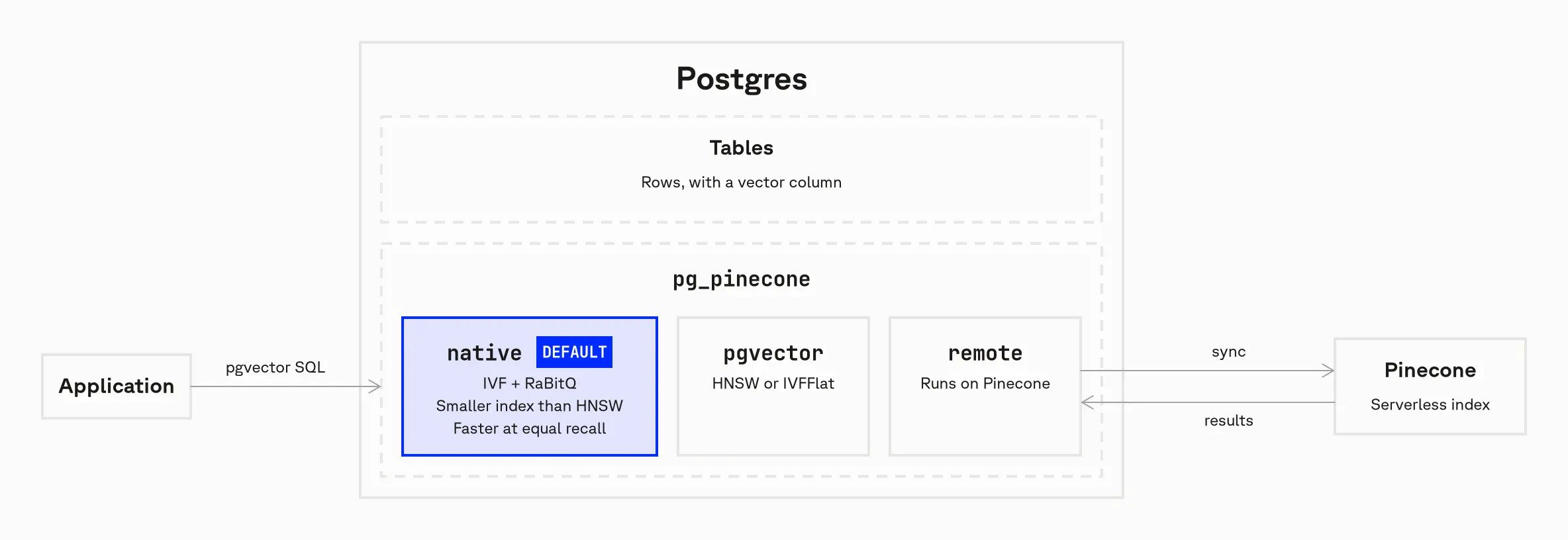
According to Harshita Daddala, staff product manager at Pinecone, and Anthony Mahanna, software engineer at the company, the architecture choice changes behavior in memory and on disk:
It indexes the vector columns you already have. Rather than a graph, its index stores a compact summary of each vector, so search stays fast on a small memory footprint and indexes build quickly. It applies the filter during search, not after, so a narrow scope still returns a full set of results.
Harshita Daddala and Anthony Mahanna, Pinecone
The problem that filtering during search solves
The pain point Pinecone is targeting is familiar to anyone who has used pgvector with selective filters (for example, searching for similar vectors only within a tenant, a category, or a date range). In traditional HNSW, the filter is applied after the nearest neighbors have already been retrieved, which can discard most candidates when the filter is very restrictive. The practical result is fewer rows than requested, or extra scans that increase latency and can reduce accuracy (recall).
In pg_pinecone's native engine, the filtering strategy changes based on query selectivity. Daddala and Mahanna detail the mechanism:
The native engine filters during the search, and picks its strategy based on selectivity. It stores the value of one filter column next to each row's RaBitQ code and, at build time, counts how many rows carry each value (...) With 10% of rows matching, the native engine uses single-stage filtering and reaches 1.000 recall in 12.3 ms. HNSW with iterative scans reaches 0.920 recall at best, in 5.9 ms.
Harshita Daddala and Anthony Mahanna, Pinecone
Index size is the number that stands out
Beyond accuracy in filtered queries, Pinecone released a disk footprint benchmark: on a dataset of one million 768-dimension vectors, the pg_pinecone index came in at 136 MB, versus 2 GB for a pgvector HNSW index using half-precision vectors. That's a difference of more than tenfold, a direct result of RaBitQ compression to roughly one bit per dimension.
A context note is worth making: the numbers are Pinecone's own benchmarks, published on the company's blog, and have not yet been independently verified. This doesn't invalidate the architecture, but it does mean teams evaluating the extension for production need to run their own tests with their own data before replacing an existing index.
What changes for those already building on Postgres
For RAG and semantic search architectures in Brazil, the central promise is operational: one less external service in the application's critical path. Today, a team that wants vector search with Postgres has basically three paths: use plain pgvector with HNSW, hire a managed vector database (Pinecone, Weaviate, and the like), or adopt an alternative extension. pg_pinecone tries to be a middle ground: open source, running locally, but built by the same company that sells the managed service.
The extension also offers an optional remote mode, which offloads search to Pinecone's managed service without changing SQL queries. In practice, this provides a gradual migration path: start locally and, if data volume or QPS justifies it, move the workload to the managed service without rewriting the data access layer. For those dealing with data residency restrictions, or who simply want to avoid yet another cloud account and another invoice in dollars, running the index within Postgres itself, auditable and under the Apache 2.0 license, has direct appeal.
Adam Hevenor, CEO and founder of hev min, sums up the value in one sentence:
Filtering during search without leaving Postgres is a useful combination.
Adam Hevenor, CEO and founder of hev min
What still remains open
Not everyone is convinced the numbers generalize to real production scenarios, especially in multi-tenant systems with highly uneven tenant sizes. Khalid Alhabibie raises exactly this point:
The tenant filtering part is interesting. I'd be curious to see how recall and query latency behave when tenant sizes vary a lot. That's where benchmarks can get tricky.
Khalid Alhabibie
pg_pinecone also isn't entering an empty market. TensorChord maintains the VectorChord extension for a similar purpose, Databricks offers vector Postgres via Lakebase, and Tiger Data recently launched pg_vectorsearch, also focused on index performance. For those weighing which path to follow, the practical criterion today is clear: compatibility with existing pgvector columns, maturity of the open source license, and, above all, an independent benchmark run with your system's actual workload, not just the number published by the vendor.
Translated from the Brazilian Portuguese original · Read the original

Google adds context parallelism to MaxText and trains LLMs with up to 14 million tokens on TPU
Google integrated four context parallelism strategies into MaxText, its open-source JAX framework, and reported utilization of up to 70% of TPU compute power even with sequences of millions of tokens.