Pinterest replaces clustering pipeline with 4B-parameter Qwen3 LLM


- Reading
- 5 min
Pinterest replaced a hierarchical clustering pipeline with a 4-billion-parameter Qwen3 LLM to infer the long-term goals of app users, with gains of up to 1.3% in engagement metrics, according to a report by InfoQ.
Pinterest replaced the system that infers what each user is trying to do on the platform, internally called "journey," moving from a classic clustering pipeline to a generative language model with 4 billion parameters, derived from the Qwen3 family. The change was detailed in a report by InfoQ published on November 9, 2026, based on Pinterest's own technical material.
The case is relevant to anyone building recommendation systems because it shows a pattern that keeps repeating at scale companies: replacing a chain of specialized models (embeddings, hierarchical clustering, ranking, diversity heuristics) with a single LLM that takes in raw history and generates structured text as output. It is less "adding AI" and more "collapsing an entire pipeline into a prompt."
What a journey was before the LLM
Pinterest defines a journey as a goal that connects interests, intent, and context across multiple sessions. The example given by the company is someone remodeling a kitchen: the person searches for cabinet designs, saves countertop ideas, and then explores tiles or lighting. Separately, these are isolated interactions; together, they suggest a coherent project.
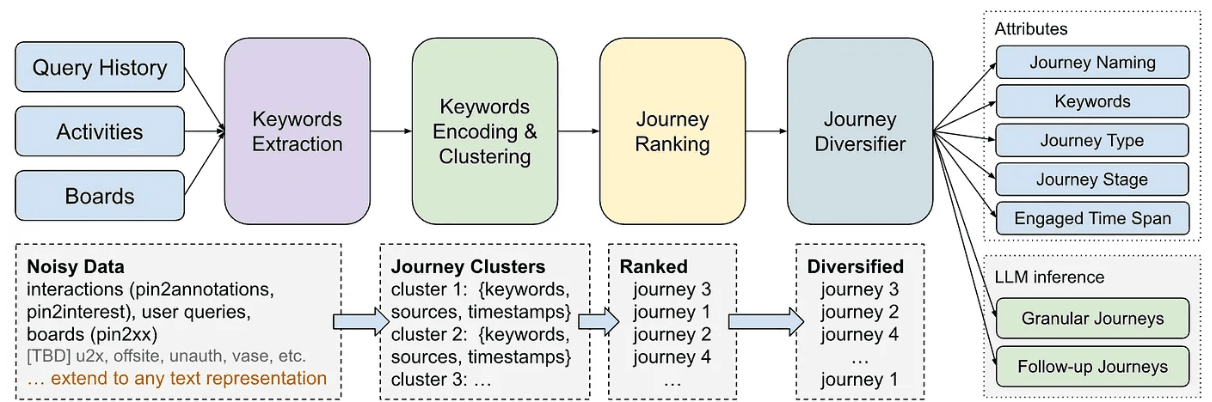
The previous system extracted keywords from user activity, grouped those keywords by embedding similarity and hierarchical clustering, named the resulting clusters, and then applied additional ranking models and diversity heuristics to decide what to show. It worked better than notifications based solely on isolated interest, but it had known flaws: it fragmented related activities into separate journeys, generated overly generic labels, or confused incidental engagement with sustained intent.
Treating the journey as generated text, not as a cluster
In the new design, inferring a journey became a generation task. The fine-tuned model reads a chronological history of up to 150 user actions within a 360-day window, along with a compact profile, and generates a ranked set of journey names directly as text output.
The prompt gives more weight to searches and saves than to incidental clicks, and instructs the model to consider recurrence, recency, and specificity before naming a journey. Much of the business logic that previously lived in separate ranking models and filters migrated into the prompt's instructions: avoiding the merging of unrelated interests, suppressing one-off activity and noisy automatic tags, and returning an empty result when there isn't enough evidence of a real journey.
This migration of logic into the prompt has a practical consequence worth noting: Pinterest started treating changes to these instructions as production releases, not as trivial text edits. For anyone designing similar systems, it's a sign that prompts in production demand the same review and rollout rigor as code.
Training without a mass human-labeled dataset
Building this fine-tuning without a large volume of human-labeled data was another engineering challenge. Pinterest used frontier models to generate synthetic training examples from users' own activity histories, and then used those examples to fine-tune smaller, open-weight models from the Qwen3 family, via supervised fine-tuning (SFT) combined with LoRA.
The team tested variants ranging from 0.6 billion to 8 billion parameters before settling on the 4B model, chosen for its balance between inference quality and serving throughput. It's a useful data point for anyone deciding on model size for a production task: the largest doesn't always win once serving cost enters the equation.
Serving a generative LLM at Pinterest's scale
Running this model across Pinterest's user volume required a dedicated inference stack. The company placed NVIDIA Dynamo in front of vLLM workers running on L40S GPUs, combining continuous batching, PagedAttention, and prefix-cache-aware routing to improve inference efficiency.
One of the most relevant throughput gains, however, didn't come from optimizing inference itself, but from avoiding running it at all. The system tracks when each user's journey was last generated and skips reprocessing for those already served in recent days. For teams dealing with the cost of serving models at scale, it's a direct reminder: the cheapest LLM call is the one that doesn't happen.
The A/B test numbers
The evaluation of journey quality combined side-by-side comparisons, a separate LLM acting as a judge of relevance and adherence to user activity, and online experiments. The initial A/B test, run in the United States and Canada, compared the new generative system with the clustering pipeline and reported:
- 1.1% improvement in email click-through;
- 1.3% increase in push open rate;
- statistically significant gains in engagement and retention, according to Pinterest.
These are modest numbers in percentage terms, but they are aggregate metrics from a user base the size of Pinterest's, where fractions of a percentage point already represent a relevant volume of interactions.
A pattern that isn't unique to Pinterest
InfoQ draws a parallel with Netflix's work on foundation models for personalization, which learns representations from long subscriber interaction sequences to reuse in downstream recommendation models. The key difference is that Netflix focuses on internally reusable representations, while Pinterest generates explicit journey descriptions in natural language, but both approaches use long-term behavioral history to enrich an existing personalization infrastructure, without replacing it entirely.
The report leaves open what the inference cost was compared to the previous pipeline in absolute terms, and how the system behaves outside the initial test in the US and Canada, in markets with different usage patterns. For anyone evaluating a similar migration, these are exactly the questions to ask before replacing a proven clustering pipeline with a generative LLM in production.
Translated from the Brazilian Portuguese original · Read the original

Harness, DeepSeek's AI agent tool, hits 1.54 million users per day
Launched in August, DeepSeek's agent framework already processes 92 trillion tokens per day and is building a plugin ecosystem to compete with OpenAI's Codex and Anthropic's Claude Code.