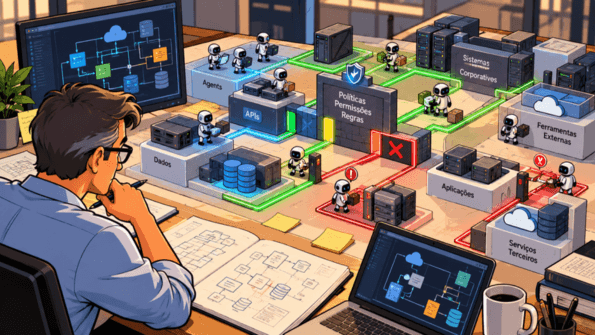
The new role of the senior developer in 2026: less feature factory, more system decisions

For a long time, the senior developer was treated as a kind of premium executor. The person who delivers faster, solves the hardest tasks, unblocks the team, reviews pull requests, and steps into problems when no one else can move them forward.
All of that still has value.
But by 2026, that definition has become too narrow.
Systems have become more distributed. APIs turned into ecosystems. Data started feeding decisions and AI. Observability stopped being just infrastructure. API security became continuous governance. AI agents began accessing tools, contexts, and business flows.
In this scenario, the most valuable technical seniority is not just about writing better or faster code. It's about improving the system's decisions.
If the only difference between a mid-level and a senior developer is the speed at which both deliver cards, something important is being wasted.
The end of seniority as a feature factory
The pressure to deliver has turned many teams into feature factories. The backlog becomes an assembly line, the sprint becomes a production unit, and the senior developer ends up being measured almost exclusively by throughput.
How many stories did they deliver? How many bugs did they fix? How many tasks did they pick up? How many PRs did they review?
These metrics are easy to observe, but often incomplete.
The problem is that a senior developer's biggest impact doesn't always show up as one more visible delivery in the week. Sometimes it shows up as a bad decision that was never made. A fragile integration that never went to production. A premature abstraction that was avoided. A poorly defined contract that was fixed before it became a dependency. An AI agent that wasn't granted overly broad permission. A piece of data that got an owner before feeding an executive dashboard.
That's hard to measure. But it's exactly where seniority starts to become more strategic.
The senior developer as a reducer of ambiguity
One of the most important functions of the modern senior developer is reducing ambiguity.
Real problems rarely arrive ready-made. They arrive as vague requests, poorly explained urgencies, contradictory requirements, and solutions already suggested before the problem is even understood.
The high-impact senior doesn't just ask “What should I implement?”. They help clarify:
- What problem are we solving?
- Who will be impacted?
- What trade-offs exist?
- What happens if we do it the simplest way?
- What happens if we over-engineer it?
- Which part of this is a product decision?
- Which part is a technical constraint?
- What risk are we accepting?
This ability to turn confusion into decision is one of the strongest marks of seniority.
A senior who reduces ambiguity speeds up the entire team, even when they're not the one writing the most code that week.
The senior developer as guardian of contracts
Modern systems are, to a large extent, systems of contracts.
Contracts between APIs. Contracts between services. Data contracts. Event contracts. Behavior contracts between product and technology. Implicit contracts between teams that, when left unnamed, become a source of conflict.
Much technical debt is born when these contracts are weak.
An API exposes more than it should. An event changes without warning. A dataset is consumed without a clear definition. A service assumes another will always respond in a given order. An AI agent accesses a tool without an explicit limit. A dashboard uses a metric that each department interprets differently.
The senior developer needs to spot these points before they become structural problems.
That requires a perspective that goes beyond local implementation. It requires asking:
- Who consumes this?
- What does this interface promise?
- What happens if we change it?
- Who owns it?
- What expectation are we creating?
- How does this contract age?
In complex systems, protecting contracts means protecting the capacity to evolve.
The senior developer as an operator of trade-offs
Technical seniority isn't about knowing the right answer in the abstract. It's about knowing how to decide under constraint.
Almost every relevant decision involves a trade-off.
- Speed versus maintainability
- Simplicity versus flexibility
- Autonomy versus governance
- Distribution versus cohesion
- Consistency versus availability
- Automation versus control
- User experience versus operational cost
- AI innovation versus risk and auditability
The senior isn't the one who always chooses the most sophisticated architecture. Nor is it the one who always chooses the simplest option. It's the one who understands the context well enough to justify a choice and its consequences.
For example:
- Maybe the system doesn't need microservices right now, but better domain boundaries
- Maybe the API doesn't need GraphQL, but a better-designed REST response
- Maybe the dashboard doesn't need another BI tool, but a clear data contract
- Maybe the AI agent shouldn't execute actions yet, only suggest them with human review
- Maybe the technical metric is green, but the user journey is degraded
This kind of reasoning doesn't show up in a Jira card. But it changes the system's fate.
The senior developer who protects the system from aging poorly
Every system ages. The difference lies in how it ages.
Some age with clarity: well-separated modules, explicit contracts, documented decisions, understandable boundaries, and reasonable paths for evolution.
Others age as accumulation: exceptions, workarounds, temporary endpoints that became permanent, jobs with no owner, data with no contract, obscure integrations, overly broad permissions, and flows that no one can fully explain.
The senior developer plays a central role in this difference.
Not because they can prevent all technical debt. That would be unrealistic. But because they can identify which debts are acceptable, which need to be paid off quickly, and which shouldn't be taken on at all.
Seniority shows up in the question:
“Are we making a conscious trade-off, or just pushing complexity into the future?”
That question applies to code, architecture, data, APIs, AI, security, and operations.
The less visible, but more valuable impact
There's a problem in how many organizations recognize technical impact: they value what shows up as delivery more than what shows up as prevention.
But bad systems almost always come from small, seemingly reasonable decisions made without enough context.
The high-impact senior prevents part of that accumulation.
They improve names. Question boundaries. Ask for a contract. Refuse unnecessary coupling. Suggest a simpler path. Spot a hidden dependency. Ask for observability before the critical feature ships. Demand an owner for a dataset. Ask how a decision will be audited. Help a junior understand the why, not just the how.
None of this looks heroic. But it's what keeps a system sustainable.
How to better measure a senior developer's impact
If a company measures seniority only by delivery volume, it loses much of the value.
Some better signals of senior impact would be:
- Improved technical decisions
- Reduced ambiguity
- Anticipated risks
- Avoided rework
- Clearer contracts
- Prevented incidents
- Deeper technical reviews
- Documentation of critical decisions
- Growth of other developers
- Improvement of team standards
- Reduced unnecessary coupling
This doesn't mean abandoning delivery. Code still matters. But the question changes.
It's not just “How much did this senior deliver?”. It's also “how much clarity, safety, and technical direction did they generate?”.
The new senior needs to engage with more dimensions of the system
The current context demands a more cross-cutting kind of seniority.
A senior developer doesn't need to be a deep specialist in everything. But they need to understand enough to engage with multiple dimensions of the system:
- Architecture
- Product
- Operations
- Security
- Data
- Integrations
- User experience
- AI and automation
- Cost
- Maintenance
This breadth doesn't replace technical depth. It provides the context for that depth to be applied better.
The senior who only sees the local code may optimize one part and make the whole worse. The senior who sees the system can make more balanced decisions.
A simple self-assessment framework
If you're a senior developer, or working your way toward that role, it's worth asking yourself some honest questions.
1. What important decision did I recently help improve?
Not just 'did I deliver the task,' but also 'did the decision get better because of my involvement?'
2. What risk did I anticipate before it became an incident?
Seniority shows up a lot in prevention.
3. What technical contract became clearer because of my influence?
API, event, data, module, permission, responsibility. Did any contract improve?
4. What ambiguity did I reduce for the team?
Did the team move from a confusing discussion to a clearer path?
5. What part of the system did I help age better?
This may be the most important question.
It shifts seniority from the short term to sustainability.
Future seniority will be less about control and more about influence
There's another important shift. The senior developer won't always have formal authority. Often, they won't be the manager, won't be the official architect, and won't have the final word.
Even so, they'll need to influence.
Influencing isn't commanding. It's building enough clarity so that the best decision becomes easier to make.
That requires communication, context, trust, repertoire, and the ability to explain trade-offs without turning every discussion into an ego contest.
The senior who 'knows a lot' but can't elevate the group's decision-making will have limited impact.
The senior who helps the team think better multiplies their impact.
Conclusion
The role of the senior developer is changing. And that change is positive.
We still need people who write good code, solve hard problems, and ship working software. But that no longer defines, by itself, the value of seniority.
By 2026, the most important senior developer won't just be the one who ships the most features. It will be the one who improves decisions, reduces ambiguity, protects contracts, anticipates risks, and helps the system age better.
Less feature factory. More system decisions.
Reassess your seniority less by delivery volume and more by the quality of the decisions you help sustain.
Translated from the Brazilian Portuguese original · Read the original