


When software starts to act, architecture changes

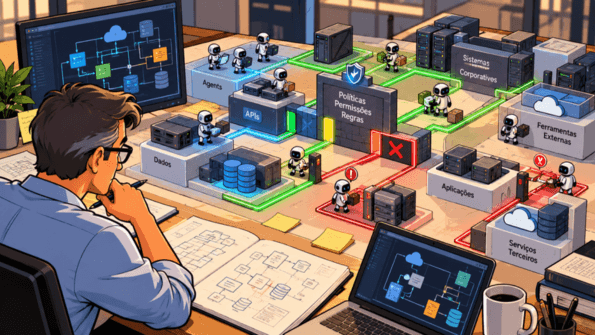
I have been talking with many architects about what will happen to the profession as AI and agents become incorporated into companies' development and operations.
And I am starting to think we are asking the wrong question. The issue is not simply whether AI will replace architects. It is how the architect's work will change when AI significantly reduces the time needed to produce analyses, documentation and first solution alternatives.
After all, “architect” was never a single role. We have architects closer to software and applications, others focused on solutions, data, cloud, infrastructure, security or enterprise architecture. The boundaries vary between companies, often overlap, and will likely become even more porous with AI and agents.
AI can already speed up documentation, code analysis, dependency identification, pattern exploration and comparison of alternatives. Quality varies, depends on context and available tools, and still requires validation. That alone already changes part of the work's dynamics.
But agents add another dimension. We are starting to put into production systems in which models can interpret objectives, select tools, query systems and, within the permissions granted, influence or execute actions.
Structure, integration, data, security, resilience, performance and operation remain fundamental. But now architecture needs to incorporate another question: what degree of authority are we willing to delegate to software?
In systems with greater capacity for action, some decisions about authority and control will need to move out of documents and be incorporated into the operation itself. Identities, permissions, policies, checks, observability, approvals and execution limits become part of that design.
That does not mean every architecture will become “executable.” It means that some architectural decisions will need to be effectively operationalized.
And that is not the architect's exclusive responsibility. Architecture, engineering, security, business, risk and governance will have to jointly define the rules of the game for that autonomy.
Who or what can act. Under which identity. What data it can use. What systems and tools it can access. Which actions can be executed automatically. Which require approval. How they will be monitored, audited, reversed or interrupted.
This is where I see an important change in the profession. Architecture is not just producing diagrams or specifications. It has always involved decisions under technical, economic, regulatory and organizational constraints.
AI can generate a technically plausible architecture, compare known patterns and suggest different paths. But it does not automatically have all the context needed to determine which solution makes sense for that company, at that moment.
And even when it receives that context, its recommendation does not transfer responsibility for the decision to the model. The capacity to recommend is not the authority to decide.
That is why I do not see AI eliminating architecture. Documentation can become easier. Diagrams can be produced more quickly. Dependencies can be analyzed faster. Alternatives can be explored with less effort.
This shifts part of the work, but it does not eliminate architectural decisions. With agents, in fact, a new class of them emerges.
The architect will continue to take part in defining how systems should work, but will also have to take part, together with other roles, in defining who or what can act, with what authority, under what conditions and within what limits.
And that is the most interesting change. For decades, we mainly architected structures, integrations, flows, data, security and operating conditions. Now we are starting to architect systems that can also receive objectives, select tools and execute certain actions.
This changes the nature of many architectural decisions. It is not enough to design the path software can follow. We also need to design how far it is authorized to go.
And one of the new frontiers of architecture in the age of agents will be architecting not just how systems work, but also the limits of their autonomy.
Translated from the Brazilian Portuguese original · Read the original