SoftBank's billion-dollar loss reveals the limits of its natural gas bet for AI

- Reading
- 5 min
- Tables
- 1
SoftBank posted a quarterly loss of $7.1 billion, much of it tied to non-refundable deposits on natural gas turbines over-ordered for AI data centers. The case exposes the risk of overprovisioning infrastructure in a race whose real size no one can yet measure.
The hole that came from the wrong bet
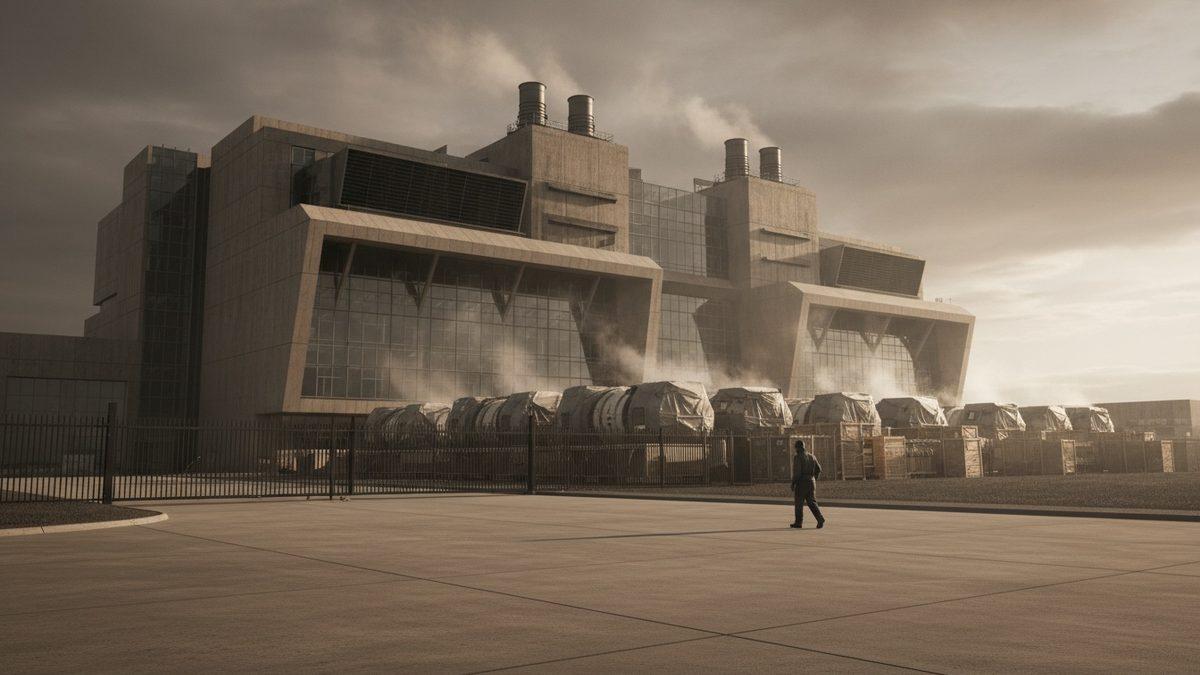
On Tuesday, November 10, SoftBank announced a quarterly loss of $7.1 billion, according to a TechCrunch report by Tim De Chant. More than half of that amount, over $3 billion, comes from losses tied to power generation equipment: natural gas turbines ordered to power AI data centers that the company now considers, in large part, worthless.
The money had already left the cash register. These were non-refundable deposits, paid to turbine manufacturers just to secure a spot in the delivery queue. When demand didn't grow at the pace and in the shape SoftBank had bet on, those deposits turned into pure accounting loss, with no chance of reimbursement.
How SoftBank tried to jump the line
The logic behind the bet started taking shape about two years ago, around 2024. According to TechCrunch, SoftBank began reserving turbines well beyond what its own projects required: more than 13 gigawatts in deposits, nearly 50% more than it needed. In February of this year, subsidiary SB Energy announced it would invest $33 billion in a 9.2-gigawatt gas plant.
The rationale was simple and expensive: the energy world was caught off guard by the speed of AI demand, and turbine order queues today stretch into the early 2030s. If SoftBank wanted capacity fast, it would have to reserve more than it needed, knowing part of the order would later be scrapped.
SB Energy did not have a choice except to overbook turbines in the future if they wanted some turbines right away.
Peter Gardett, CEO of Noreva
It's worth noting the pattern: the same SoftBank that bet $30 billion on OpenAI in early 2025 treated energy the same way it treats venture capital, with a big check to avoid being left out. The difference is that turbines don't have a follow-on round: the non-refundable deposit is burned money if the bet is wrong.
The euphemism that explains the loss
Peter Gardett, CEO of energy consultancy Noreva, described SoftBank's loss as something more sober than a management mistake: price discovery. The company preferred to overpay and over-order rather than risk ending up with no turbines at all in a tight market.
This charge is just that price discovery finally happening.
Peter Gardett, CEO of Noreva
In plain terms: the market for gas turbines for AI didn't yet have a reliable equilibrium price when SoftBank placed its orders. Two years later, with more players in the game and clearer demand, that real price emerged, and it was lower than what SoftBank had projected when it reserved capacity in a panic.
The counterpoint: natural gas hasn't lost the race
It would be tempting to read SoftBank's loss as a sign that the bet on natural gas for AI has broadly failed. TechCrunch itself rules out that reading: AI's energy demand remains too large to trigger a domino effect of gas plant cancellations across the sector.
The report sums up the situation with precision: for now, natural gas remains on the rise as an energy source for AI data centers, but SoftBank may have found its own ceiling. The mistake wasn't betting on gas, it was betting too big, too fast, on a contract structure (non-refundable deposit) that doesn't forgive miscalibration.
The alternative gaining ground: smaller grid connection plus battery
While SoftBank dealt with the shortfall, Brent Nelson, senior director of markets and strategy at consultancy Ascend Analytics, offered the TechCrunch podcast Equity a different take on what works best for those running AI data centers today. In his view, natural gas looks safe, but it carries its own risks, including winter supply cuts, when supply drops and demand rises at the same time.
The alternative Nelson describes isn't giving up the power grid, but rather requesting a smaller connection than an operator would normally request, making up the difference with large-scale batteries. These batteries cut consumption peaks and provide breathing room to comply with utility curtailment requests without bringing down the operation.
In short: the trend the article describes is a shift by some AI data center operators from "natural gas as an energy insurance policy" to "grid connection sized with battery headroom," a combination that's cheaper and more flexible than building or reserving dedicated generation.
What this changes for those deciding AI infrastructure in Brazil
The SoftBank episode isn't about Brazil, but the reasoning behind it is exactly what any engineering team faces when planning AI computing capacity: over-reserving today so as not to run short tomorrow, betting on a demand curve that nobody can predict with precision.
The table below summarizes, in my reading, the trade-off between the three energy infrastructure strategies that appear in the case, which have a direct parallel with cloud GPU capacity decisions:
| Strategy | Access speed | Stranded cost risk | Flexibility |
|---|---|---|---|
| Dedicated natural gas (own plant) | High, if reserved years in advance | High: non-refundable deposit becomes a loss if demand doesn't materialize | Low: fixed capacity, long-term contract |
| Smaller grid connection + battery | Medium, depends on the utility's connection queue | Low: battery still has use even if peak demand decreases | High: adjusts operation to actual consumption |
| Full grid connection, no reinforcement | Low, connection queue is the biggest bottleneck today | Low, but subject to peak-time interruption | Low during grid stress moments |
For those in Brazil negotiating GPU capacity with cloud providers, allocating infrastructure budget to run their own models, or deciding between reserving long-term discounted instances and using on-demand capacity, the lesson is the same one Gardett described for turbines: over-reserving seems prudent until the market reveals the real price, at which point the excess becomes an unrecoverable cost.
The turbine queue stretching into the early 2030s also matters indirectly here: it suggests that the energy supply for new AI data centers worldwide will remain tight for years, which tends to keep pressure on the cost of cloud GPU capacity, even in regions with a cheaper power mix, like hydroelectric Brazil.
It's worth watching whether the hyperscalers serving the Brazilian market shift, as Nelson suggests, toward the smaller grid connection plus battery model: that tends to lower the marginal cost of new units and, over time, pass part of that relief on to cloud GPU pricing.
Translated from the Brazilian Portuguese original · Read the original
Microsoft and Terradot use Brazilian data to train AI that cuts carbon sampling in half
The TerraNova model, built on Microsoft's Aurora weather system, cut the soil samples needed in half in simulations with farms in Brazil and the United States. That slack hasn't yet turned into certified cost savings per ton of CO₂.