

YC's post-money SAFE: the formula that decides your cap table slice before the round
Y Combinator keeps online the document package that became the market standard for early-stage fundraising in the United States. For founders raising from Brazil, understanding the mechanics of the post-money SAFE avoids selling more of the cap table than intended.


A Y Combinator keeps online the document package that became the market standard for early-stage fundraising in the United States. For founders raising from Brazil, understanding the mechanics of the post-money SAFE avoids selling more of the cap table than intended.
A 2013 Contract That Became the 2026 Standard
The SAFE (Simple Agreement for Future Equity) was created at Y Combinator in 2013 by Carolynn Levy, and since 2018 the accelerator has used the post-money version as the standard for funding its own program's startups. YC's official documents page (ycombinator.com/documents) gathers the instrument's three templates, the usage guide, and a tool called Send a SAFE, which generates, signs, and sends the contract in about two minutes.
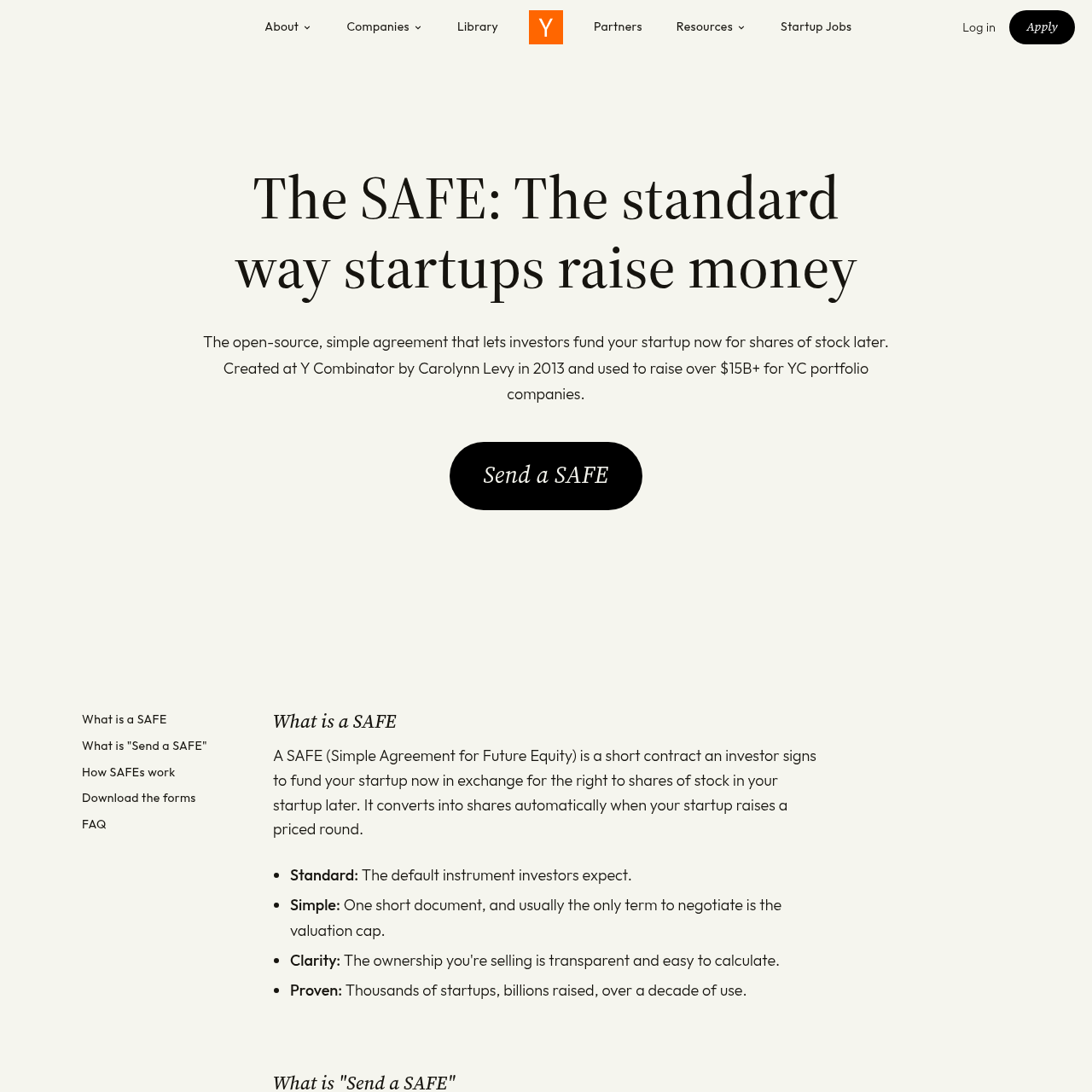
None of this is news in 2026. What matters for anyone closing a bridge or a seed round with a US investor is the mechanics behind the paper: the SAFE is not debt, carries no interest, has no maturity date, and automatically converts into preferred stock when the startup does a priced round. Simplicity is the product. And it's exactly that simplicity that hides where the founder loses equity without noticing.
The Math That Defines How Much You Sold
In the post-money SAFE, the formula is straightforward: ownership sold = amount invested divided by the valuation cap. YC describes the reverse path, which is how founders should think about it: first choose how much to raise and how much equity you're willing to sell, then let the cap fall out of that math.
The example YC itself uses in the material: a raise of $1 million selling 15% of ownership results in a post-money cap of approximately $6.7 million (or $5.7 million pre-money). Raising less at the same cap sells a smaller slice: $500k equals ~7.5%, $800k equals ~12%. You can also stack different caps: $500k at a $5.5 million cap (~9%) plus $500k at an $8.3 million cap (~6%) add up to the same ~15% sold.
This per-SAFE transparency is YC's central argument in favor of the post-money model: each contract, on its own, states exactly what slice is being sold at the moment of signing.
Where the Math Disappears From the Founder's Radar
The problem isn't each individual SAFE, it's the sum. If the startup signs three or four SAFEs over the course of months, at different caps, for different investors, each paper is clear on its own, but the founder rarely stops to add up the aggregate ownership of all of them before entering the priced round.
YC's own documentation points to a technical detail that often goes unnoticed: the post-money valuation cap is "post" all the money raised in SAFEs and post the option pool that already existed before the priced round. It is not post the money from the equity round itself, nor post a new or expanded option pool created precisely in that round.
In practice, this means the nice-looking number of "I sold 15% in SAFEs" doesn't include the additional dilution that the lead investor of the next round will demand when asking for a larger option pool before pricing the company. That pool usually comes out of the founder's side, not out of the already-converted SAFE. It's dilution that doesn't show up in any cap math done before the round.
Pro Rata Doesn't Come Inside the SAFE, and That's a Bargaining Chip
The pro rata right, which lets an investor put money into the next round to maintain their ownership percentage, sits outside the body of the SAFE. It lives in an optional side letter standardized by YC.
The accelerator's own guidance to founders is direct:
It's fine to push back on granting any of these rights; evaluate whether it's appropriate to give any of them based on the amount that an investor is investing. An investor buying a $500k SAFE has a good case for pro rata rights versus one who is investing $10k.
Y Combinator, official SAFE documents guide
For founders negotiating with a small-check American angel, this is concrete ammunition: pro rata, MFN, and information rights aren't a standard package, they're negotiation items proportional to the check size.
The Brazil Angle: the Tool Doesn't Support Brazilian Companies
Here's the point that matters most for founders raising from Brazil. The Send a SAFE tool only works for companies incorporated in the United States. YC provides adapted versions of the valuation-cap SAFE for companies formed in Canada, the Cayman Islands, and Singapore, each with its own pro rata side letter, but there is no version for a company incorporated in Brazil.
In practice, this reinforces a behavior that's already common among Brazilian startups seeking US capital: opening or migrating to a Delaware entity (the so-called corporate inversion, or "flip") before accepting a SAFE from a US investor. Without that, the negotiation falls to a lawyer manually adapting the American form to a Brazilian structure, or the startup uses a local instrument, such as the convertible loan agreement (mútuo conversível) governed by Brazilian law, which is not the same legal product and doesn't carry the same market expectations the American investor is used to reading.
Three paths, in practice, for founders raising from Brazil with a US investor:
| Path | What it solves | What it doesn't solve |
|---|---|---|
| Flip to Delaware before fundraising | Allows using YC's official SAFE without adaptation | Cost and time of corporate restructuring |
| Adapt the form with a local lawyer | Keeps the Brazilian entity | Loses standardization; each version becomes its own negotiation |
| Convertible loan agreement under Brazilian law | Instrument already recognized in Brazil | US investor may demand extra terms due to unfamiliarity with the instrument |
SAFE vs. Convertible Note vs. Priced Round
YC's page points to a comparison among the three instruments on cost, speed, and control, without detailing numbers. But the terms YC itself defines make the structural difference clear:
| Instrument | Nature | Maturity | When dilution is defined |
|---|---|---|---|
| Post-money SAFE | Not debt, no interest | Doesn't expire; converts at the round | At the moment of signing (investment ÷ cap) |
| Convertible note | Is debt, with interest | Has a maturity date | At conversion, with a discount on the round |
| Priced round | Direct equity, no future conversion | Closes immediately | At closing, with a negotiated valuation |
The Tool Now Talks to AI Agents
YC's Send a SAFE can now be operated via command line and by AI agents. The documented flow installs the yc CLI with curl -fsSL https://bookface.ycombinator.com/cli/install.sh | bash, authenticates with yc login --device, and then allows listing, creating, and sending contracts with yc safes list, yc safes create, yc safes update <id>, and yc safes send <id>.
YC itself puts an explicit guardrail in the flow: sending a SAFE triggers a real email to the investor and can't be undone, so the agent must show the exact terms and ask for the founder's explicit confirmation before running yc safes send. It's a small technical detail, but a relevant one for anyone thinking about automating part of the fundraising process: the point of no return still requires a human in the loop.
The Counterpoint: Post-Money Isn't the Villain
It's worth separating criticism from fact. The pre-money model, which YC used before 2018, framed the same valuation at an earlier point in time: the cap was set before the SAFE money itself came in, unlike the post-money model, which is already "post" all the money raised in those contracts. In practice, this made the ownership percentage sold in each SAFE less immediate to calculate until conversion at the priced round. The post-money model resolved that ambiguity by fixing the percentage per contract at the moment of signing.
The standard also reduces legal cost: the only term that's really negotiated tends to be the cap, which explains why the instrument is accepted both by investors and by YC itself to fund its portfolio. The opacity that remains, the sum of multiple SAFEs plus the expansion of the option pool at the next round, is a discipline problem for whoever is tracking the cap table, not a flaw in the contract itself.
What's Left for Decision-Makers
For the Brazilian founder negotiating with a US investor, the post-money SAFE delivers per-contract clarity, but it requires three disciplines that don't come printed on the paper: adding up the aggregate ownership of all active SAFEs before entering the round, separately modeling the option pool the lead investor will ask for at the priced round, and resolving the entity question (flip to Delaware, manual adaptation, or a local convertible loan agreement) before accepting the first check. Each individual SAFE is simple. The whole cap table isn't.
Translated from the Brazilian Portuguese original · Read the original

OpenAI completes shift to Public Benefit Corporation: what changes for those building on the API
Completed in October 2025, OpenAI's recapitalization swapped the profit cap for conventional shares and created a Public Benefit Corporation. For those betting their entire product on the API, the governance change redraws the risk around pricing power and platform dependency.

