

RAG Não É Memória: O Problema Real dos Agentes de IA

The RAG Hype and the Promise of “Intelligent Agents”
For a while, the idea took hold that all it took was connecting an LLM to a vector database and, presto, an “intelligent agent” appeared. The narrative became almost a recipe: take documents, generate embeddings, run semantic search, and hand it all over to the model. They called this RAG.
And, indeed, for many simple question-and-answer cases, it works very well. However, once we enter the territory of autonomous agents and multi-agent systems, the limitations begin to show up in a much more serious way.
What RAG Actually Solves
The problem is that RAG was designed as a context retrieval mechanism, not as a mechanism for reasoning, planning, or continuous operational memory.
An agent needs to maintain persistent goals, break down tasks, review previous decisions, handle ambiguities, monitor intermediate states, correct errors, and adapt behavior over time. Classic RAG, on the other hand, does something much simpler: it searches for content that is semantically similar to the current query.
Furthermore, vector search operates through statistical proximity between embeddings. In other words, it finds semantically related content. However, agents often need content that is causally relevant, procedurally relevant, or temporally relevant, and this does not always show up as semantic similarity.
The Problem of Coherence in Long Executions
Imagine a corporate agent executing a long sequence of tasks. In many cases, the truly important piece of information surfaced dozens of steps earlier, described in a way completely different from the current query.
In this scenario, the retrieval system does not “understand” that this is essential to the plan in progress. It merely measures mathematical similarity.
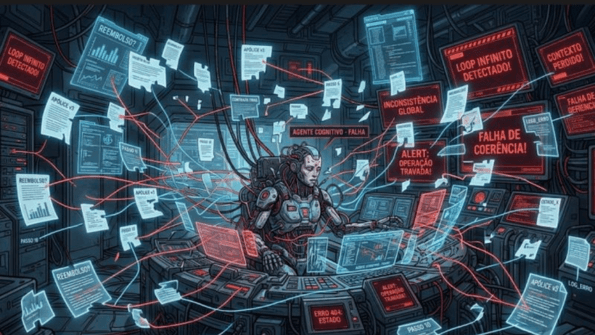
As a consequence, an increasingly common phenomenon emerges: agents that appear to have broad memory but cannot maintain operational coherence for long.
There is also another important problem. Chunking helps with retrieval, but it also destroys part of the documents' logical structure. Reports, contracts, policies, and business processes have hierarchical relationships and internal dependencies. However, once everything turns into a vector fragment, the agent loses structural insight into the knowledge.
The result is answers that are locally plausible but globally inconsistent.
The Invisible Cost of Multi-Agent Systems
Another point rarely discussed involves practical limitations. Multi-agent systems drastically increase the cost, latency, and complexity of retrieval and context management.
In longer executions, an agent can end up spending more time retrieving context than actually reasoning about it.
Furthermore, the more agents share context, the bigger the problem of synchronization, consistency, and memory updating between execution steps becomes.
Dynamic Memory Is Different from Documental Memory
There is also a deeper limitation: agents need dynamic memory, not just documental memory.
They need to remember previously made decisions, discarded hypotheses, past errors, changing priorities, and dependencies between tasks. However, none of this fits naturally into a classic RAG pipeline.
This is why many systems can answer questions about documents but fail when they need to sustain coherent behavior over time.
The Real Challenge of AI Agents
Perhaps this is exactly why so many “intelligent agents” impress in short demos but fall apart in long executions.
RAG helps, and a lot, with knowledge retrieval. However, it is far from solving the central problem of agents: continuous operational memory, persistent reasoning, and contextual adaptation over time.
Translated from the Brazilian Portuguese original · Read the original