Anthropic agents generate six hours of work per human hour, and design became the line of defense
An internal Anthropic study, published on October 16, shows that agents already work six times more than humans. The bottleneck is no longer generating work, it's deciding what deserves attention.


On October 16, four Anthropic researchers published How employment is changing at Anthropic, a study on how the company's own agents changed internal work. The decision that matters here isn't technical, it's about product: faced with agents that produce more than any person can read, Anthropic chose to design judgment systems for what deserves attention, instead of simply stacking more automation.
The study's numbers, analyzed by UX Collective in a piece by Patrick Neeman, give the measure of the problem. By August 2026, agents directed by employees were already logging six hours of work for every human hour. Agent sessions sat idle around 80% of the time, waiting for someone to respond. And even for people who don't write code, reading everything the agents produced would take more than half a workweek.
The decision behind the number: attention became a finite budget
Economist Herbert Simon predicted this in 1971, well before any agent existed. In Designing Organizations for an Information-Rich World, he described the cost of any information overload like this:
A wealth of information creates a poverty of attention.
Herbert Simon, economist and cognitive scientist
Gloria Mark, a researcher at UC Irvine, measured how far that poverty had already advanced before generative AI. Her studies between 2016 and 2020 found an average screen attention span of 47 seconds, compared to two and a half minutes recorded in her first study, in 2004, according to a university report.
Anthropic converted agent output into reading time the same way a product team would measure any other engagement metric: output tokens turning into words, at 250 words per minute. The result crossed half a workweek of reading even in areas that don't write code. This turns reading time into a budget, just like page load time: something a team sets and defends, not something that grows on its own as AI gets more productive.
Queue design: why every alarm at the same volume fails
An Anthropic engineer compared managing agents to looking after two children at once: one is asking for a juice box, the other is bleeding, and both arrive at the same volume. Hospitals already solved this problem, and their solution is a direct case study in interaction design.
The Joint Commission's 2013 report on medical equipment alarm safety estimated that between 85% and 99% of clinical alarms require no intervention at all. Staff stop listening, which the literature calls alarm fatigue, and the commission's own database recorded 80 alarm-related deaths between January 2009 and June 2012.
Hospitals' response was to create priority levels, silent defaults for routine readings, and a named owner for every alert. Mark Weiser and John Seely Brown, of Xerox PARC, described the goal in 1996 in The Coming Age of Calm Technology: technology that moves from the periphery of attention to the center, and back, only when it needs to.
Most agent interfaces skip the periphery and throw every request straight into the center. At Anthropic itself, agents mostly post in channels reserved for work between Claude and humans, which keeps conversations between people readable. It's a product decision equivalent to giving the agent the obligation to justify a severity level before interrupting someone.
The review screen is the product, not a detail
At Anthropic, agent-written code was removed or reverted at the same rate as code written by hand by the same engineers, although the study's authors warn that agent errors can be harder to notice. The bigger risk isn't technical, it's perceptual.
In the 2025 study Measuring the Impact of Early-2025 AI on Experienced Open-Source Developer Productivity, METR measured 16 experienced developers who expected to gain 24% in speed using AI and, in practice, took 19% longer. The expectation of a gain is what turns review into a rubber stamp.
Andrej Karpathy made the same point in June 2025, in his Y Combinator opening talk on how software is changing again. For him, the model generates and the person verifies, so that cycle between the two needs to run as fast as possible, with the model always kept on a short leash, without autonomy beyond what review can keep up with.
In short: a well-designed review screen shows what changed next to what existed before, what the agent checked and what it skipped, and where each claim came from. It puts the riskiest change first and logs how long reviewing each item took, so the team can see its own reading tax instead of just feeling it.
Context engineering: writing the decision only once
An Anthropic employee kept getting requests for t-shirts and mugs months after switching roles, because their name stayed listed in an old document about the company's swag. Agents reason from what people leave in writing, nothing more.
Tobias Lütke, CEO of Shopify, named this discipline in June 2025: context engineering, the skill of deciding what's made available for the agent to read before any task, as Simon Willison recorded. Anthropic itself treats this as a budget in Effective context engineering for AI agents: a model's context is finite, the same way a person's reading time is finite.
The table below summarizes how much this practice has already changed Anthropic's internal routine in a year:
| Indicator | Baseline | August 2026 |
|---|---|---|
| Standing instructions written for agents | A few hundred | 8,500 |
| Work about work (meta-work) in sessions | 10% (fall 2025) | 22% (spring 2026) |
| Time in meetings (median employee) | Previous baseline | +20% |
| Junior share in technical roles | 21% (early 2025) | 14% |
| Junior technical hires | 27% | 9% |
For design and research teams, documenting decisions isn't new: research repositories and design rationales always existed, few people just opened them. Now every agent reads every page, which changes the update standard for these sources of truth.
The role nobody designed: becoming an agent boss
A fifth of the employees Anthropic surveyed in April 2026 said their job shifted from producing to managing Claudes, with individual contributors making vice-president-level decisions. Peter Drucker already saw this change coming in 1967, in The Effective Executive, when he wrote that every knowledge worker in a modern organization is, in practice, an executive, if they're responsible for a contribution.
Microsoft named this role in The 2025 Annual Work Trend Index: agent boss. Work about work, such as specs for multi-agent runs, pipeline dashboards, and loops where one agent reviews another, grew from 10% to 22% of interactive sessions between fall 2025 and spring 2026, as shown in the table above.
Ethan Mollick calls this ordinary management, just applied at a new scale; what's scarce, in his view, is knowing what to ask for. Designers and researchers already carry that management repertoire, but the tooling layer that organizes agent requests is still being born improvised, in homemade dashboards, with no one designing it on purpose.
The blind spot: who never walks through the door
The hardest data point in the report is about who stopped getting hired. The share of juniors in Anthropic's technical departments dropped from 21% to 14% since early 2025, and junior technical hires fell from 27% to 9%.
Anthropic isn't an isolated exception. Erik Brynjolfsson and Stanford colleagues, in Canaries in the Coal Mine?, found a relative 13% drop in employment for people between 22 and 25 in the occupations most exposed to AI. Not every executive agrees with this direction: AWS CEO Matt Garman called replacing juniors with AI the dumbest thing he's ever heard, in August 2025, arguing that juniors cost less and use the tools more, and that without them no one will have learned anything ten years from now.
Lisanne Bainbridge already warned about this in 1983, in Ironies of Automation: automate most of a job and the person is left with only the hardest part, supervision, without having built up the practice that constructs that judgment. Rebuilding entry-level roles around review, with a junior giving the first opinion on agent output and a senior explaining every time they disagree, is one way to keep that learning without giving up productivity.
The question left for whoever designs product
In 1950, the UAW and General Motors signed the Treaty of Detroit, an agreement in which the union ceded factory management ground in exchange for predictable gains for workers. Anthropic's study seeks the same kind of deal, with broad equity participation, an early warning system for roles at risk, and priority for redeploying people instead of laying them off.
Few product teams set pay policy. But every team that designs what an agent shows, when it interrupts, and how review works is, without realizing it, deciding whether the new agent manager role comes with real authority or just an approve button. The question worth bringing to your own roadmap is simple: if a workflow's weekly agent output volume, divided by 250 words per minute, exceeds the hours any person has in a week, that workflow has a design problem, not a capacity problem.
Translated from the Brazilian Portuguese original · Read the original
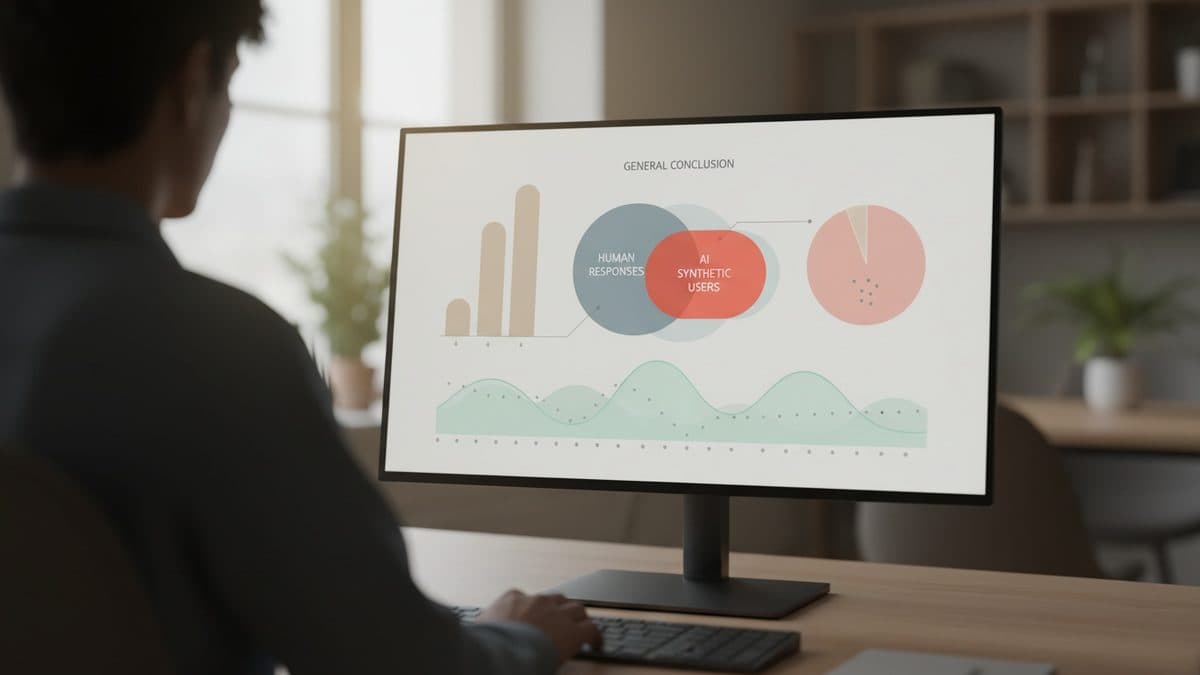
Synthetic AI users repeat human conclusion, but with less variation
A Nielsen Norman Group study compared 120 synthetic respondents with a survey of 604 human professionals and reached the same overall conclusion, only with much less diversity of responses. The phenomenon has a name: mode collapse.