Teresa Torres turns her annual review process into a Claude Code plugin

- Reading
- 6 min
Teresa Torres, of Product Talk, started running her year-end goal-setting ritual with Claude and turned the workflow into a Claude Code plugin. What she learned applies to product planners, not just personal life.
The decision behind the plugin
Teresa Torres, author of Continuous Discovery Habits and founder of the Product Talk blog, has a personal ritual every December: she stops, looks back at the year that passed, and plans the next one. She calls it her personal annual review. In recent weeks, for the first time, she decided to run the whole process together with Claude, from Anthropic, and then packaged the workflow as a Claude Code plugin, available to Product Talk subscribers.
The product decision here isn't about "adding AI" just for the sake of it. Torres wanted a thinking partner capable of spotting patterns in something that she herself, immersed in her own reflection, would have trouble seeing. She also wanted to be pushed to turn outcome goals into process goals, the kind of translation any PM recognizes from their own work.
I am always going a million miles an hour. At any given time, I have way too many irons in the fire.
Teresa Torres, founder of Product Talk
What a Claude Code plugin actually is
Claude Code is Anthropic's command-line tool for coding with an AI agent. Plugins are packages of instructions, templates, and reusable "skills" that you install and invoke inside it: instead of re-explaining context every time, you package an entire workflow (questions, structure, output format) and reuse it whenever you need.
Torres, for instance, already had her own fitness tracking skill (fitness-check-in) running in Claude Code before the annual review plugin even existed. That matters: she didn't start from scratch. The plugin reuses and connects skills she was already using separately, a lesson in personal product architecture: build small, composable blocks instead of one monolithic tool.
The four exercises that structure the review
The process isn't a free-form brainstorm. Torres splits life into categories (this year: work, relationships, health, finances, hobbies, travel, and learning) and goes through four structured exercises in each one:
- Reflect on the year: what worked and what didn't in each category, compared with the goals set before.
- 100 wishes: a list of one hundred items, unfiltered, mixing categories, sizes, and audiences. The high number is deliberate: pushing the list beyond the obvious is what reveals what really matters.
- Set goals: based on the reflection and the wishes, she writes down what she wants for the next year, without worrying yet about format or feasibility.
- Refine the goals: each goal becomes an outcome goal (what she wants to happen) and a set of process goals (what she'll do to get there), with clear targets and a way to track progress.
The four exercises aren't isolated: Torres jumps from one to another, revises, changes her mind, takes on more goals than she can deliver. The structure comes from the whole, not from a rigid order.
A real example: from ankle surgery to the hockey goal
In her previous review, Torres logged an outcome goal: get back to playing hockey, after an ankle surgery in March. The process goals were concrete: follow her physical therapist's exercises, two strength workouts a week, three cardio sessions (one light, one interval, one endurance) and try skating once the rink opened in October.
A year later, reviewing that goal, the outcome didn't come through: she followed almost the entire training plan, but when she got back on the ice a few weeks earlier, she still felt pain because of the surgical hardware in her ankle. The week before the piece was published, she had a second surgery to remove the plate and the thirteen screws, and wrote the post from the couch, foot propped up.
It's this kind of detail that separates a real review from a vanity exercise. Torres didn't hide the goal she missed, she showed the process she followed anyway and used that as input for the next cycle's goal.
What the AI actually added
According to Torres, Claude didn't decide anything for her. The value showed up in two specific points: pulling out themes that crossed different categories of the reflection and pushing the translation of outcome goals into measurable process goals.
The example she gives is telling. Claude noticed that, across several categories (work, finances, hobbies), she had built software for fun: a personal finance tracking app, a trip-itinerary app for her new camper-van life, and even an economic model to evaluate NHL player contracts. On her own, she hadn't connected the dots; seen together, the picture is of someone who enjoys coding as a hobby, not just as a profession.
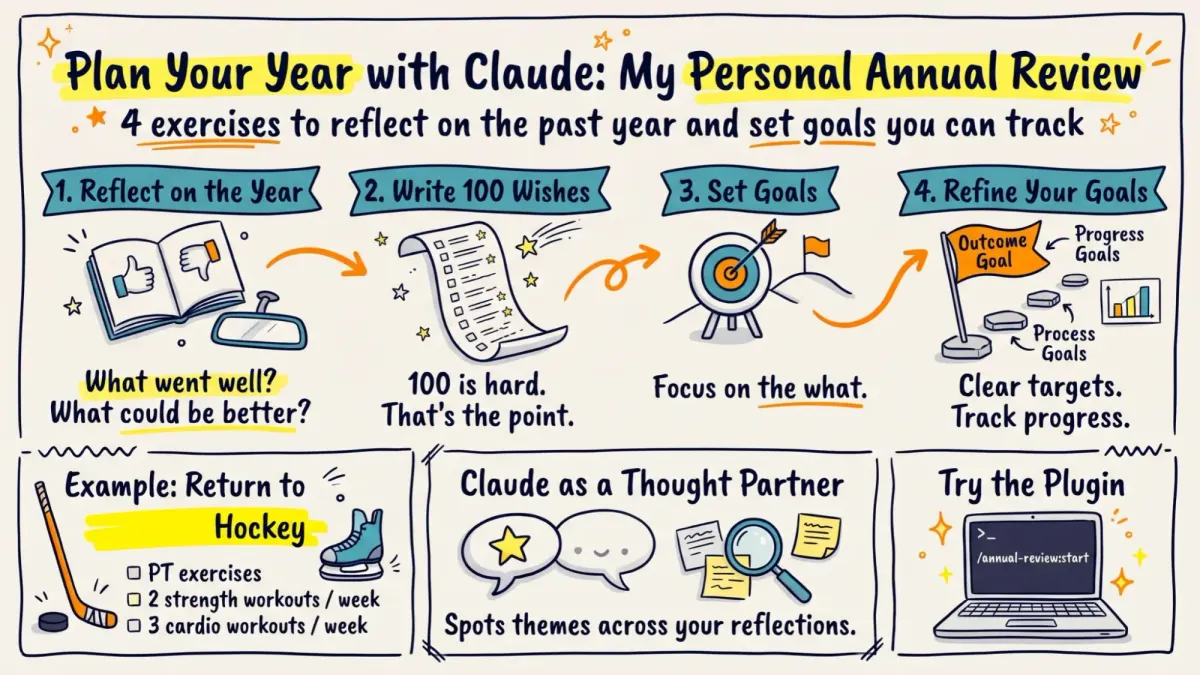
In the case of the goal to get back to hockey, Claude pushed her to define what "getting back" actually meant in practice and suggested reusing the training-tracking skill she already had, instead of creating a new tracking mechanism.
What a PM takes from this for their own work
Translating an outcome goal into process goals is, at its core, the same problem any product team faces when moving from a north star metric (such as activation or retention) to the initiatives that will actually move that metric. Torres applies to herself the discipline she teaches in Continuous Discovery Habits: outcome first, work after.
The architecture lesson also holds outside the personal context. She didn't buy a ready-made productivity tool: she built small, specific skills (annual review, fitness check-in) and let them connect when it made sense. It's the opposite of designing an entire platform just because you can.
There's a question worth taking to your own roadmap: is there an outcome goal (retention, activation, revenue) that hasn't yet become a clear process goal, with a target and a way to track it? If the answer is no, the problem isn't a lack of AI, it's a lack of the translation exercise Torres repeats every year-end.
What's left open
The plugin doesn't publish methodology or aggregate usage data: it's a one-person process, shared for transparency's sake, not validated as a universal framework. Torres herself is clear that she almost never sticks to the plan exactly, and that this isn't the point of the exercise.
There's also a caveat that isn't in the original piece, but is a reasonable inference: conversational AI tools tend to agree with whoever is using them, because the model is optimized to be helpful and pleasant. Anyone repeating this exercise would do well to check whether Claude is actually pushing back on some comfortable narrative, or just handing back, neatly organized, what the person already typed. The plugin is available to both free and paid Product Talk subscribers; the practical value depends on already having, as Torres does, the habit of structured reflection before outsourcing part of it to an AI model.
Translated from the Brazilian Portuguese original · Read the original

Figma Dev Mode MCP Server Links Design to Code, but UX Curation Remains Manual
Figma's Dev Mode MCP Server lets AI agents extract variables, components, and layout directly from the design file to generate code in the editor. What it solves from the classic handoff and where human UX review remains indispensable.