

Before giving more tools to your AI agent, check if it knows how to use the ones it already has
A model had a calculator available and still failed at some basic math problems. The calculator worked perfectly, but the problem was the model knowing when to use the tool and what information to pass to it.


- Reading
- 2 min
Giving more tools to an AI agent doesn't necessarily make it better. It seems obvious, but I found it interesting to revisit a piece by Lilian Weng about autonomous agents that brings a very simple example of this.
A model had a calculator available and still failed at some basic math problems. The calculator worked perfectly, but the problem was the model knowing when to use the tool and what information to pass to it.
And I think this discussion became even more interesting now, with so many people building agents.
We're connecting more and more tools, systems, APIs, and data… but before expanding this catalog, it's important to understand how well the agent can already use what we've made available to it.
More tools also mean more decisions for the agent to make. And more options don't always mean a better agent…
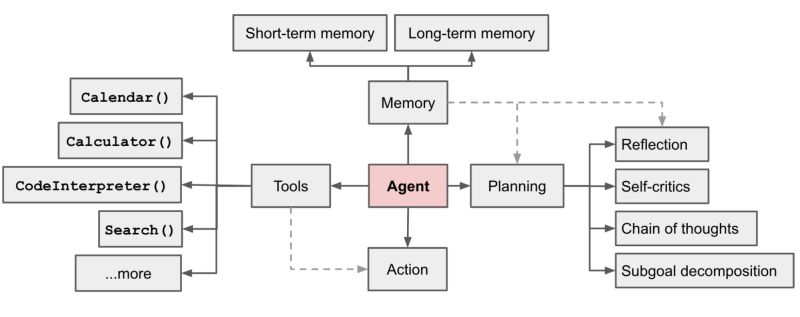
About Lilian Weng's article
In the article LLM Powered Autonomous Agents (June 2023), Lilian presents the idea of using an LLM as the "brain" of an autonomous agent. Projects like AutoGPT, GPT-Engineer, and BabyAGI show that these models can go beyond generating text and code and act as general problem solvers. According to the author, the system relies on three components: planning, memory, and tool use. Short-term memory corresponds to in-context learning, while long-term memory usually relies on an external vector store with fast retrieval. In tool use, the agent calls external APIs to get what the model doesn't know, such as current information, code execution, and proprietary sources.
In planning, the text highlights two capabilities. The first is task decomposition, in which the agent breaks large goals down into smaller subgoals. This can be done with Chain of Thought ("think step by step"), with Tree of Thoughts, which explores multiple reasoning paths in a tree format, or with an external classical planner, as in LLM+P, which uses the PDDL language. The second is self-reflection, which allows the agent to correct mistakes and refine past decisions, something essential in real-world tasks involving trial and error. ReAct combines natural-language reasoning with actions in the environment, such as querying the Wikipedia API.
The article ends with three limitations/challenges. The first is the finite context, which limits the history, instructions, and API responses the agent can take into account. Vector stores help, but they don't have the same representational power as full attention. The second is the difficulty with long-term planning, since models struggle to adjust plans in the face of unexpected errors and are less robust than humans. The third is the reliability of the natural-language interface: the model may get the format wrong or refuse to follow instructions, which is why much of the agents' code is dedicated to parsing their outputs.
Translated from the Brazilian Portuguese original · Read the original