

Cloud Computing vs VPS: Which Is the Best Choice for Your IT Project?

Introduction
Every website, web application, and corporate system needs to be hosted on a server. This infrastructure is what ensures data is processed, stored, and delivered to users quickly and securely.
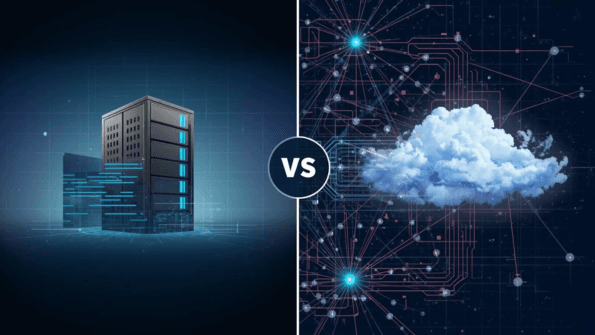
However, choosing the right type of server is a crucial decision for the success of any digital project. Among the most popular options are VPS (Virtual Private Server) and Cloud Computing, each with its own specific characteristics, benefits, and limitations.
This article provides a complete comparison between VPS and Cloud Computing to help you choose the best solution for your scenario.
Virtual Private Server (VPS)
A VPS is a virtual server created by splitting a physical server through virtualization. Each \"slice\" functions as an independent server, with dedicated resources (memory, CPU, and storage) isolated from the others.
Advantages of VPS
Among the main advantages, we highlight:
-
More affordable cost
VPS typically costs less than cloud solutions, offering excellent value for money for small and medium-sized projects. -
Dedicated resources
Unlike shared hosting, VPS guarantees exclusive resources for the user, which improves performance and stability. -
Greater control and customization
Users can configure the environment as needed, install packages, adjust the operating system, and optimize services. -
Good option for predictable workloads
Projects with stable traffic work very well on VPS, since they don't require dynamic scalability.
Disadvantages of VPS
Among the main disadvantages, we highlight:
-
Limited scalability
Resources are limited to the physical machine's hardware. Sudden traffic spikes can cause slowdowns or downtime. -
Dependence on a single physical server
If the hardware fails, all VPS instances hosted on it can be affected, resulting in downtime.
Cloud Computing
Cloud Computing uses a distributed infrastructure across multiple interconnected servers. As a result, resources are provisioned on demand, and your application can automatically scale up or down as needed.
Advantages of Cloud Computing
Among the main advantages, we highlight:
-
High scalability
Ideal for applications with variable traffic. Resources can be automatically increased or decreased. -
High availability
Since the environment operates across multiple servers, the application keeps running even if one server fails. -
Optimized performance
The cloud allows load distribution and the use of state-of-the-art hardware with constant updates. -
Pay-as-you-go model
Customers pay only for what they use, which can be advantageous for projects with variable demand.
Disadvantages of Cloud Computing
Among the main disadvantages, we highlight:
-
Higher price
Cloud solutions generally have a higher initial cost than VPS, especially for small projects. -
Operational complexity
Some level of expertise is required to handle configurations, networking, scalability, and monitoring. -
Variable billing
Since resources are billed on demand, costs can vary significantly and catch you off guard without proper oversight.
Comparison Table Between Cloud Computing and VPS
| Feature | VPS | Cloud Computing |
|---|---|---|
| Cost | Cheaper and more predictable | More expensive and variable |
| Scalability | Limited | High and automatic |
| Performance | Good, but dependent on the physical server | High distributed performance |
| Availability | Can suffer from physical failures | High redundancy and fault tolerance |
| Management Complexity | Moderate | Higher, depending on the provider |
| Recommended for | Medium-sized websites, stable applications | Robust, scalable, and mission-critical systems |
Which One to Choose?
The choice between VPS and Cloud Computing depends directly on the scenario and objectives of the project and systems involved:
Choose VPS if:
-
You're looking for a solution with good cost-benefit.
-
Your traffic is stable and predictable.
-
You need a dedicated environment, but don't require advanced scalability.
-
You're starting a project and want to keep costs under control.
Choose Cloud Computing if:
-
Your system requires high availability.
-
You expect traffic spikes or rapid growth.
-
Your project is critical, and any downtime could result in losses.
-
You want enterprise-level scalability, performance, and security.
Conclusion
Choosing between VPS and Cloud Computing goes far beyond comparing prices; it's about aligning your infrastructure with your business's strategic moment. While many believe that \"any server will do,\" the wrong decision can be costly in terms of performance, security, and scalability.
To avoid making the wrong choice, consider the following points:
-
Choose VPS if: Your project has predictable traffic, a limited budget, and doesn't require instant hardware changes. It's the ideal solution for institutional websites, blogs, and medium-sized applications focused on cost-effectiveness.
-
Choose Cloud Computing if: Your application is mission-critical, experiences sudden traffic spikes, or requires global high availability. It's the perfect model for e-commerce sites, fast-growing startups, and complex systems (ERPs).
-
Analyze the technical scenario: The best technology isn't the one the team prefers, but the one that meets the project's security requirements, response time (latency), and growth projections.
In short, the ideal infrastructure should support your operation with stability today, without hindering your expansion tomorrow. A choice based on technical analysis ensures your budget is invested efficiently, avoiding rework and emergency migrations in the future.
-
Translated from the Brazilian Portuguese original · Read the original