Ultorg offers a visual interface for querying and editing relational databases without writing SQL
Ultorg generates SQL queries behind a visual grid that handles joins and one-to-many relationships. The Harmonic team already uses the tool daily to investigate research data, while names like Gene Kim reacted with enthusiasm after watching the product's presentation.


- Reading
- 5 min
- Tables
- 1
Ultorg generates SQL queries behind a visual grid that handles joins and one-to-many relationships. The Harmonic team already uses the tool daily to investigate research data, while names like Gene Kim reacted with enthusiasm after watching the product's presentation.
A grid that generates SQL under the hood
Ultorg is a generic graphical interface for relational databases: any source organized into tables with named rows and columns. The tool was created by Eirik Bakke and presented in a talk at the HYTRADBOI conference in 2022, according to the link to the recording published on the product's own page (ultorg.com).
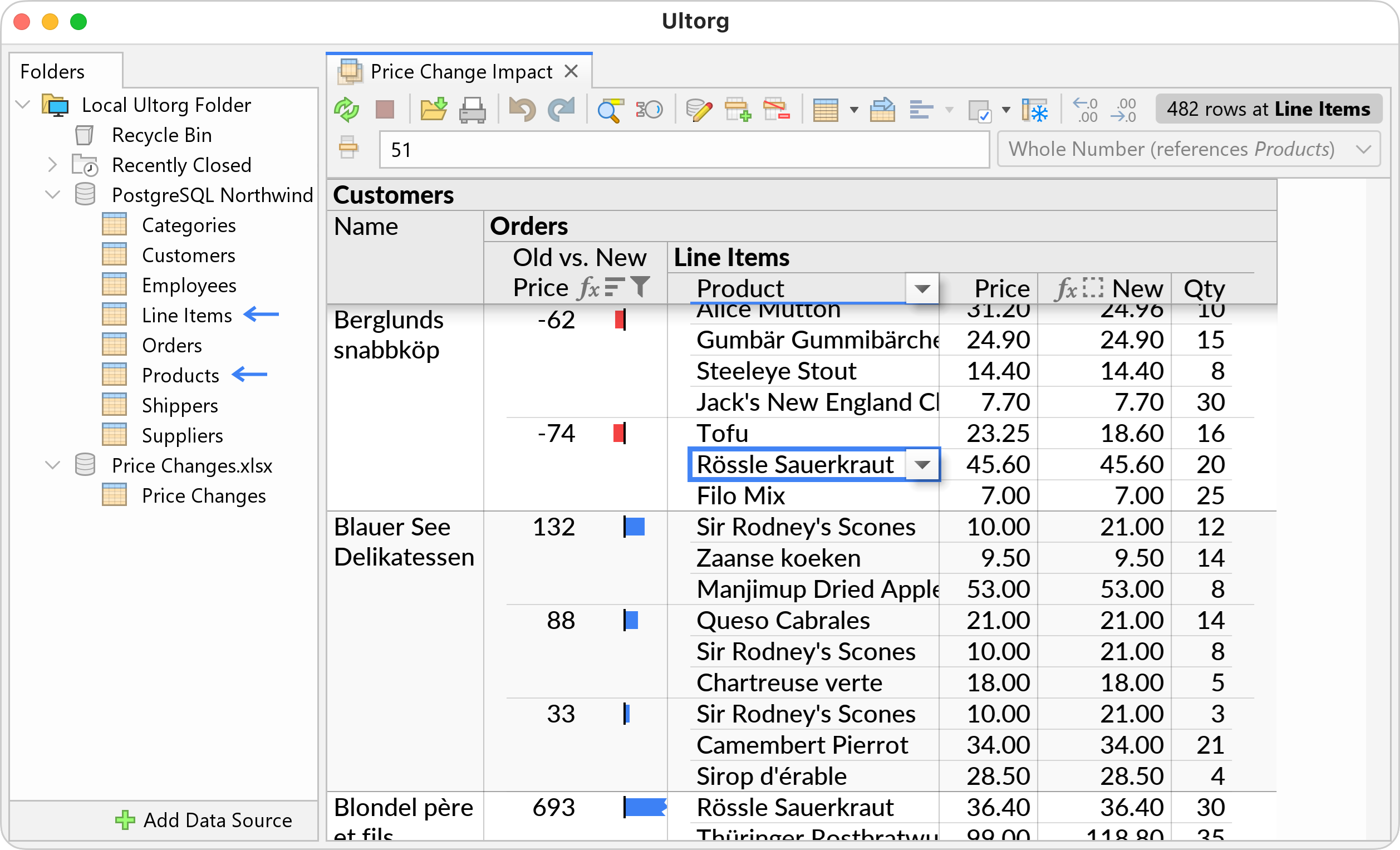
The central proposal is simple to describe and hard to execute well: offer a spreadsheet-like surface for exploring, combining and editing data from multiple tables, without requiring the user to write SELECT, JOIN or GROUP BY by hand. Behind the grid, Ultorg generates real SQL queries, which can run remotely or locally, and which can be updated without risking the underlying raw data.
Supported connectors
The list of data sources is broad and covers both traditional databases and spreadsheet files:
| Category | Sources |
|---|---|
| Relational databases | PostgreSQL, Microsoft SQL Server, MySQL/MariaDB, DuckDB, BigQuery, generic JDBC sources |
| Files and spreadsheets | Microsoft Access (.mdb/.accdb), Microsoft Excel (.xls/.xlsx), Google Sheets, CSV/TSV |
| In beta | Oracle, Snowflake, SQLite, Athena, Exasol |
For SQL-based sources, the tool recognizes existing foreign keys and automatically suggests the relevant joins. It is also possible to join arbitrary fields, useful for combining, for example, a spreadsheet with a CSV file that has no formal foreign-key relationship.
The problem Ultorg tackles: one-to-many relationships
According to the product's page, Ultorg's differentiator among visual database tools is how it handles one-to-many relationships, when a row in one table corresponds to several rows in another. The tool visualizes these relationships compactly using its own layout system, allowing filters, sorting and formulas to be applied at any level of the hierarchy, including when joins are chained or placed side by side.
The same mechanism applies within aggregate queries: when grouping fields to sum or average, Ultorg shows the individual values that make up each sum, allowing the result to be visually audited before it is trusted. It is the kind of check that would normally require writing a second debugging query.
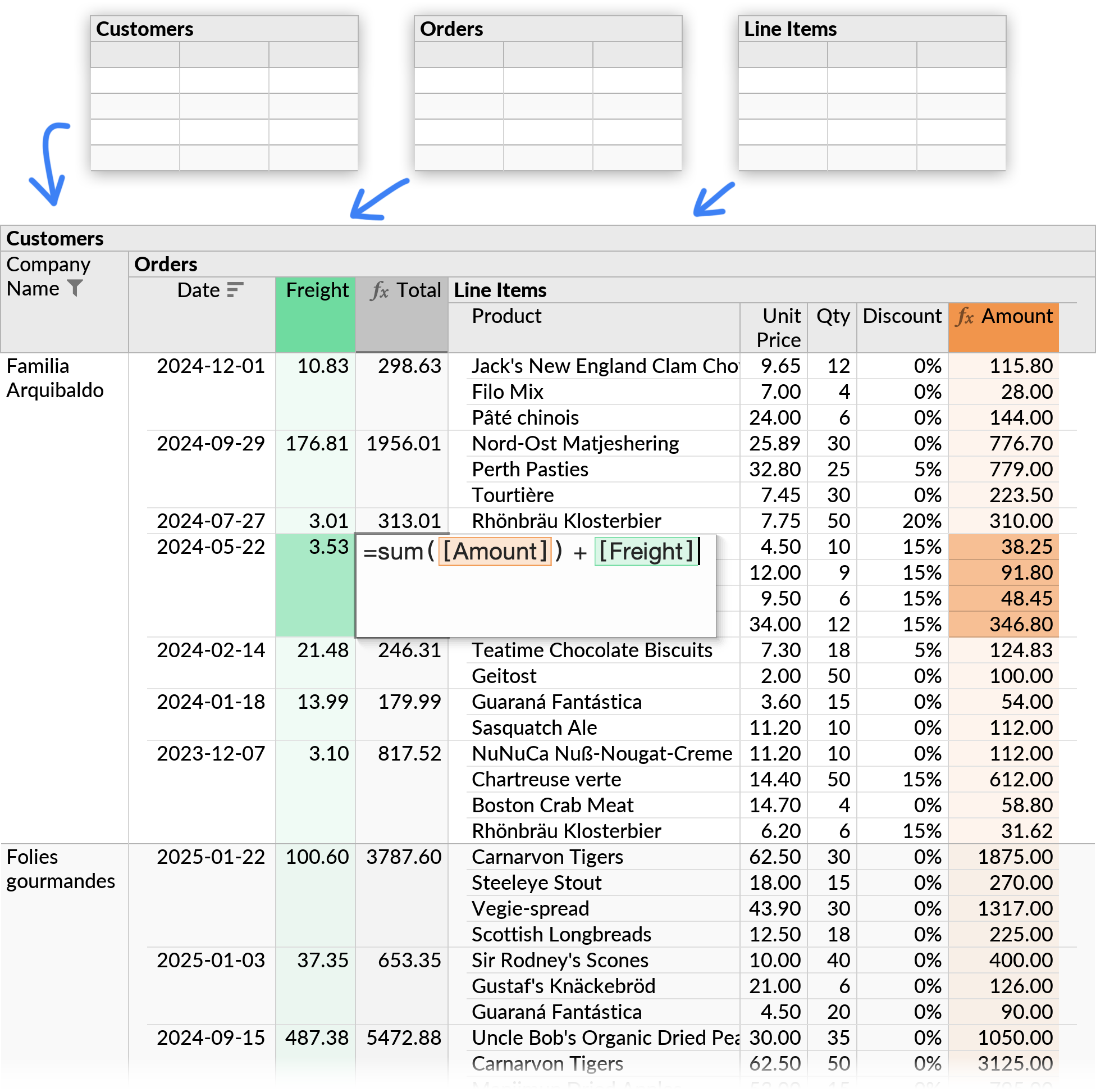
For formatting, the tool promises to automatically derive label placement, column width, decimal precision and pagination, using a combination of strategies such as nested tables, forms and crosstabs, without field-by-field manual configuration.
Collaborative editing as an alternative to CRUD screens
Besides querying, Ultorg allows editing data directly: changing cell values, choosing dropdown options, inserting rows or filling down, as in a regular spreadsheet. Changes can be reviewed before they are actually written to the database, and multiple users can edit at the same time.
In practice, the maker's positioning is explicit: to serve as an alternative to custom CRUD interfaces for internal business operations, or as reinforcement for spreadsheets that today function as the de facto system of record. The tool runs locally or within the corporate network, without depending on the manufacturer's cloud infrastructure, according to the same page.
Who is testing it
Among the testimonials gathered on the official page is one from Tudor Achim, co-founder and CEO of Harmonic, a startup that describes its work as building "mathematical superintelligence":
Harmonic is building mathematical superintelligence. Deep, detailed analysis of our system's outputs is crucial for rapid advancement of our research agenda. Ultorg offers, by far, the best tool for visualizing and investigating our data. It is an invaluable tool for our research.
(original, en) Harmonic is building mathematical superintelligence. Deep, detailed analysis of our system's outputs is crucial for rapid advancement of our research agenda. Ultorg provides, by far, the best tool for visualizing and investigating our data. It is an invaluable tool for our research. (autor) Tudor Achim, co-founder and CEO of Harmonic
Gene Kim, an author known for DevOps books such as The Phoenix Project, publicly commented on the product's presentation, without indicating that he already uses it daily:
A jaw-dropping talk about a way to view SQL databases without writing a custom app. Imagine Microsoft Access crossed with Microsoft Excel and a big dose of incredible sorcery. So exciting, I can't wait to learn more about Ultorg.
(original, en) Jaw dropping talk on a way to view SQL databases without writing a custom app. Imagine Microsoft Access crossed with Microsoft Excel and a big dose of incredible sorcery. So exciting!! Can't wait to learn more about Ultorg. (autor) Gene Kim
Other comments cited on the page come from developers who already used competing tools. Tom Larkworthy, for example, publicly stated that he was happy with Metabase until watching Ultorg's presentation. Pedro Paulo, in turn, pointed out, also in a public comment cited by the maker, that the critical point for adoption will be integration with the workflows that already exist in Excel, Salesforce and CRM or ERP systems.
What changes for those who build
For those who develop and maintain internal systems in Brazil, Ultorg enters a category already contested by data administration and exploration tools like Metabase, but with a more specific focus: it is not a BI tool for fixed dashboards, nor a generic screen builder, but rather an ad hoc exploration tool for relational data focused on complex joins.
The stated use case is the work that today falls into standalone SQL scripts, manually exported spreadsheets or internal CRUD screens custom-built for an operations team or analysts who don't write SQL. If automatic foreign-key recognition and the visualization of one-to-many relationships work as described, that shortens the time between a business question and an answer without depending on a developer to put together each query.
It remains unclear, from the material available, how Ultorg behaves with databases that have very large schemas or poorly defined foreign keys, a common situation in legacy Brazilian systems. The tool is paid, with a 14-day free trial period, which limits informal evaluation by those who just want to try it before taking the discussion to their team.
Translated from the Brazilian Portuguese original · Read the original

Fireworks AI breach exposes Notion AI chats in fewer than 1% of workspaces
Fireworks AI, the AI infrastructure provider used by Notion, suffered a security incident that exposed Notion AI conversations without user identification. See what leaked, who was notified, and what to do if you pasted credentials into the chat.