Anthropic launches Claude Fable 5.2 and Mythos 5.2 with focus on code and reasoning

- Reading
- 3 min
The new models arrive two months after version 5.1 and promise to solve engineering and reasoning problems faster. Only one of them is available to everyone.
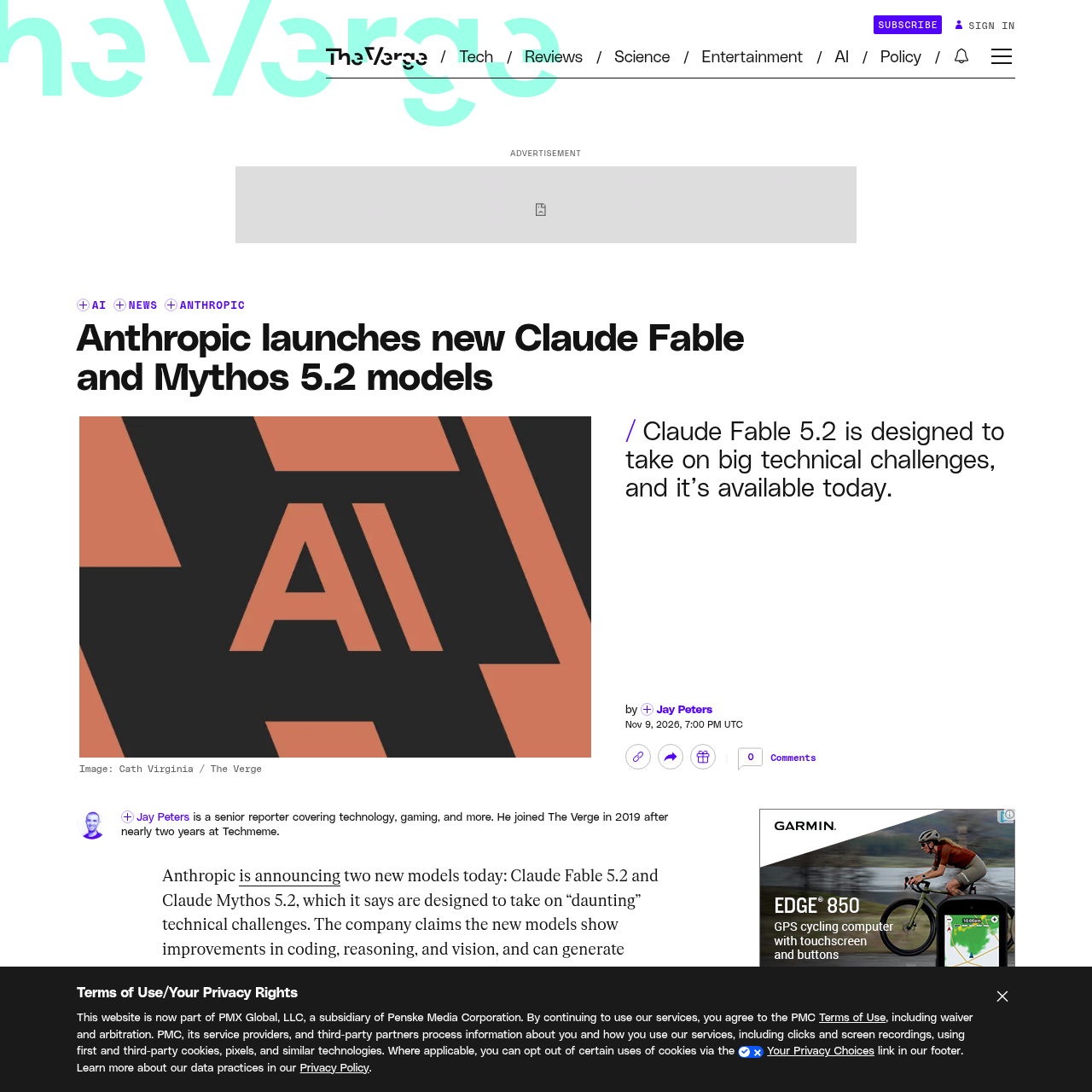
Anthropic announced on Monday (November 9, 2026) two new models in the Claude line: Fable 5.2 and Mythos 5.2. According to the company, the models were designed to tackle "daunting" technical challenges and bring improvements in code, reasoning, and computer vision, in addition to generating responses faster than the 5.1 versions, released in September 2026, according to a report by The Verge.
The most practical difference for anyone deciding today which model to use in production: Fable 5.2 is already available starting today to any Anthropic API customer. Mythos 5.2, on the other hand, only grants access to organizations previously approved by the company, a closed rollout model similar to what Anthropic has already done with previous, more capable versions.
What Anthropic claims Fable 5.2 solves
According to the company, Fable 5.2 handles difficult software engineering problems well, can orchestrate teams of agents, and sustain long-duration projects without losing track. Anthropic also says the model helped solve two open problems in theoretical physics.
During pre-launch testing, the company states that the two models helped internal engineers complete software migrations previously considered unfeasible, design three functional electronic devices from scratch, advance robotics evaluations, and formalize the proof of Fermat's Last Theorem in 30 hours, in addition to solving two open problems in black hole physics. None of these claims came with a public benchmark or independent evaluation: these are figures and achievements reported by Anthropic itself, with no third party confirming the results as of the original story's publication.
None of this runs on your machine
It's worth separating out something the announcement doesn't make explicit, but that changes the decision for anyone choosing a model for a project: Fable and Mythos remain closed models, accessed via Anthropic's API. There are no open weights to download, nor the option to run them locally on your own GPU or on an on-premise cluster.
This places both models in the same decision category as always with the Claude family: a direct comparison with OpenAI's GPT or Google's Gemini, not with open projects like Llama or Mistral. Anyone who needs full control over where data travels, or wants to avoid recurring per-token costs, still has no alternative within Anthropic's catalog: the decision here is between paying for the newer API or sticking with version 5.1, which remains available.
What changes in practice for developers
For teams already using Claude in agent pipelines, the promise of orchestrating "teams of agents" and sustaining long tasks is the most relevant point in the announcement. Projects that today break the session when chaining multiple agent calls, or that need to rebuild context at every step, are the kind of case Anthropic says it is addressing with Fable 5.2.
In practice, this can only be confirmed by testing against each application's real load: the company has not published comparable benchmarks for latency, per-token cost, or code-task accuracy between 5.1 and 5.2. Before migrating a production pipeline, it makes sense to:
- Run the same set of regression prompts already in place for version 5.1 and compare cost and output quality;
- Check whether access to Mythos 5.2 is available for the organization's account, since access is restricted to approved partners;
- Measure the speed gain claimed by Anthropic in scenarios with real request volume, not just in a single isolated call.
What's still unclear
The Verge's report does not include pricing, context limits, or a date for opening Mythos 5.2 to the general public. There is also no technical detail on how agent orchestration works under the hood, nor a comparative benchmark against competitors like GPT-5 or Gemini 3. This information typically appears in Anthropic's own technical documentation in the days following this kind of announcement, and it's what will actually determine whether the upgrade is worth it for a team that already has a workload running in production.
Translated from the Brazilian Portuguese original · Read the original

H100 costs from $2.69 to $12.29 per hour, depending on where you rent it
A survey compared the price of the same H100 SXM 80GB across AWS, Azure, and neoclouds like RunPod: for the identical chip, the difference reaches 4.57 times per hour of use.