Carina FerreiraAuthor
- Reading
- 4 min
- Tables
- 1
- Code
- 1
Thinking Machines added Inkling 2 Mini to the catalog of Vercel's AI Gateway: a reasoning model that repeats internal layers to think more while spending fewer tokens, accessible via API without needing your own GPU.
What Inkling 2 Mini Is
Thinking Machines added Inkling 2 Mini to Vercel's AI Gateway, a catalog that brings together models from different providers behind a single API. It's a multimodal reasoning model (accepts text and image input, returns text), built for agentic coding, tool use, and knowledge tasks. Vercel's changelog notes that, like Inkling 2 Small, the model is stronger at long-running agentic tasks, without establishing any size relationship between the two.
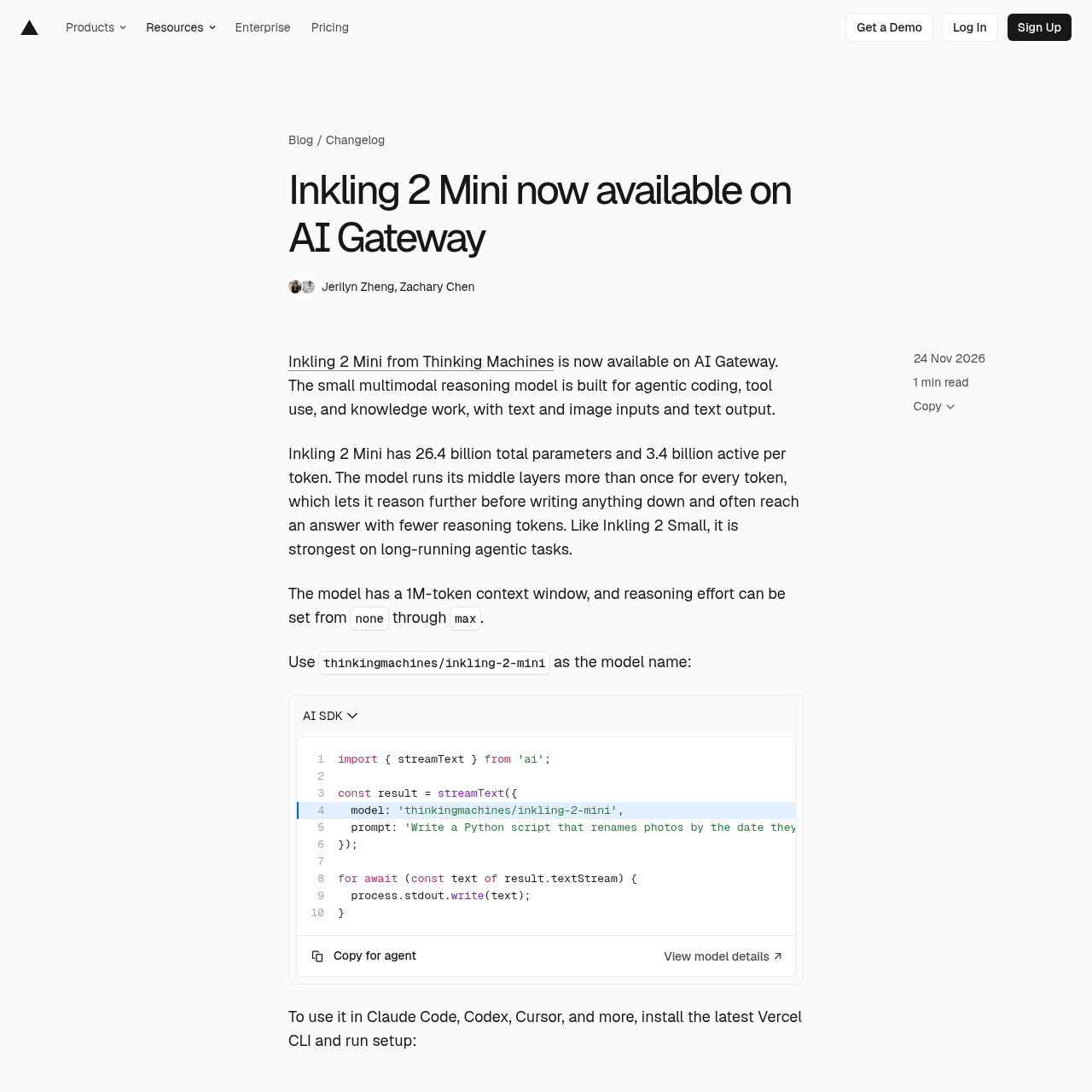
Numerically, it totals 26.4 billion parameters, but activates only 3.4 billion per token, a sparse architecture that keeps inference cost low even for a large model. The context window reaches 1 million tokens, and reasoning effort can be adjusted on a scale from none to max, giving fine control over how much the model "thinks" before responding.
Looped Reasoning: Thinking More Without Writing More
The most interesting part of the announcement, for the technical reader, isn't the model's size: it's how it processes each token.
The model runs its middle layers more than once for every token, which lets it reason further before writing anything down and often reach an answer with fewer reasoning tokens.
Official Vercel changelog on AI Gateway
In practice, this tackles a well-known problem with reasoning models: they tend to "think out loud," generating extra tokens that cost money and response time. If the internal loop reduces this volume of written tokens, the API bill drops and so does perceived latency, especially relevant for anyone exposing a chat or assistant inside an app to the end user.

Expert views
What people are saying about it.
Data Egret, a consultancy, published a set of questions to assess, before running in production, the real risk of an ALTER TABLE, a constraint validation, or a bulk UPDATE in PostgreSQL.
JetBrains has confirmed that CVE-2026-114938, nicknamed Java4Shell, affects the JBR embedded in all its IDEs as well as the JDK running in production. There's a patch and a workaround, but they are separate fixes.
Calling the Model via the AI SDK
The changelog provides the exact name to use in the AI Gateway: thinkingmachines/inkling-2-mini. The official example uses Vercel's own AI SDK:
import { streamText } from 'ai';

const result = streamText({
  model: 'thinkingmachines/inkling-2-mini',
  prompt: 'Write a Python script that renames photos by the date they were taken.',
});

for await (const text of result.textStream) {
  process.stdout.write(text);
}
This is the same pattern used for any other AI Gateway model: you swap the model string and the rest of the streaming code stays the same. For those already using streamText() or generateObject() in Next.js API routes, adopting Inkling 2 Mini is a matter of changing one line, not rewriting the AI integration layer.
The model can also be used inside terminal agents like Claude Code, Codex, and Cursor: just install the latest version of the Vercel CLI and run npx vercel ai-gateway setup to select it as the active model in the agent. There's also a playground right in Vercel's own dashboard for testing prompts without writing code.
What Changes for Those Building on the Frontend and at the Edge
An expectation correction is in order here: Inkling 2 Mini doesn't run inside the browser or locally on the user's device. It's still a hosted model, called via API. What changes is that this call can originate from anywhere, including an Edge Function, without the frontend team needing to provision, update, or pay for its own GPU.
This matters because today the alternative for "AI close to the user" is usually running a small model directly in the browser, via WebGPU or ONNX Runtime, which requires much more limited models. Inkling 2 Mini goes the opposite way: it keeps reasoning power and a 1M-token context, but solves the infrastructure dependency on the gateway side, not the device side.
| Running locally (WebGPU/ONNX) | Inkling 2 Mini via AI Gateway | |
|---|---|---|
| Where inference happens | On the user's device | Hosted by Thinking Machines |
| Dependency on your own GPU | Depends on the client's GPU | None, on the developer's side |
| Context and capability | Small models, short context | 1M tokens, agentic reasoning |
| Network latency | Zero (runs locally) | Depends on the API call |
| Data privacy | Data never leaves the device | Subject to provider policy (BYOK and Zero Data Retention mitigate this) |
Vercel emphasizes that the AI Gateway reflects the provider's price with no markup and no platform fee on inference, including calls with Bring Your Own Key (BYOK). For anyone building an AI agent integrated into a product, this simplifies the decision: the cost per token is the same charged directly by Thinking Machines, just with retries, failover, and usage reporting from the Gateway thrown in for free. The Gateway also offers per-API-key budgets and routing rules, useful when the same app calls multiple models depending on the task.
When It's Not Worth It
The adjustable reasoning effort (none to max) is a double-edged sword: setting max on every call from a chat interface where the user is waiting for a real-time response can inflate perceived latency, even with the token efficiency gain. It's worth measuring time to first token, not just the final cost per request.
It's also not the right choice for those who need fully offline inference or data that never leaves the device: there, the path remains a small model running locally, even if weaker at reasoning. Inkling 2 Mini solves the problem of managing GPUs, not that of eliminating network dependency.
Translated from the Brazilian Portuguese original · Read the original
Vercel cuts latency between workflow steps by up to 12x with new engine
Workflow SDK version 5.8 swaps out the execution engine, drastically cutting dead time between steps and the cost of parallel fan-outs, right at the backbone of durable AI agents.