GitHub Octoverse 2026 shows commits tripling with agent-generated code


- Reading
- 5 min
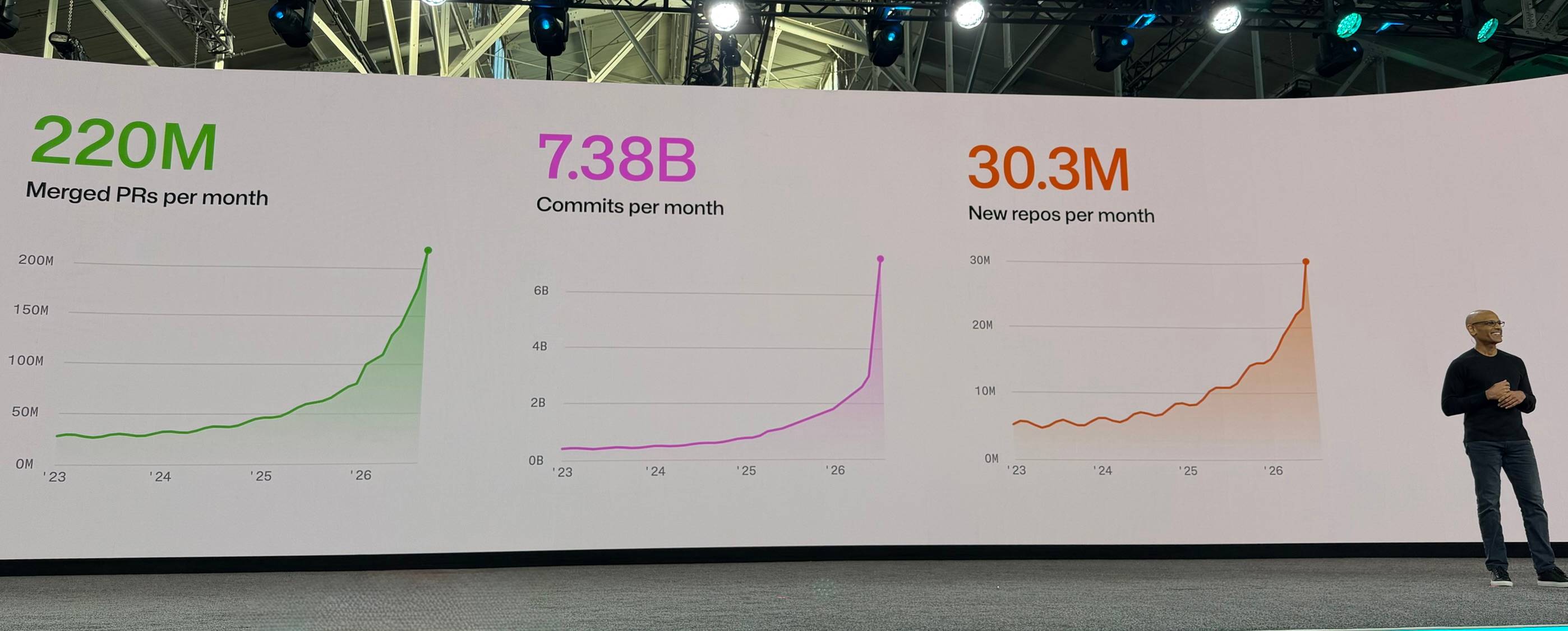
At GitHub Universe 2026, the company announced that merged pull requests reached 220 million per month and commits topped 7.38 billion a month in less than a year. The numbers are real, but what they mean for whoever reviews that code is another story.
GitHub Universe 2026 is underway this Wednesday (October 28), and it was there that EVP Jay Parikh presented the annual Octoverse report with a set of numbers that, according to developer and blogger Simon Willison, form "a pretty stark representation of the impact of agentic engineering on GitHub." Willison was at the event on a ticket provided by GitHub itself through the GitHub Stars program, a detail he made a point of disclosing in the original post.
The Octoverse report has existed for more than a decade and traditionally measures GitHub's pulse: rising languages, most active countries, open source project growth. The 2026 edition shifts the axis of the conversation: for the first time, the highlight isn't a programming language, it's the aggregate behavior of AI agents writing and submitting code at scale.
The three numbers GitHub chose to highlight
According to the report, three metrics define the year:
- Merged pull requests: tripled in less than a year, reaching 220 million per month
- Commits: more than tripled, to 7.38 billion per month, with most of the jump concentrated in the second half of 2026
- New repository creation: doubled over the year, to 30.3 million per month
The report doesn't disclose the exact baselines for comparison, only the growth ratio and the final value of each metric. Even so, the curve is unambiguous: the second half of 2026 concentrated most of the acceleration, which lines up with the broader adoption of agents capable of opening and iterating on PRs on their own throughout the year.
How GitHub measured this (and why methodology matters)
The methodological note attached to the report is as revealing as the headline numbers. To classify repositories by industry sector (using NAICS categories), GitHub used a multilingual embedding model fine-tuned specifically for this task, applied to random samples of the name, description, topics, and README of every repository created between 2022 and 2026.
Even more interesting is the adjustment to the country ranking by pushes to public repositories. To compensate for bias caused by VPN use, GitHub used LLM-based classification to extract the ISO 3166-1 alpha-2 code from the profile of every user who pushed during the period. In short: GitHub needed a language model just to clean up its own dataset before counting who's coding where, because the location declared on a profile no longer matches the originating IP at a meaningful scale.
This is a side symptom of the same phenomenon: as more work is distributed, automated, or run via cloud agents, traditional geolocation signals (IP, commit timezone) become less reliable, and data teams turn to LLM-based inference to reconstruct what used to be trivial.
The new category: interoperability and reverse engineering
Octoverse 2026 also started counting public repositories whose name, description, topics, or README mention interoperability or reverse engineering, terms like clean room implementation, drop-in replacement, or protocol re-implementation. The report describes the methodology behind this count, but the available material doesn't include the category's absolute numbers, only the existence of the metric.
Even so, the fact that GitHub decided to track this separately is a signal in itself. AI agents are particularly good at reading an undocumented API, inferring its contract, and generating a compatible reimplementation; this kind of work, which used to require slow, manual reverse engineering, has become a plausible task for an agent to run overnight. For those in Brazil maintaining integrations with legacy systems, banks, or poorly documented government APIs, this is probably the most interesting category in the report, even without the numbers.
What the numbers don't say
Simon Willison himself, known for testing models before recommending anything, presented this data factually, without bridging the gap between "more commits" and "more real productivity." It's an omission worth noting: merged pull requests and commits are volume counts, not quality counts. An agent that opens ten small PRs where a human would open just one inflates both metrics without necessarily delivering more value.
The jump in new repository creation (30.3 million per month) also calls for careful reading. Part of this growth probably comes from what Willison himself classifies as "vibe coding": projects born from a single agent session, disposable by nature, as he has documented in recent posts about AI-generated games. A created repository isn't a product in production; it's often a one-afternoon experiment.
What changes for those reviewing code in Brazil
If merged PRs tripled and commits more than tripled, the bottleneck didn't disappear, it just moved: it migrated from writing code to reviewing it. Brazilian teams that have adopted coding agents (whether through Copilot Workspace or through in-house tools orchestrating models) are already feeling this in practice: the volume of PRs opened by agents outstrips the human review capacity available on the team.
This points to some concrete decisions that teams here should already be discussing:
- Stricter CI gates before any PR reaches a human reviewer, including automated tests and linters that catch what an agent frequently gets wrong
- Review assisted by another model as a first pass, reserving the human for architecture and trade-off decisions
- Internal quality metrics (revert rate, time to first bug in production) instead of just counting merged PRs, which is exactly the trap Octoverse itself illustrates
The complete GitHub Octoverse 2026 report, including the breakdowns by industry and by country, should detail these numbers further in the coming days. Until then, what can be taken from the announcement made at GitHub Universe is this: the amount of code passing through GitHub changed by an order of magnitude in 2026, but the metric that matters to whoever keeps that code running in production remains a different one, and that one the report hasn't measured yet.
Translated from the Brazilian Portuguese original · Read the original

Anthropic separates agent brain and hands to shield credentials in the Claude Platform
In an episode of the Latent Space podcast recorded in October 2026, Anthropic executives detail how the Claude Platform separates an agent's reasoning from code execution, a pattern that reduces latency and isolates credentials.