Google brings speech recognition and speech synthesis to run 100% on-device

- Reading
- 6 min
- Tables
- 1
Google AI Edge Gallery gained fully local ASR and TTS, paired with Gemini Nano and Gemma 4. For those building voice apps, this changes the math on latency, privacy, and API cost.
Google announced on November 10, 2026, on the Google Developers Blog, the arrival of automatic speech recognition (ASR) and text-to-speech (TTS) running entirely on-device within Google AI Edge Gallery. The idea is simple to state and hard to deliver: transcribe speech in real time and return a spoken response without any round-trip to a server, pairing these compact voice models with small language models (SLMs) that already run locally, such as Gemini Nano on Android and Gemma 4 on other platforms.
The announcement, signed by Google's AI Edge and Android ML teams, isn't just a demo app. It ships with two complete integration paths: a native one for Android via ML Kit, and a cross-platform one via MediaPipe Tasks and LiteRT, covering iOS, Web, desktop, and, according to the post itself, smart glasses.
Two integration paths, two sets of trade-offs
For those who already decide on a product stack, the choice between the two routes matters more than the hype of the announcement:
| Criterion | ML Kit (native Android) | MediaPipe Tasks + LiteRT (cross-platform) |
|---|---|---|
| Platforms | Android only | iOS, macOS, Windows, Linux, Web |
| Models | Managed by Google via AICore | Open-weight (Parakeet-TDT 0.6B, PocketTTS 100M, Kokoro-82M, Phonon 31M, and more on the Hugging Face LiteRT Community) |
| APK size | Adds 0 MB (model is already part of the system) | .litertlm bundles downloaded separately |
| Acceleration | Automatic NPU/TPU when available | Depends on hardware and the LiteRT runtime |
On Android, the ML Kit GenAI Speech Recognition and ML Kit GenAI Text-to-Speech APIs are integrated into the system via AICore: the app doesn't download or bundle a model, gets background updates, and gains automatic hardware acceleration. Everywhere else (and even within Android itself, if the developer wants fine control over the model), the path is to bundle a .litertlm file, a format that already brings together encoder, decoder, tokenizer, phoneme dictionary, and vocoder in a single package.
The numbers Google published
The post brings concrete benchmarks, not just a promise of speed:
- ASR: more than 100 languages, Word Error Rate of 8.0% to 9.0% on FLEURS, transcription at 10x real-time speed (about 300 ms to process 3 seconds of speech), and a 35% to 44% reduction in end-to-end speech translation latency.
- TTS: speech onset in about 100 ms, 24 kHz audio at up to 50x real-time speed, a 27-second paragraph synthesized in about 500 ms, and energy consumption more than 50% lower than traditional autoregressive TTS models, thanks to a few-step diffusion model.
These are numbers that put local ASR/TTS in a latency range comparable to cloud API calls over a good connection, but without depending on any network at all. The difference is that, here, the device's hardware is what pays the processing bill, not a server at Google or OpenAI.
The example Google chose to show
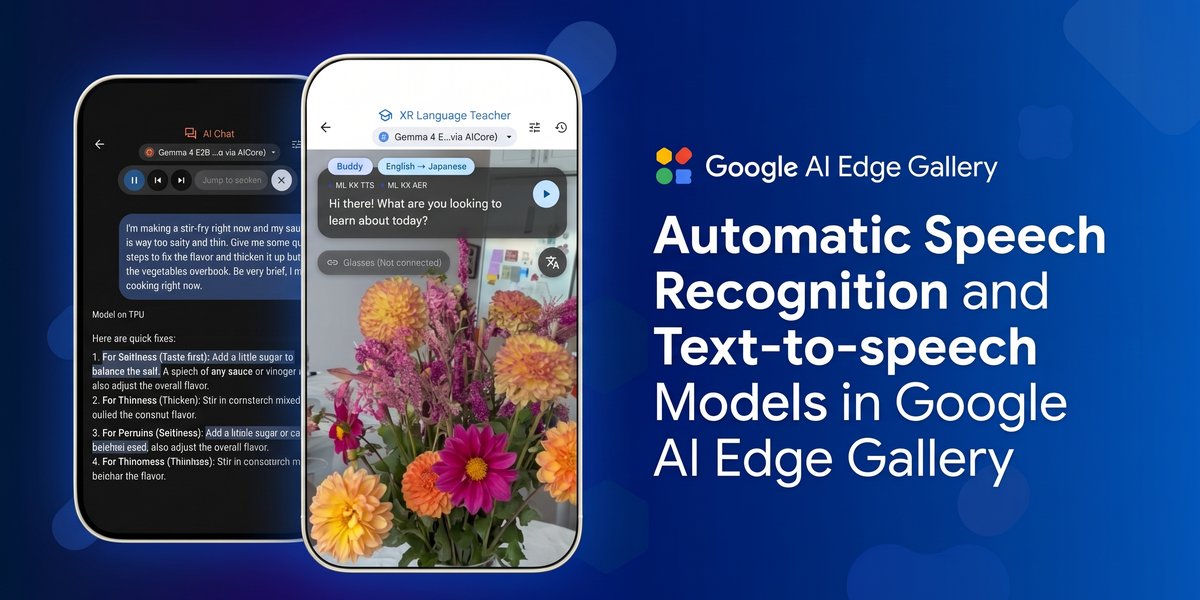
To illustrate the whole package working together, the team built the XR Language Teacher showcase inside Gallery: the user points the camera at a sign, a menu, or an unfamiliar object and asks out loud something like "what is this, and how do I order one?". The app transcribes the question via streaming, sends it along with the camera frame to Gemini Nano (or Gemma 4, outside Android) in a single pass, and returns a spoken explanation in the user's language, interspersed with authentic pronunciation in the local language.
The technical trick that makes this code-switching possible is a structured output schema: the model separately tags the foreign-language segments, and the TTS pipeline switches voice and accent mid-sentence based on that tagging, without needing two speech models running in parallel. The same pipeline, according to Google, extends directly to smart glasses paired with a phone, the subject of a specific talk at Android Dev Summit about audio-first experiences with Gemini Nano.
Beyond the showcase, Gallery's own AI Chat feature also gained voice: streaming dictation, a floating TTS bar that highlights the sentence being spoken in real time, and open reference code that demonstrates how to strip Markdown formatting and skip code blocks or tables before synthesis, scheduling speech sentence by sentence so it doesn't compete for memory with the SLM's token generation.
What changes for those building in Brazil
In short: the new piece on the board is that production-quality ASR/TTS no longer requires a pay-per-use API call. This reopens three discussions that every mobile team has had at some point.
The first is cost: apps with high volumes of voice interaction, such as customer service assistants or educational apps, stop paying per cloud transcription or synthesis call, trading that for the fixed (and already paid) cost of the user's hardware.
The second is privacy: audio that never leaves the device simplifies the compliance conversation with the LGPD (Brazil's data protection law) in sensitive sectors like healthcare and finance, where recording and transmitting a customer's voice is an additional legal risk. The third is connectivity: the very travel scenario Google chose for the XR Language Teacher, subway, market, roaming with no signal, is familiar to those developing with the real Brazil in mind, where 4G/5G coverage is spotty outside major centers.
The counterpoint that no manufacturer announcement mentions willingly is hardware fragmentation. The 10x and 50x real-time numbers assume acceleration via NPU or TPU; entry-level devices, which still account for a large share of the Android install base sold in Brazil, may lack these accelerators and run the models on CPU, with latency much higher than what was published. Before promising real-time voice response to the user, it's worth testing on the target audience's most modest device, not just on the demo flagship.
What remains open
The post cites 21 locales for ML Kit's TTS voices and more than 100 languages for ASR, but doesn't list which ones: anyone planning to support Brazilian Portuguese needs to check the official ML Kit GenAI Speech Recognition documentation before assuming full coverage, rather than trusting the aggregate number. Open models like Phonon 31M, described as "ultra-lightweight" for TTS, are explicitly described as English-focused, which reinforces that model choice within the LiteRT ecosystem still requires language-by-language evaluation.
For those who want to get started, Google left three doors open: the ML Kit GenAI Speech Recognition documentation for Android integration, the MediaPipe Tasks guides for cross-platform coverage, and the LiteRT developer guide with ready-made .litertlm bundles in the Hugging Face LiteRT community, which already has more than 10,000 followers and includes models like Whisper, Qwen3-ASR, and Moonshine for ASR, or Qwen3-TTS and Matcha for TTS. The reference code for Gallery itself, on GitHub, is the most direct starting point for adapting the streaming, code-switching, and sentence-synchronized playback pipeline into your own app.
Translated from the Brazilian Portuguese original · Read the original
Meta's Muse Ember ties on price with GPT-6 Luna and Claude Haiku 5.5 in the race for cheap agents
Muse Ember, launched by Meta on November 10, 2026, charges the same entry price as GPT-6 Luna and Claude Haiku 5.5, but the three diverge on the cheap context limit and the cost above it.