

Apple proves Mac mini ad doesn't use AI with behind-the-scenes video
Faced with public doubts about AI-generated creation, Apple responded to the stop-motion ad for the Mac mini with M6 by publishing the complete making-of on the same day, turning the defense into a campaign of its own.

Faced with public doubts about AI-generated creation, Apple responded to the stop-motion ad for the Mac mini with M6 by publishing the complete making-of on the same day, turning the defense into a campaign of its own.
Contexto
On August 25, 2026, Apple published a stop-motion commercial to introduce the Mac mini with the M6 chip. The piece follows the brand's usual minimalist visual language in its sets and product shots, but the animation itself is closer to the tone the brand has been using on its recent social media: a yellow, Hulk-style figure bursts out of the Mac mini's casing and gives rise to rockets, race cars, and multitasking robots, illustrating the chip's power in a playful way. It's a product commercial, not an umbrella brand campaign, and the stated target audience is the usual one: whoever decides to buy a compact desktop computer, from freelance creatives to corporate offices.
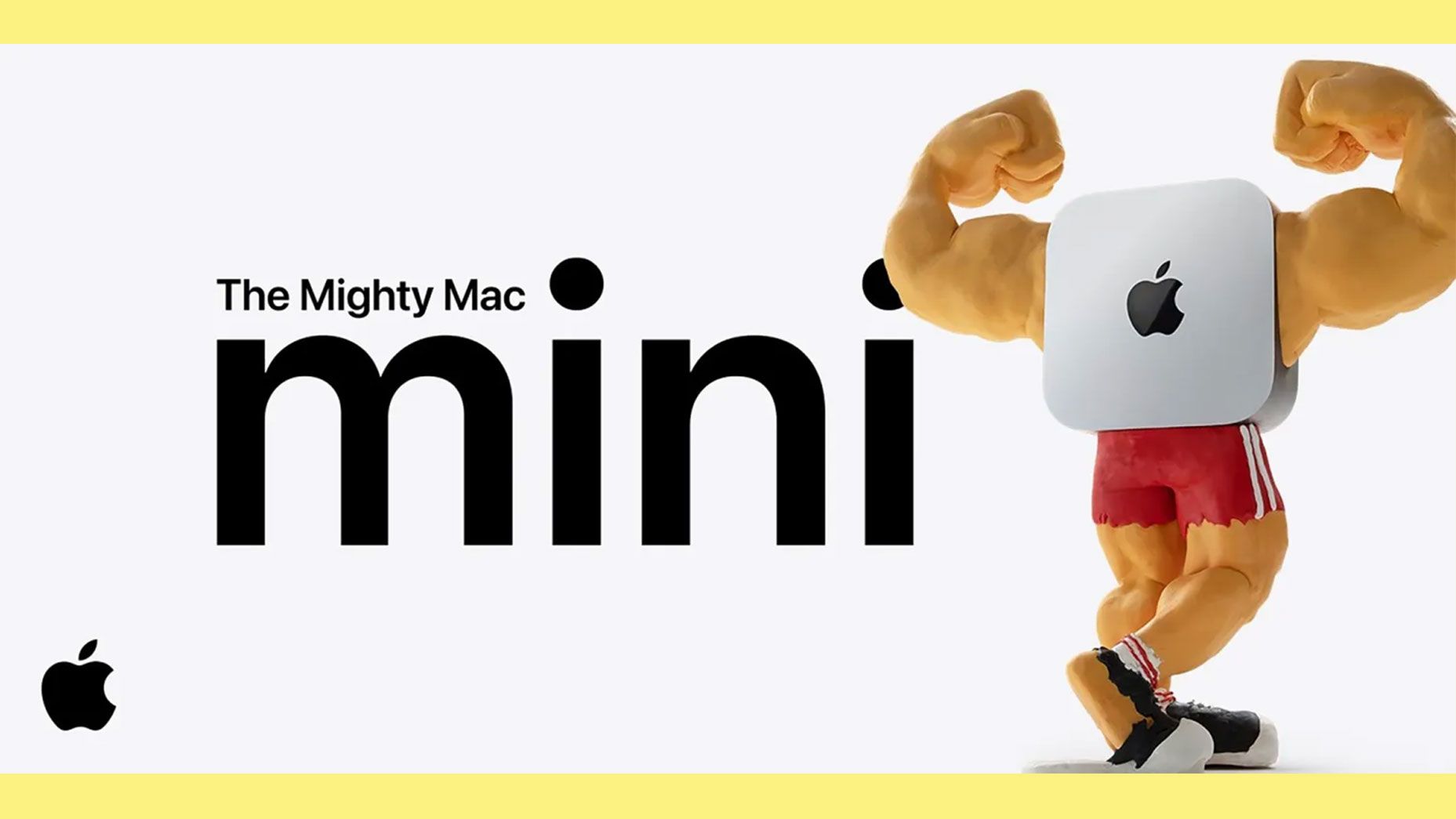
What made this launch notable wasn't the script, but the reaction it provoked. As Creative Bloq reported, part of the audience publicly doubted that the animation was made by hand, at a time when any piece with organic texture and saturated colors is an automatic candidate for accusations of generative AI. Apple responded, but not with a statement: it published a behind-the-scenes video literally showing sculptors modeling clay.
O que fizeram
The response came via the official Instagram account @helloapple, in a behind-the-scenes reel that reports like 9to5Mac's detail with names and roles: animators Justin Rasch and Scott DaRos and art director Josh Mahan appear showing sketches, props, sculptures, clay modeling techniques, and stop-motion timelapses alongside raw production footage. It's not a generic corporate 'creative process' video: it's technical proof, scene by scene, that every object on screen passed through human hands before going in front of the camera.
Creative Bloq also records a statement from animator Justin Dasch about the concept behind the animation: "To show the power and speed of the Mac mini, we turned it into a character capable of anything. So you have rockets, insane race cars, strongmen, and super-advanced robots multitasking." The quote is part of the behind-the-scenes material itself: in Creative Bloq's text, it appears right before the invitation to watch the animation team's video, which indicates the statement was pulled from the behind-the-scenes reel, not from a separate launch communication that preceded it.
It's worth noting the timeline: according to 9to5Mac, the commercial and the behind-the-scenes video were published on the same day, August 25, 2026, which indicates a quick response to the first doubts that were already starting to appear online. Apple didn't hide the process inside a closed press kit for trade media, it put it on the same social channel where the doubt was born.
Números públicos
Here the honesty of the material matters more than padding out the section: neither Creative Bloq nor 9to5Mac disclose reach, view counts, media spend, or awards for this specific piece. What exists in concrete terms is the record of the distribution channels, the video commercial through Apple's official channel and the behind-the-scenes reel on Instagram @helloapple, and the textual engagement of the articles themselves: Creative Bloq's coverage totals 2 public comments, 9to5Mac's totals 3. These numbers are too small to support any conclusion about real virality; what can be said with confidence is that the piece generated dedicated editorial coverage in at least two relevant outlets in the industry, which is already an earned-media result that a good portion of paid campaigns can't buy.
Pontos fortes
The central success lies in the choice of response format: instead of a clarifying statement, Apple responded in the very vocabulary of the doubt, visual and granular proof. Showing Justin Rasch and Scott DaRos with their hands dirty from modeling clay is an argument that no corporate text can beat, because it attacks the accusation ('this looks like AI') on the very ground where it was born (the texture of the image), not in a corporate statement.
The second strong point is strategic positioning, and Creative Bloq editor Georgia Coggan puts it into words: she recalls that Apple had already faced a similar reputational crisis a couple of years earlier, when the iPad Pro ad showed a press crushing musical instruments, paintbrushes, and other symbols of tactile creativity, sparking public outrage and an apology from the brand itself. Coggan writes that the Mac mini commercial is 'a welcome nod to the value of human creativity,' and sums up the message every tech brand should learn: 'the Mac mini is positioned as an enabler, not a replacement, and that's basically everything creatives want from their technology.' After a piece that symbolically destroyed analog tools, Apple returns to the same territory (creative productivity) with the argument inverted: here is the human hand doing the work, and the machine is what speeds up the process.
The third success is one of timing within the brand's own calendar: the campaign takes advantage of a moment when the MacBook Neo was already running a more irreverent marketing line on TikTok, so the audience was already calibrated to accept a less corporate tone from Apple. The Mac mini commercial picks up this already-prepared ground and uses it for a message of trust, without sounding like an abrupt departure from identity.
Pontos fracos
The main weak point is structural, not aesthetic: even though it was published the same day as the ad, the proof of process came as separate content, an Instagram reel apart from the main commercial, which means anyone who only saw the original ad didn't have automatic access to the counterpoint. This works well when the brand has the muscle for a quick response and active social media monitoring, but it depends on the audience going after the second video to complete the defense.
The second weak point is the reach of the proof material itself: the behind-the-scenes video went to Instagram as a reel, a quick, vertical consumption format, not as a complete making-of in long-form video, with credits for the entire team, total production time, or the number of pieces sculpted. 9to5Mac describes the process as 'extensive' ('the extensive work that went into producing the ad'), but no source provides a concrete number (how many weeks, how many people, how many physical objects) that would turn the claim of manual work into verifiable data. 'Extensive' without quantification is a press-release adjective, exactly the kind of vague claim this piece asks us to avoid, and Apple itself fell into it.
The third point is one of originality of the move: as 9to5Mac notes, the piece's tone is already less irreverent than the MacBook Neo campaign on TikTok, so Apple is recycling a recent tone playbook, not inventing a new communication territory. This doesn't invalidate the result, but it reduces how much this specific response can be read as a deliberate strategic move versus a reaction of the moment using a format the brand had already validated on another product.
O que melhoraria
The takeaway for those who work in content production in Brazil is twofold. First, on format: even when the defense against an AI accusation comes quickly, as in Apple's case, it still depends on the audience seeking out a separate second video. Smaller brands, without Apple's trust capital, would benefit from embedding some proof of process (a short clip, a seal, a mention) directly into the main piece, reducing the dependence on the audience actively seeking out the counterpoint later.
Second, on quantification: if Apple wanted to turn this defense into a genuinely reusable brand asset, it would be worth publishing not just the behind-the-scenes reel, but longer, more specific material, with the number of production days, the size of the animation team, and the number of objects physically sculpted. This kind of concrete data is what separates a claim of craft from proof of craft, and it's exactly the gap that this very piece had to flag instead of filling with a made-up number.
Finally, for those who design product or lead a content team here, the case serves as a case study in precaution: documenting the production process from the start, even without initial intent to publish it, has become insurance against accusations of generative AI. Keeping sketches, clay proofs, and behind-the-scenes timelapses as part of production routine (not as crisis response) is the difference between building a response from scratch and simply publishing what already exists when the doubt appears, because it will appear, with or without actual AI use in the piece.
Translated from the Brazilian Portuguese original · Read the original