

Apple Uses Stop Motion to Sell the AI in the New Mac Mini M6
In a campaign signed by TBWA\Media Arts Lab, Apple turned down the shortcut of generative AI and made the entire Mac Mini commercial out of modeling clay, frame by frame, precisely to sell the machine that promises 4x more local AI performance.

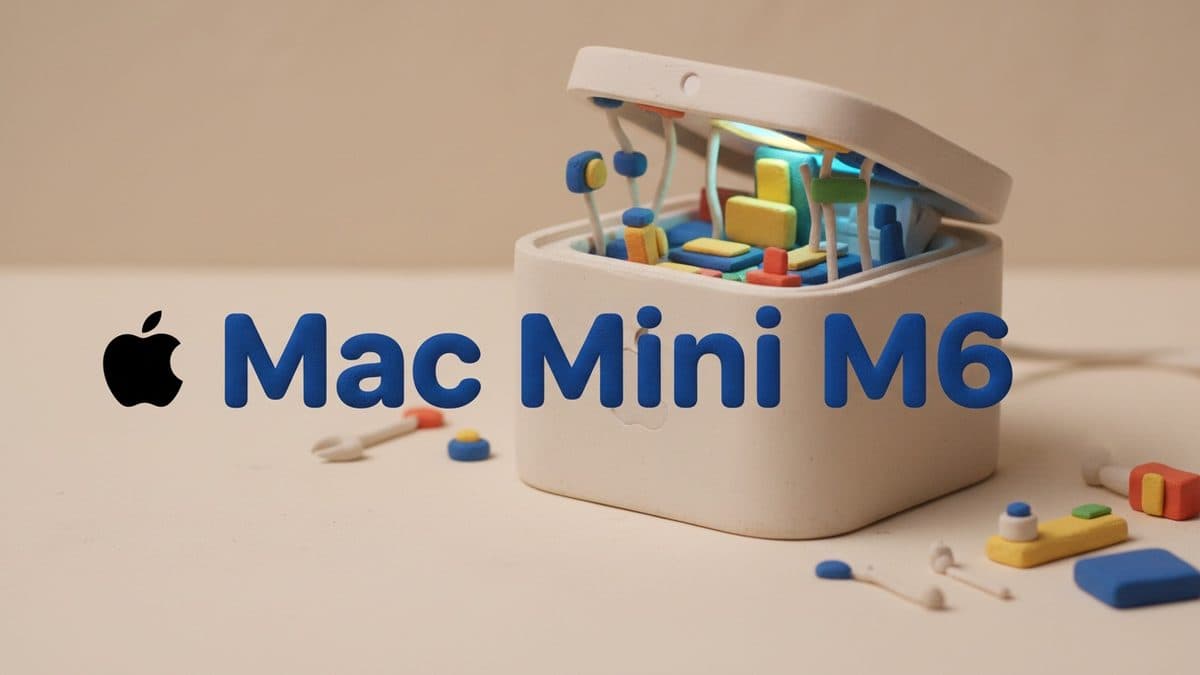
In a campaign signed by TBWA\Media Arts Lab, Apple turned down the shortcut of generative AI and made the entire Mac Mini commercial out of modeling clay, frame by frame, precisely to sell the machine that promises 4x more local AI performance.
On August 26, 2026, Apple published a commercial for the new Mac Mini with the M6 chip made entirely in stop motion, the frame-by-frame animation technique using hand-manipulated modeling clay figures. The piece, covered by The Drum as "Ad of the Day" (source), draws attention for a reason that matters directly to whoever decides budget and campaign narrative: the advertised product is sold, among other things, on its leap in local AI performance, but the film that sells it uses no AI-generated imagery at all. This is Apple choosing the most manual and most expensive process possible to advertise the machine most associated with automation in its desktop lineup.
Context
The agency behind the piece is TBWA\Media Arts Lab, described by the agency itself as Apple's exclusive global agency ("the bespoke global agency for Apple and only Apple"). The stated goal, according to The Drum's reporting, is to communicate a list of technical upgrades (CPU, graphics, and AI performance) in a way that escapes the spec-sheet slide and reaches the end consumer, not the technical early adopter. The Mac Mini has historically occupied the "entry-level" Mac spot, and the commercial's target audience is precisely whoever hesitates between buying a basic desktop and a more robust one: people who decide based on perceived benefit, not benchmark.
The angle that matters to anyone working in growth and media is the moment this piece is born into. In 2026, ad feeds are already saturated with imagery generated by generative models, often used precisely to promise speed and production savings. By choosing the slowest and most manual path available in the advertising market, Apple is making a positioning bet as much as a product bet.
What They Did
The film opens in the classic style of an Apple ad: light gray background, studio lighting, a hand placing the Mac Mini's silver box at the center of the frame, with a voiceover saying "Say hello to the new Mac Mini." From there, the piece shifts register. An M6 chip modeled in clay (without the usual metallic render) slides into the Apple logo on the box lid, throws off sparks with the same texture as fingerprints pressed into the clay, and the Mini starts shaking like the Hulk until it tears its own "shirt," revealing bodybuilder arms and legs doing a bench press, illustrating the CPU and GPU gains.
Next, the product turns into a race car with sculpted spoilers and clay exhaust smoke, to speak to the dual neural accelerators. Then it grows a brain, robot legs, and multiple arms all busy at once, to represent the 4x gain in AI performance. Finally, the Mini is coupled to a handcrafted rocket, with hand-painted flames, and "takes off" while the voiceover promises to send the user's productivity into the stratosphere. The film closes back in Apple's usual restrained tone: gray background, understated sans-serif type, headline "The Mighty Mac Mini with M6."
The credits list compiled by The Drum shows the scale of the investment in craft: production by Blinkink in partnership with Stoopid Buddy Stoodios, direction by Nicos Livesey, post-production by Trafik, sound by Racket Club, and the track "Pili Pili" by Polo & Pan. Apple also published a behind-the-scenes video on Instagram showing hand-drawn storyboards and animator Justin Rasch retouching the figures with a brush, along with a line from animator Scott Daros: "We have to sculpt and craft everything by hand. There's no shortcuts." The behind-the-scenes material is not available as a direct, verifiable video link in the sources consulted, so it is not reproduced here.
Public Numbers
This is the section where the available material is honestly limited: neither The Drum nor Apple disclosed, in the material covered, media reach, media spend, or any award received by this specific piece. What does exist as public numbers are the product claims themselves, used as the film's creative hook: 4x faster AI performance, 40% faster CPU, and 2x faster graphics, all cited within the ad itself according to The Drum's description. These are Apple's own marketing claims about the M6, not campaign performance metrics, and it's important not to conflate the two when reporting this case: as of the source's publication, there is no audience, engagement, or media return data associated with this specific piece.
Strengths
The campaign's clearest win is using worn-out visual metaphors (muscle for strength, race car for speed, multiple arms for multitasking, rocket for peak performance) and making them feel new through execution alone. The Drum describes exactly this mechanism: the stop-motion technique and finish take a technical spec list (the so-called spec sheet) and turn it into a benefit understood at a glance, without the viewer needing to know what a neural accelerator is. This is a production decision, not a script decision: the same idea in live action or generic CGI would probably look like one among many.
The second win is the coherence between medium and message. By publishing, in parallel, the behind-the-scenes video showing Justin Rasch retouching figures with a brush and Scott Daros's line about the absence of shortcuts, Apple turns the process itself into part of the sales argument: the implicit message is "this was made by human hands, with the same artisanal care any Apple object should have," at a time when much of tech advertising is model-generated. For whoever decides production budgets, this is a lesson replicable at a smaller scale: visible craft becomes part of the brand case, not just a making-of detail.
The third strong point is the tonal modulation within the piece itself. The film opens and closes in Apple's usual restrained register (gray background, controlled lighting, sober typography) and only takes on the playful stop-motion tone in the middle. This framing preserves the brand's credibility while lending it a more playful personality, which helps sell an entry-level product without cheapening the perceived quality of the Mac line.
Weaknesses
The most fragile point, and precisely the center of this analysis's angle, is that the film never shows what the M6's local AI actually does in practice. The "brain with multiple arms" sequence illustrates the concept of parallel AI processing, but doesn't anchor it in any real use case, such as on-device image generation, real-time transcription, or any task the user would recognize from daily life. The metaphor communicates "this is fast for AI" without communicating "this is useful for AI at what." For a machine whose technical sales pitch depends on neural acceleration, the absence of a concrete example of an app or workflow is a gap that The Drum doesn't question, but that jumps out at anyone working in growth who needs to justify a click with perceived utility, not just visual spectacle.
Another weak point is the total absence of campaign performance numbers in the available sources. A piece praised by the trade press as "Ad of the Day" can be a critical success without necessarily being a success in reach or conversion, and there's no way to know, from the public material, whether Apple measured this or simply didn't disclose it. This limits how much this case can be cited as proof of return on investment in stop motion, even if it serves well as proof of craft.
There's also a risk of cynical reading that the production choice itself opens up: by avoiding any AI-generated imagery precisely in the ad for the machine sold as "the most AI-capable" of the line, Apple may unintentionally reinforce the narrative that on-device AI still doesn't have a visually convincing enough use case to carry the campaign on its own. This isn't an execution flaw, it's a strategic tension that the piece neither resolves nor discusses.
What Would Improve It
The reading I propose here: the film would benefit from an additional scene, still within the stop-motion language, that tied the "brain with multiple arms" metaphor to a real, recognizable task, such as the Mini processing several creative work windows at once without lagging, or finishing in seconds something that today takes minutes. This would fully preserve the piece's playful tone and would close the gap between the pretty metaphor and the concrete benefit, without needing to resort to any AI-generated imagery to prove the point.
For those thinking about media and not just creative, it would also be worth Apple (or any brand replicating this kind of bet) disclosing, even if in limited form, some indicator of campaign performance, such as organic reach generated by trade press coverage compared to previous campaigns for the same product line. This would turn the case from "praised by critics" into "case with measurable return," which is what decides whether an artisanal production budget, more expensive and slower than any AI generation, pays off again in the next campaign.
Finally, a test that would suit any growth team inspired by this case: run this same piece in parallel with an equivalent version generated by generative AI, with the same core idea and the same script, to measure the difference in brand recall, sentiment, and attention time between the two versions. There's no indication that Apple did this, and I'm not claiming it did. But it's exactly the kind of data that would be missing to prove, with numbers and not just praise from trade critics, that the bet on the manual process was worth the extra time and cost.
Translated from the Brazilian Portuguese original · Read the original