Zero Moment of Truth gains two new sources: creators and AI enter the purchase decision funnel

- Reading
- 6 min
- Tables
- 1
The framework Jim Lecinski created at Google more than a decade ago has gained two new sources, content creators and AI assistants, and this changes what Brazilian brands need to monitor before the sale.
A few years ago, Jim Lecinski published the "Zero Moment of Truth" (ZMOT) manifesto: the idea that, before reaching the shelf or the cart, the consumer has already gone looking for evidence to decide what to trust. In a recent Adweek article, Lecinski (now a professor at Kellogg School of Management) and researcher Kelly Cutler update the framework. The three original sources (search, social media, reviews) have become five: content creators and AI assistants have entered the mix.
For those who decide media and content in Brazil, this isn't just an academic repositioning. It's the formalization of something that already shows up in any growth brainstorm today: the consumer no longer reads the brand's website to decide, they ask ChatGPT, Gemini embedded in search, or Meta AI inside Instagram, and the answer they get already comes with a pre-filtered set of brands.
From a single message to a body of evidence
The authors' central argument is that marketing's job is no longer just managing the brand's message. It has become managing the "decision evidence body": the set of content, reviews, mentions, and data that humans and machines use to form an opinion about a product. The brand doesn't control all of these sources, but it can influence the quality, freshness, and consistency of what's available in them.
This requires a practical change in routine: those in charge of growth and media can no longer treat SEO, review management, creator relations, and AI optimization as separate teams with separate goals. According to the article, each source reinforces or weakens the credibility of the others, so evidence work needs to be orchestrated, not fragmented across agency or squad silos.
The five sources that make up the Zero Moment today
The updated framework describes a specific role for each source:
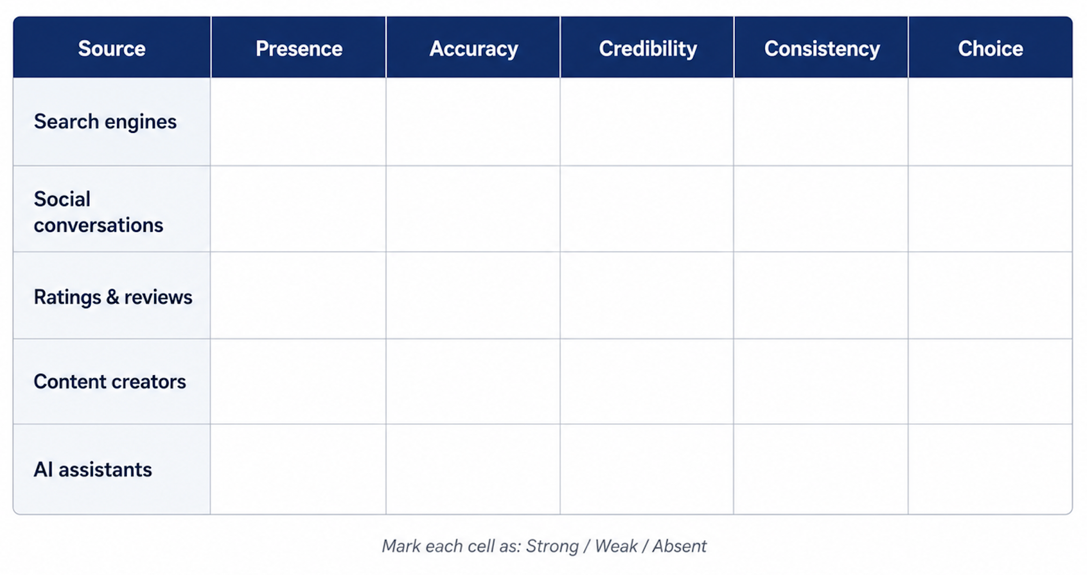
- Search engines: help the customer express intent, compare options, and verify details.
- Social conversations: reveal what people ask, praise, and criticize in real time.
- Ratings and reviews: provide structured public evidence from people who have already bought.
- Content creators: interpret product and category through demonstration, comparison, and personal experience.
- AI assistants: synthesize all of this and deliver a direct answer, comparison, and recommendation.
The point the authors highlight is that these sources overlap: a creator's video shows up in search results, a review feeds an AI answer, a community conversation becomes a chatbot citation. Treating any one of them in isolation no longer reflects how the customer actually decides.
Generative AI: a direct source and a synthesizer at the same time
The article draws attention to a detail that often gets overlooked in GEO (Generative Engine Optimization) discussions: the AI assistant isn't just one more search channel, it plays two roles at once. It's the source the customer consults directly and, at the same time, it's what synthesizes the other four sources before answering.
In practice, this means a brand can rank well on Google and still disappear from an AI Overview answer, because the model found a contradiction between what the brand's website says and what reviews or creators say elsewhere. The authors sum up the risk in a direct line:
Strong search rankings no longer guarantee visibility in AI-generated answers.
Jim Lecinski and Kelly Cutler, authors of the article in Adweek
The article also cites a concrete shift already underway: Google launched ad formats such as Conversational Discovery Ads, Direct Offers, and Highlighted Ads, which answer questions, bring analysis, and suggest products within the ad creative itself, without the user leaving the conversation. It's advertising designed to appear inside the AI's synthesis, not alongside it.
Another data point cited in the article comes from a BrightEdge report: YouTube already accounts for nearly 30% of citations in Google's AI Overviews, which makes the platform an authority asset for language models that prioritize multimodal content and cite video directly. For those deciding where to invest in content production, this carries more weight than it might seem at first: YouTube video has become an input for answer training, not just a reach channel.
The evidence checklist across the five sources
The authors propose a simple diagnostic, called the Zero Moment Five-Source Evidence Check. For each of the five sources, the brand assesses five criteria and rates the result as strong, weak, or absent:
| Criterion | Question it answers |
|---|---|
| Presence | Does the brand show up when the customer asks the right question? |
| Accuracy | Is the available information complete, correct, and up to date? |
| Credibility | Is there validation from a customer, expert, creator, or independent outlet? |
| Consistency | Does what appears here match what appears across the other four sources? |
| Decision | Does this evidence reduce uncertainty and help the customer choose the brand? |
In practice, this gap tends to show up between accuracy and consistency: a brand with an up-to-date website but an outdated review, or a creator talking about an old product version that AI still cites as if it were current.
What changes for those deciding growth and media here
For Brazilian growth professionals, the practical takeaway from the framework is that optimizing only for paid or organic search clicks no longer covers the whole funnel. It's worth prioritizing three fronts the article points to as a recurring bottleneck:
- Audit what AI assistants (ChatGPT, Gemini, Meta AI, Copilot) say about the brand today, comparing it with what the official website and ads say.
- Treat relationships with content creators as a purchase-evidence input, not just awareness media, since their video feeds both search and AI answers.
- Monitor reviews and complaints with the same priority as technical SEO, because that's often where much of the "contradiction" that knocks a brand out of an AI answer originates.
None of these fronts is new on its own. What the updated ZMOT forces is looking at the five sources as a single evidence portfolio, with a shared owner and goal, instead of leaving SEO, social, review CRM, and creator relations in squads that don't talk to each other.
Where the framework still falls short
The article is strong on diagnosis and weak on measurement: it doesn't offer a methodology for quantifying "presence" or "credibility" in quantitative terms, nor an industry benchmark. For those deciding budgets, this means the proposed checklist works as a qualitative guide for internal auditing, not as a ready-made ROI measurement tool. It's worth using as a starting point to build your own dashboard, cross-referencing AI mention data with metrics the team already tracks, such as review volume, search position, and engagement with creator content.
Translated from the Brazilian Portuguese original · Read the original
Incubeta research shows gap between confidence in marketing measurement and AI's real results
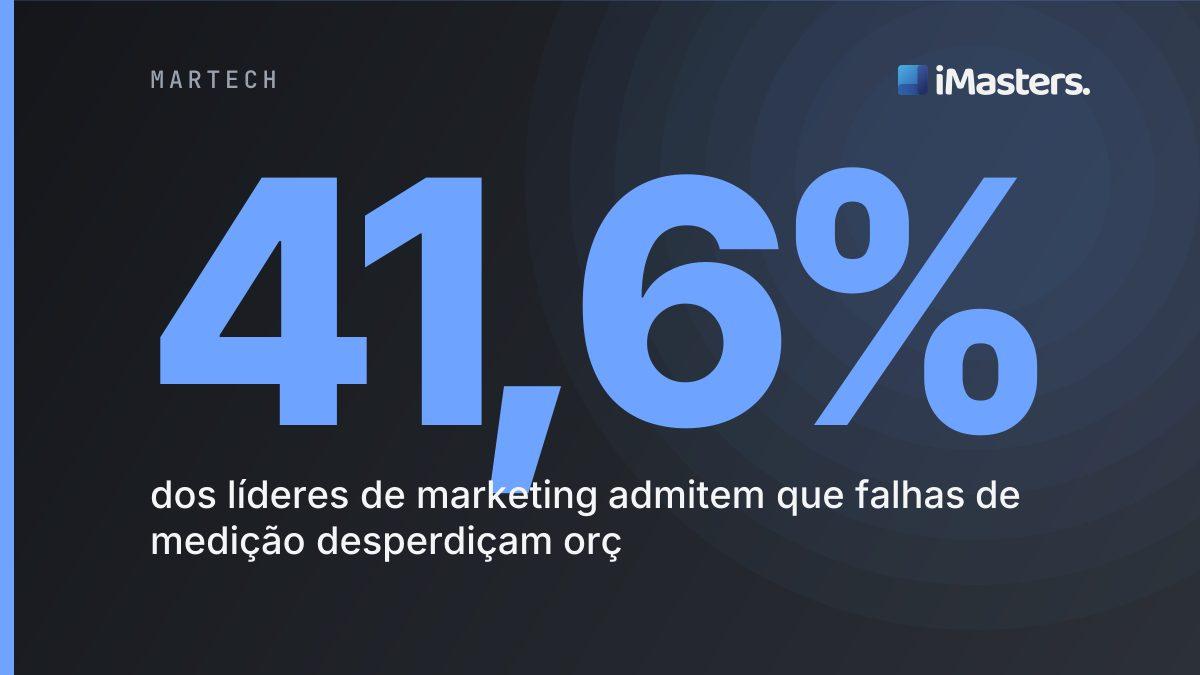
A survey by Incubeta published by Marketing Dive on November 16, 2026 shows that 92% of marketing leaders trust the accuracy of their measurement, but nearly half admit to wasting budget due to measurement failures. Generative AI only widens that gap.