Companies Promote Devs to Architects Without Telling Them, Report Finds

- Reading
- 5 min
A 15-second bug in a Google Forms add-on became a case study on what generative AI doesn't do for you: defining architecture. Understand why this pushes devs into a role no one has formalized.
The Bug That Cost 15 Seconds of Welcome Screen
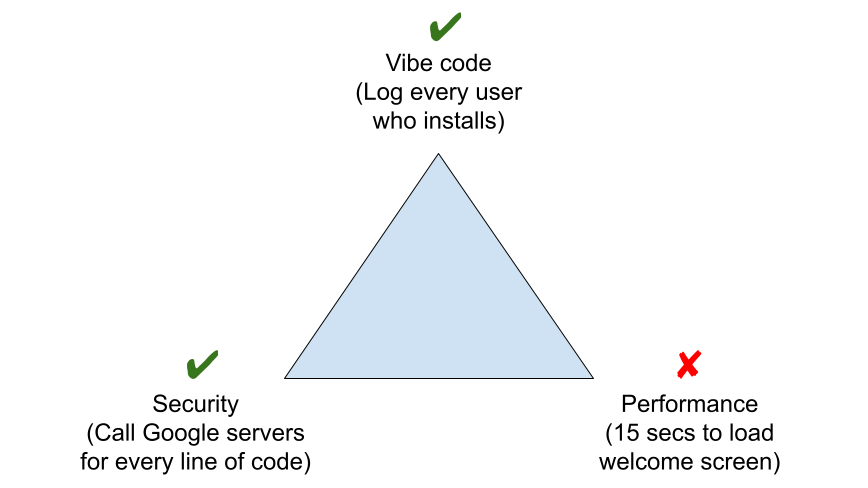
In a report published this week, developer Mani Doraisamy described how he spent hours debugging a performance issue in a Google Forms add-on his company maintains. The welcome screen, which should have appeared instantly, was taking 15 seconds to load.
The cause was a logging snippet a colleague had "vibe coded" to track new installations every week. The AI-generated code ran a chain of try/catch blocks: it first tried to fetch the user's email (if they had consented to share it), then fell back to the user ID if that failed, and logged a generic error if that failed too. Each of those attempts is a single line of code, but behind it are multiple calls to the Google API, which has restricted how much an app can know about a user since December 2025.
The problem wasn't the intent: tracking new installations is a legitimate part of running a business. The problem is that no one reviewed the performance cost of that decision before it went into production.
What an Architect Would Have Done Differently
Doraisamy argues that the right solution was simple, but required someone thinking about architecture, not just requirements. Two possible approaches:
- Log only the installation timestamp, telling the marketing team they wouldn't have the email to trigger a follow-up based solely on that.
- Show the welcome screen first and log the user's email or ID asynchronously while the user is already looking at the screen, even if that requires the server to accept a payload without full authentication.
Neither option is obvious to an AI coding tool, because both involve deciding what the application won't do perfectly well, for the sake of something else that matters more.
Why AI Won't Say No to You
The central argument of the piece is that AI coding tools are tuned to fulfill the functional requirement requested, plus two standard non-functional constraints: security and backward compatibility. That has a predictable side effect, according to Doraisamy: AI tends to sacrifice performance in the name of security, and tends to stack redundant versions of tables and logic in the name of not breaking anything.
If you generate code by specifying your requirements instead of specifying your architecture, AI will decide the architecture on your behalf.
Mani Doraisamy, developer
In practice, this means AI will never write an endpoint that accepts an unauthenticated payload, even when that's the right choice for that specific case, and if you write it manually, it tends to "fix" it by reintroducing authentication, which can tank performance again or force the user to log in again.
The Role No One Announced
Doraisamy's thesis is direct: teams that use AI to code have already promoted their developers to architects, they just haven't told them. The part of the job these professionals learned to love (writing code) is now done by the tool. What's left is something else:
- Questioning requirements that will make the app slow or insecure, before asking for the implementation.
- Designing the data model first, and only then constraining AI to code within that design.
- Deciding when to keep old versions of tables and logic for compatibility, and when to wipe everything and keep just one.
- Reviewing generated code the way an architect reviews a junior developer's code.
You got promoted. Nobody told you, so I am telling you.
Mani Doraisamy, developer
According to the author, it's this gap, between the role the company expects and the role the developer thinks they still have, that explains much of the frustration and distrust around vibe coding today.
In Brazil, This Conversation Isn't Happening Either
The source doesn't offer turnover numbers or Brazilian market data, but the pattern it describes is familiar in squads here: tech leaders start demanding "use AI and deliver faster" without renegotiating title, salary, or career expectations. The developer keeps being hired and evaluated as a coder, but what actually sets them apart in practice is something else.
This mismatch has a direct cost for whoever leads the team: a professional who feels they've become an AI reviewer without formal recognition tends to look for the company that offers that recognition, whether in title or in salary range. Formalizing the transition isn't a courtesy, it's retention.
How to Structure the Transition, in Practice
Some concrete steps for engineering leaders who want to avoid repeating the addon case:
- Name the new role out loud. If the real expectation is architecture design and review, say so explicitly, with a title adjustment and, when it makes sense, a compensation adjustment.
- Specify architecture before asking for code. In the comments on the original post, a reader asked whether spec-driven development would solve the problem. Another reader, Anh Le, replied directly:
In this case, if your spec doesn't start from the architecture level, but from the requirements level, it wouldn't help.
Anh Le, comment on Mani Doraisamy's blog在这个案例中,如果你的规格不是从架构层面,而是从需求层面出发的就没有
- Treat AI code like a junior's PR. Reviewing the data model, external calls, and performance trade-offs remains human work, even when AI wrote the first version.
- Decide backward compatibility case by case. Tell the tool when it's acceptable to keep old versions of tables and logic, and when it's time to consolidate, instead of letting it happen by default.
What's Left Open
The report doesn't say how many companies have already made this silent promotion, or how to measure its impact on turnover or productivity. There's also no indication in the source that AI coding tools will evolve to accept architecture specification as a first-class input, rather than just functional requirements. For now, the line between "what AI decides on its own" and "what requires someone thinking like an architect" still depends on who's on the other side of the prompt.
Translated from the Brazilian Portuguese original · Read the original


Anthropic's IPO tests the circular financing that powers the AI race
Anthropic's stock market debut, on November 19, returns billions to Amazon, Google, Nvidia, and other suppliers that are also investors in the company. The case exposes a model that AI startups in Brazil replicate on a smaller scale, trading equity for cloud credits.