Google announces Agent Compute Engine to run AI agents in isolated microVMs

- Reading
- 5 min
Managed service isolates each agent in a microVM, keeps credentials out of the sandbox, and uses checkpoints to suspend and resume runs. Still no general availability date or pricing.
What Agent Compute Engine Is
On November 22, 2026, Google announced Agent Compute Engine, a managed service that runs AI agents in isolated microVMs, with checkpointing to suspend and resume the execution environment. The core idea, according to InfoQ's coverage, is to separate what the agent can do from what it can access: credentials, API keys, and OAuth refresh tokens stay out of the sandbox, injected by an external component called Agent Gateway, which authenticates each call before releasing the secret.
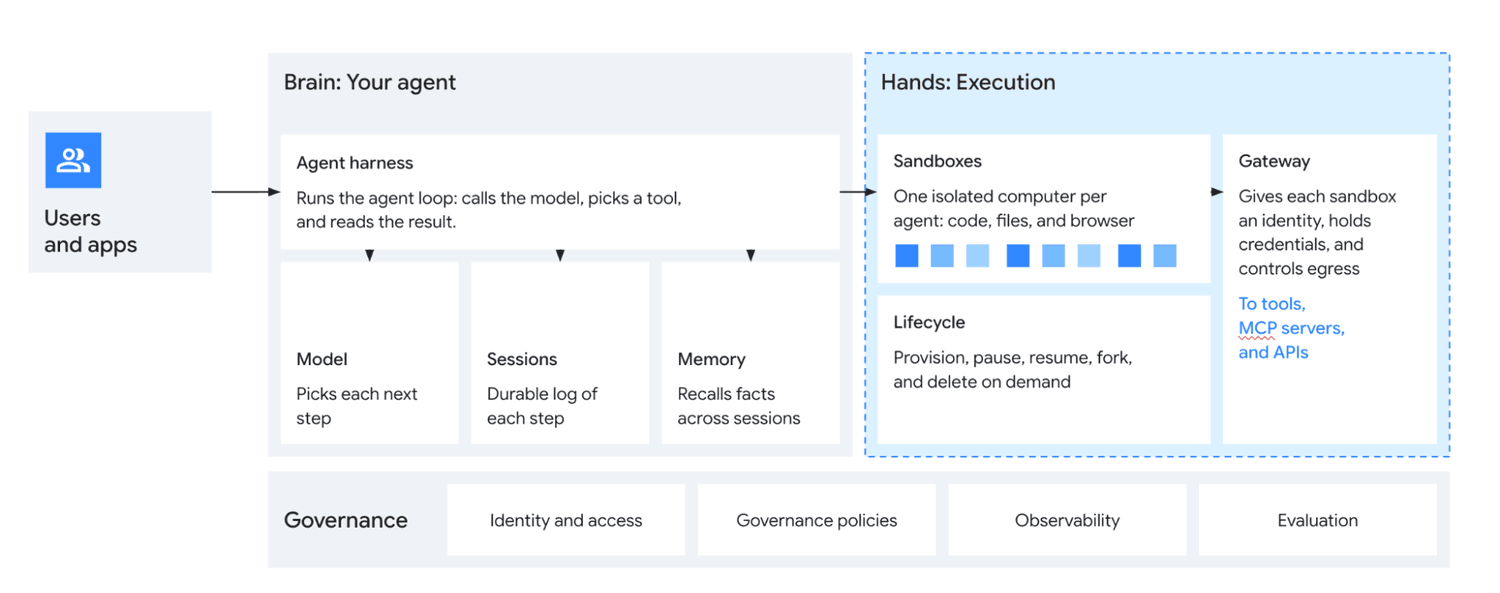
In practice, this changes the threat model that any team running autonomous agents in production needs to consider. Today, most agent implementations store credentials inside the execution environment itself, which means an agent that hallucinates a destructive command, or that is compromised by prompt injection, has direct access to the same secrets it would legitimately use. Google's proposal targets exactly this point.
Three Problems the Architecture Tries to Solve
Google designed Agent Compute Engine to address three requirements at global scale: keeping sandboxes free of exploitable credentials even when the agent makes a mistake; reducing cost and latency when resuming idle agents; and preserving persistent workspaces across sessions and operating system updates. The infrastructure team describes the technique used for this:
Agent Compute Engine achieves this by using copy-on-write memory sharing to run multiple agents on a single operating system template, and pausing idle microVMs via fast checkpoint and restore.
Google's infrastructure team
The technical detail matters because it's what allows many agents to run per physical machine without paying the cost of booting a full VM on every call. Fast checkpoint and restore also mean that an agent waiting minutes or hours for a human response doesn't need to keep compute resources reserved the whole time.
Harness Outside, Sandbox Inside
In the technical article "Inside Agent Compute Engine," Google Distinguished Engineers Ramanathan Venkatapathy and Rohit Jnagal detail the architecture: microVM isolation, credential management, agent identity, storage, and scheduling at scale. They explain the strict separation between the agent's orchestrator and the environment where it executes:
The orchestration harness (the brain) runs completely outside the execution sandbox (the hands), helping ensure that untrusted guest environments only execute explicit commands dispatched by the harness and stream output back. This boundary establishes a deterministic audit trail correlating every harness-initiated tool call with expected compute activity inside the sandbox.
This separation is the differentiator Google wants to sell against architectures where the agent's own process decides and executes within the same context. For anyone auditing security incidents involving agents, having every tool call correlated with an explicit harness command makes it easier to reconstruct what happened after a failure.
Four Workload Types, Internal Use in Gemini
Agent Compute Engine's architecture covers four workload categories: interactive consumer and enterprise agents that execute code, browse the web, and take actions; persistent Linux workspaces for autonomous software engineering; large-scale parallel environments for model evaluation and reinforcement learning; and lightweight, isolated execution environments for dynamic logic inside Google services. Venkatapathy and Jnagal confirm that Google already uses the platform internally for Gemini, Gemini for Business, the Antigravity agentic development platform, and model evaluation workloads.
Agent Substrate: the Open Part
Separately, Google maintains Agent Substrate, an open-source, Kubernetes-native runtime for running AI agents in isolated environments. Unlike Agent Compute Engine, which is restricted to Google Cloud, Agent Substrate manages the sandbox lifecycle independently of the underlying compute infrastructure, allowing idle agents to be suspended while preserving state and resumed on available workers when needed. It's the piece any team can run today outside Google's cloud.
What Hasn't Shipped Yet
In the article "Google's Agent Compute Engine: A MicroVM Sandbox With No Credentials Inside, and What Google Has Not Shipped Yet," Harel Asaf, an AI specialist at Elementor, examines the security architecture and points out the gap between the announcement and what's actually available:
The deep dive gives no boot time, price or density figure for Agent Compute Engine itself. It says developers will control each environment's image, identity, network access and lifecycle, while Google manages the fleet, and that the service is targeted for preview in the coming months. The numbers in the announcement belong to Agent Substrate.
Harel Asaf, AI specialist at Elementor
In other words: much of what sounds like a benchmark in Google's announcement comes from the open-source component that already exists, not from the managed service still in preview. It's worth separating the two before planning a migration.
Google Enters an Already Crowded Race
Google isn't the only provider offering isolated, managed execution environments for AI agents. AWS and Azure already have similar capabilities through Bedrock AgentCore and Foundry Agent Service, respectively. Google's difference in approach lies in keeping credentials out of the agent's sandbox by default and injecting them through an external gateway, rather than leaving that design decision up to whoever implements it.
In the same batch of announcements, Google also expanded its agent governance stack with centralized identity and policy: Agent Gateway for traffic control and policy enforcement, Agent Registry to track approved agents and tools, SPIFFE-based Agent Identity for authentication and auditing, and OpenTelemetry-compatible observability to monitor model calls and tool invocations.
What Changes for Those Building Agents Here
For teams in Brazil already running AI agents in production, or planning to scale beyond a prototype, the announcement serves more as a directional signal than an immediate option: Agent Compute Engine still isn't available, has no announced pricing, and Google's target is a preview in the coming months, without a firm date. Anyone who needs isolation and credential management today still has three concrete paths to compare: Google's own open-source Agent Substrate (runnable on any Kubernetes), AWS's Bedrock AgentCore, or Azure's Foundry Agent Service.
The architectural decision worth adopting right now, regardless of provider, is the separation between harness and sandbox that Google describes: never let the process that decides what to do have direct access to the credentials that execute the action. This reduces the blast radius of a compromised agent or a misinterpreted command, and is cheaper to implement with existing credential-proxy libraries than waiting for a service still locked inside a single cloud.
Translated from the Brazilian Portuguese original · Read the original

Databricks in talks for round that would value company at $225 billion
According to the Wall Street Journal, the data and AI company is in early talks to raise several billion dollars at a valuation of around $225 billion, just three months after a $5 billion round at $190 billion.