Google isolates AI conversations in Search to avoid contaminating history or personalization
- Reading
- 4 min
Starting November 18, 2026, Google Search's AI Mode gains temporary threads: the conversation disappears without entering the history or influencing future ads and recommendations.
What Google launched
In a statement published on November 18, 2026, Google announced that AI Mode in Search, its conversational interface within Google Search, now offers "temporary threads." The news was reported by TechCrunch. In practice, it's an incognito mode applied specifically to AI conversations within Search, something Google had already been doing for years for conventional queries via the browser's private window.
Until this announcement, anyone who wanted an untracked conversation with Google's AI had to open Gemini separately and activate temporary chat there. Now the same logic arrives within the search flow itself, without needing to switch products.
How it works in practice
According to Google, there's no need to change any account settings. Just click the temporary threads icon, in the upper right corner of AI Mode, to start an isolated session. When the thread is closed, search returns to normal operation.
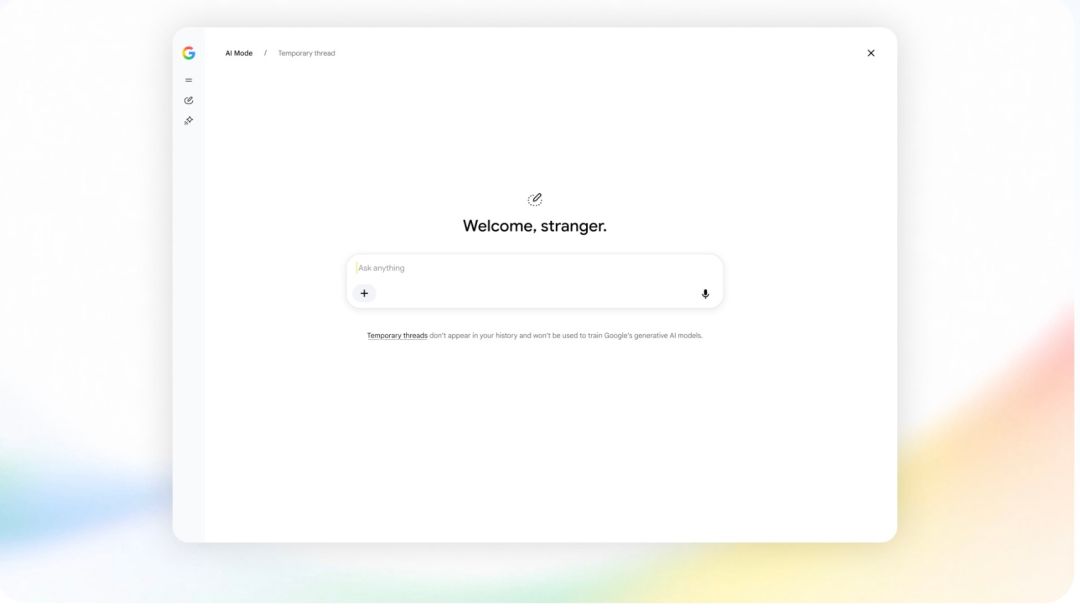
Three technical effects define the feature:
- The session is disconnected from the user's account for as long as it lasts.
- The AI's responses are not informed by that person's preferences or previous searches.
- Nothing that happens in the thread enters the search history or feeds future recommendations.
The rollout is global, on desktop and mobile, in all languages supported by AI Mode, according to Google's own statement.
Why this matters to growth and martech people
This isn't a productivity feature: it's a trust feature, and trust is what determines whether a user uses search AI for topics they currently avoid typing into Google while logged in, such as health, personal finance, legal situations, or job searches. Brands operating in sensitive verticals (YMYL, in SEO jargon) gain a channel where the user can search without fear that it will turn into an ad later.
The flip side is signal loss. All the logic behind search personalization, contextual ads, and long-term interest modeling depends on the history Google accumulates about each account. A conversation in a temporary thread simply doesn't generate that data. For those building remarketing campaigns or audiences based on search intent, this means that a share (not yet publicly quantified by Google) of the most context-rich search interactions, precisely the ones where the user digs deeper into sensitive topics via AI Mode, will stay off the radar.
What changes for those thinking about GEO
For those working on generative engine optimization (GEO), the news reinforces a point that had already been taking shape with AI Mode itself: the response Google's AI delivers depends less and less on a fixed ranking of pages and more and more on session context. In a temporary thread, that context disappears when the conversation closes, which tends to make the response more "generic" (relying only on the current query, without the account's history) than in a normal, personalized session.
This creates a practical incentive for brands investing in GEO: content needs to answer an isolated question well, without relying on Google already "knowing" the user to deliver the right response. If a relevant share of queries on a given topic (health, finance, sensitive purchase decisions) starts happening in temporary mode, the authority and clarity of the page itself will matter more than the behavioral profile of the person asking.
The parallel with Gemini and what remains open
The feature mirrors what Gemini, Google's chatbot, already offered as temporary chat. The difference is that the function now reaches the company's highest-traffic point, Search itself, rather than a separate app. This suggests a standardization of privacy policy across Google's AI products, rather than an isolated experiment within AI Mode.
Google's statement, according to TechCrunch, doesn't detail adoption numbers, data retention at another level (such as internal security logs, which normally don't disappear just because the session is "temporary" for the user), or whether the feature changes anything in how ads are auctioned around queries made via AI Mode.
For those managing paid media and measurement, this is the question that still has no public answer: do temporary threads actually remove query volume from the data funnel used for segmentation, or do they just hide from the end user something Google continues to process for other purposes, such as security and abuse. Until Google details this, the feature should be treated as a change in perceived trust, not necessarily as a complete change in what the company knows about each search.
Translated from the Brazilian Portuguese original · Read the original


Ruby flaw exposes default Rails apps to memory corruption; RCE not demonstrated
An advisory from Veria Labs describes a one-byte heap overflow in the Ruby interpreter, reachable from Rails' default configuration and present in GitLab, GitHub Enterprise, Mastodon, Discourse, and Chatwoot, but the company has not demonstrated remote code execution.