OpenAI reaches $1.25 trillion valuation in round that still hasn't hit its original target

- Reading
- 4 min
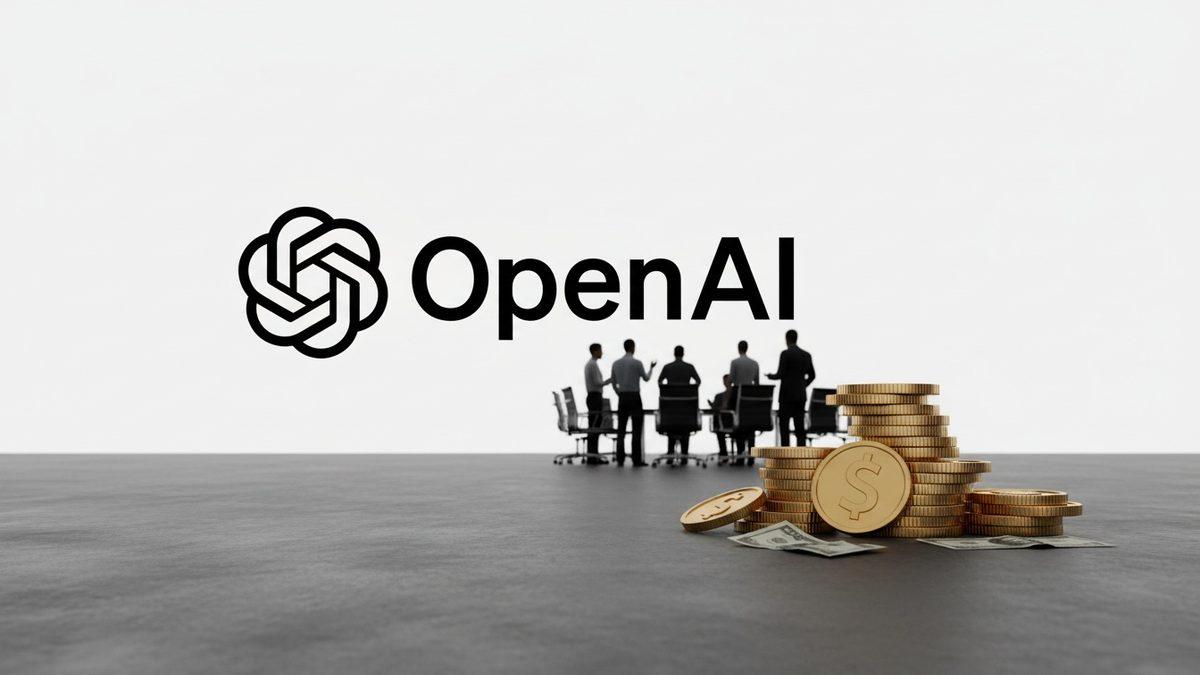
OpenAI's new round values the company at $1.25 trillion, but has raised only $11 billion of the $30 billion sought, while rival Anthropic's valuation is also losing steam in the market.
What Bloomberg found
OpenAI has raised $11 billion so far in a new investment round that values the company at $1.25 trillion, according to a Bloomberg report published this past Friday (Nov. 6) and picked up by TechCrunch, citing people familiar with the matter. The round has not yet closed: a source told Bloomberg the total could reach around $20 billion once the process wraps up in the coming weeks.
OpenAI was contacted by TechCrunch for comment on the numbers and had not responded by the time the original story was published.
The target that fell short
In September, Bloomberg had already reported that OpenAI was seeking to raise $30 billion in this round. The current figures (the $11 billion already confirmed and the $20 billion projected at closing) fall well short of that original target.
In short: even while raising more capital and pushing its valuation up to $1.25 trillion, OpenAI was unable to attract the volume of investors it had planned for two months earlier. That doesn't amount to failure, but it's a data point that contradicts the narrative of unlimited appetite for shares in generative AI companies.
Anthropic shows the same symptom
On the same day as the OpenAI news, Bloomberg reported that potential buyers of shares in Anthropic's IPO, OpenAI's main competitor, are targeting a valuation far lower than the one the company was aiming for. According to the report, some of these investors believe Anthropic may be worth just $1.1 trillion, down from the $2 trillion the market expected about a month earlier.
The simultaneous pullback in the two biggest bets in the generative AI sector is no calendar coincidence: it points to a broader repricing of risk among the investors backing frontier labs.
The political backdrop weighing on the numbers
The TechCrunch report links this movement to a specific political scenario in the United States. The Democratic victory in the midterm elections and the largely negative sentiment among voters toward data centers have created instability in the market, with growing expectations of regulatory challenges for the AI sector.
This detail matters because data centers are the physical input behind the entire billion-dollar valuation narrative: without computing capacity, there's no frontier model to justify a trillion-dollar valuation.
The IPO that keeps getting pushed back
OpenAI had already publicly signaled its intention to go public as early as 2026, but it has revised that plan. The expectation now, according to the report, is that the IPO will happen sometime in 2027.
A private round that misses its fundraising target, at a company planning an IPO the following year, usually means one thing: the public market is going to demand sturdier numbers than the ones propping up the current narrative. It's the kind of adjustment that typically happens before the offering, not after.
What this means for those building with AI in Brazil
Most Brazilian founders of AI products don't hold stock in OpenAI or Anthropic, but they do have a direct dependency on both via API. When the capital that sustains these labs becomes more expensive or harder to raise, the pressure to monetize compute ends up passed down the line, whether through per-token pricing or changes in usage policy.
It's worth looking at three concrete signals from this episode when planning the roadmap for a product built on third-party models:
- Gap between target and actual funds raised. OpenAI was seeking $30 billion and, so far, has confirmed $11 billion (with a projected $20 billion at closing). That gap is a proxy for institutional investors' real appetite for yet another round at a record valuation.
- Anthropic's simultaneous repricing. An expected valuation drop from $2 trillion to possibly $1.1 trillion, in about a month, shows that the skepticism isn't just about OpenAI, it's about the entire category of frontier labs.
- Political regulatory risk, not just technical. The dip in sentiment about data centers in the US, tied to the election results, is a reminder that the infrastructure behind generative AI is also a matter of public policy, and that affects the cost and availability of compute in the medium term.
For those raising their own round citing "strategic partnership" or "preferential access" to OpenAI's or Anthropic's models as a pitch differentiator, this is a good time to also map out a backup supplier plan. Not because these labs are at immediate operational risk, but because volatility in pricing across the entire sector tends to translate, sooner or later, into changes in commercial terms for those downstream in the chain.
The episode also serves as a gauge for Brazilian investors who value AI startups by comparison to Silicon Valley multiples: if the world's two biggest labs are being repriced downward in the same week, the same adjustment tends to arrive, with a lag, at the valuations of smaller companies that use the generative AI narrative as a fundraising lever.
Translated from the Brazilian Portuguese original · Read the original
OpenAI uses AI to find 1,724 Linux kernel vulnerabilities for $1.21 million
OpenAI agents scanned the Linux kernel, confirmed 1,724 vulnerabilities, and built around 950 exploits capable of granting root access, for a fraction of the cost of a human audit.