Ripple-65B Preview matches closed models in agentic coding at one-tenth the cost

- Reading
- 10 min
- Tables
- 1
Ricursive Intelligence released Ripple-65B Preview, an open-weight model that beats much larger competitors on TerminalBench 2.1 and runs on local hardware like NVIDIA's DGX Spark.
Ricursive Intelligence, an AI lab that builds self-improving systems for chip design, released Ripple-65B Preview. It is the general-purpose version of the proprietary model that already runs internally on the company's chip design platform, according to the official announcement. The model has 65 billion parameters, was pretrained on 12 trillion tokens, and supports up to 1 million tokens of context.
The reason for the spotlight isn't the size, but the result: according to Ricursive, Ripple-65B Preview achieves the state of the art among American open-weight models in agentic coding, surpassing competitors many times its size. For those developing in Brazil and currently relying on closed APIs for code-agent tasks, this opens a different path: a model that fits on smaller hardware and can be audited, fine-tuned, and hosted without depending on a single provider.
The TerminalBench 2.1 numbers
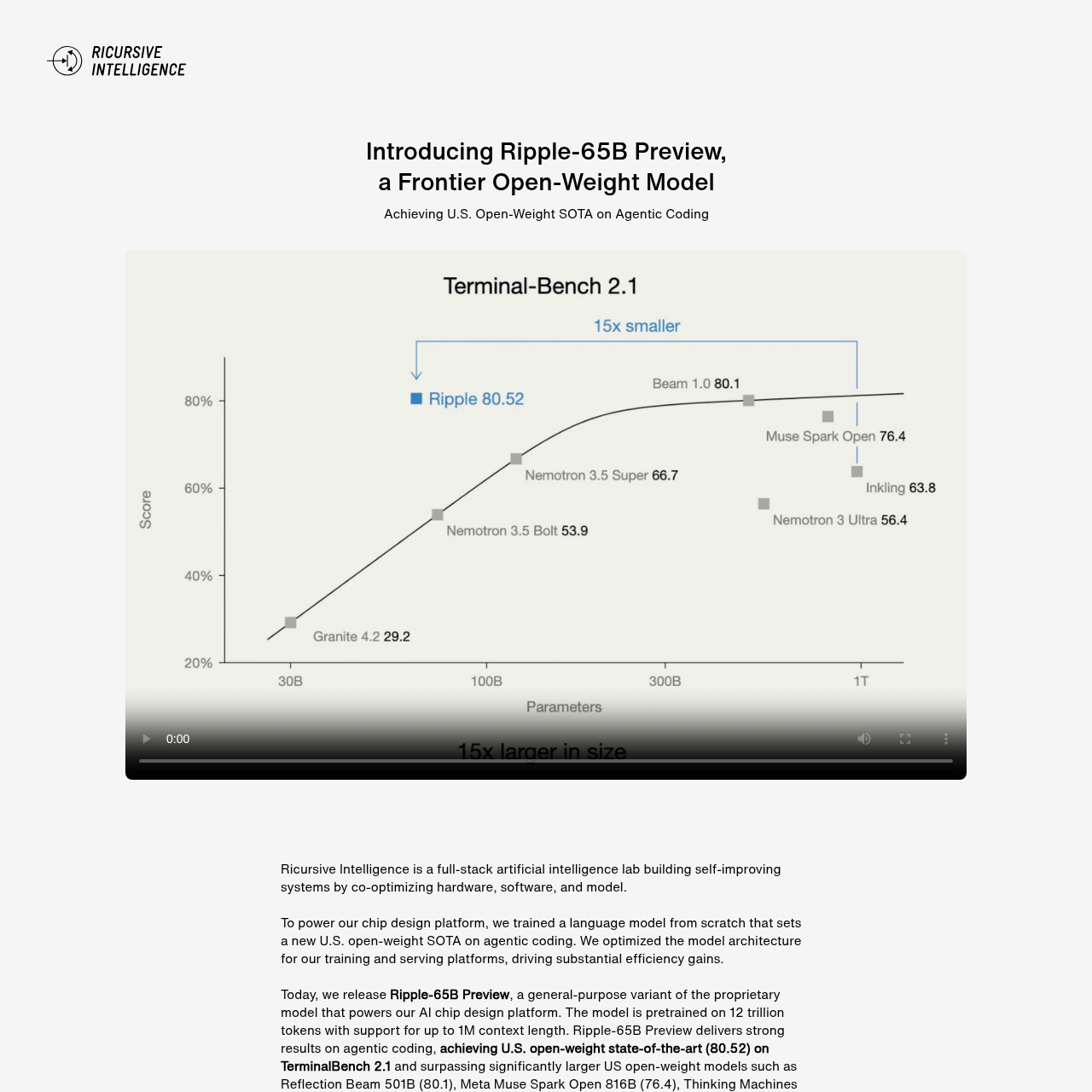
The central metric of the announcement is TerminalBench 2.1, a benchmark that evaluates models performing agent tasks in a real terminal. Ripple-65B Preview scored 80.52 points, which Ricursive classifies as open-weight SOTA in the United States. The comparison with other open models, all substantially larger, is the central point of the release:
| Model | Parameters | TerminalBench 2.1 |
|---|---|---|
| Ripple-65B Preview | 65B | 80.52 |
| Reflection Beam | 501B | 80.1 |
| Meta Muse Spark Open | 816B | 76.4 |
| Thinking Machines Inkling | 975B | 63.8 |
| NVIDIA Nemotron 3 Ultra | 550B | 56.4 |
In other words: a model with an eighth of Reflection Beam's parameters delivered a slightly higher score on the same evaluation. That changes the calculus for those choosing a model based on the ratio between capability and inference cost, not just the benchmark score.
Training at one-tenth the cost
The most striking point of the announcement is financial. Ricursive says it developed and trained Ripple-65B Preview for $32 million, a figure that includes the entire R&D cycle: pretraining ladder development, data mixing, evaluations, synthetic data generation, posttraining recipe, and the final training run. The company estimates this amount is one-tenth the cost of the previous open-weight SOTA.
To put the scale of the sector in context, the announcement cites public statements from industry executives: in 2023, OpenAI CEO Sam Altman said GPT-4 training cost more than $100 million; the following year, Anthropic's Dario Amodei projected that frontier models would cost up to $1 billion, forecasting $10 to $100 billion for pretraining alone by 2026-2027. A footnote in the post mentions that competitors like Reflection reportedly committed to paying $150 million per month for compute on SpaceX's Colossus supercluster, with Beam taking four weeks to pretrain and another four to posttrain.
Efficiency also shows up in the reinforcement stage: Ricursive says it reached 80.5 points on TerminalBench 2.1 with only 1.4 million rollouts, roughly 70 times fewer than Reflection Beam needed. Instead of buying posttraining data, the company built its own synthetic pipelines, with quality filtering and coverage metrics, using techniques such as truncated importance sampling and score centering.
Dense architecture, not MoE
Unlike the recent trend of using Mixture-of-Experts (MoE) to scale models, Ricursive opted for a modernized dense Transformer. The decision reduced training and serving infrastructure complexity, according to the company, which maintained 40% MFU throughout pretraining and posttraining, even with simple sharding, no custom kernels, and no quantization.
Ripple-65B Preview uses a thin-and-deep aspect ratio: a narrow d_model of 5,120 and 80 total layers. To offset the depth and improve reasoning, the architecture overprovisions attention heads, adjusts the ratio between local (SWA) and global attention layers, and reduces the SWA window. Other combined techniques include FFN activation clipping, gated attention, global NoPE, and value residuals.
The company also details the laddering process: it started from Olmo 3's model ladder (an open project from the Allen Institute for AI) and tested interventions at small scale until consolidating a recipe that, according to Ricursive, improves compute efficiency for code by up to 16x at the 4B-parameter scale, compared to the original Olmo 3 ladder.
Where to run it, and why it matters here
Ripple-65B Preview is already available on Hugging Face, Together AI, GMI Cloud, and OpenRouter; Fireworks went live the same day as the announcement. For those working with AI infrastructure in Brazil, the more practical detail is different: the model was designed to run efficiently on local devices such as NVIDIA's DGX Spark, hardware with high compute FLOPs but lower memory bandwidth than datacenter accelerators.
This is relevant because many Brazilian teams face two bottlenecks when trying to host code-agent models: the cost of datacenter GPUs and the latency of depending on an external API for intensive tasks, such as agents that read and edit entire repositories. A dense 65B-parameter model, with a smaller memory footprint than models with hundreds of billions of parameters, is more feasible to run on local workstations or smaller clusters, reducing dependence on cloud contracts billed in dollars.
What remains open
The announcement comes from Ricursive itself, and the benchmark, cost, and rollout figures come from the company, with no independent validation published so far. The post also does not detail the commercial-use license for the weights, nor does it publish weights for all the checkpoints cited in the experiment ladder (such as the v1.0 to v1.6 variants). For those evaluating whether to adopt the model in production, it's worth watching whether third-party labs reproduce the TerminalBench 2.1 result and whether Ricursive details the full license along with the weights on Hugging Face.
Source 1: Hacker News (https://www.ricursive.com/ripple)
Recursive Self-Improvement via AI for Chip Design & Chip Design for AI - Ricursive Intelligence
Introducing Ripple-65B Preview, a Frontier Open-Weight Model Achieving U.S. Open-Weight SOTA on Agentic Coding Ricursive Intelligence is a full-stack artificial intelligence lab building self-improving systems by co-optimizing hardware, software, and model.
To power our chip design platform, we trained a language model from scratch that sets a new U.S. open-weight SOTA on agentic coding. We optimized the model architecture for our training and serving platforms, driving substantial efficiency gains.
Today, we release Ripple-65B Preview , a general-purpose variant of the proprietary model that powers our AI chip design platform. The model is pretrained on 12 trillion tokens with support for up to 1M context length. Ripple-65B Preview delivers strong results on agentic coding, achieving U.S. open-weight state-of-the-art (80.52) on TerminalBench 2.1 and surpassing significantly larger US open-weight models such as Reflection Beam 501B (80.1), Meta Muse Spark Open 816B (76.4), Thinking Machines Inkling 975B (63.8), and NVIDIA Nemotron 3 Ultra 550B (56.4).
Ripple's dense model architecture provides strong reasoning performance with low-latency token generation. The model's small parameter envelope also enables it to run efficiently on local devices such as NVIDIA DGX Spark, which feature high compute FLOPs with low memory bandwidth relative to datacenter accelerators.
Ripple-65B Preview is available on Hugging Face , Together AI , GMI Cloud , and OpenRouter . Fireworks goes live later today. Achieving U.S. Open-Weight Frontier at One-Tenth Cost LLM pretraining is legendarily expensive. In 2023, OpenAI CEO Sam Altman said that GPT-4 training costs exceeded $100 million . In the following year, Dario Amodei said that frontier AI models can cost up to $1 billion to train, projecting that costs would rise to $10-100B by 2026 to 2027 for pretraining alone.
In contrast, we developed and trained Ripple-65B Preview for only $32M, which is one-tenth the cost of the previous open-weight SOTA on agentic coding , as estimated to the best of our knowledge. ¹ Note that $32M is our full R&D cost starting from scratch, including pretraining ladder development, data mixing, evals, debugging, synthetic data generation, posttraining recipe development, and the final hero pretraining and posttraining run.
Steep Ascent Reinforcement Learning Rather than investing in a brute-force RL climb, we carefully iterated on our SFT and RL recipes with a focus on compute efficiency. We opted not to buy any posttraining data, instead devising our own synthetic data pipelines, quality filtering, and coverage metrics.
Our mixed RL recipe uses truncated importance sampling , score centering , and linear length penalty with high-quality long-horizon synthetic environments. The RL tasks are tuned for our model capabilities, and we continuously added harder tasks as the model improved.
The end result was a steep RL climb from a strong initial SFT checkpoint. We reached a TerminalBench 2.1 score of 80.5 with only 1.4M rollouts, roughly 70x fewer rollouts than Reflection Beam, the prior SOTA. A Co-Designed Model Architecture Ripple-65B Preview's architecture was designed to be trained and served efficiently on NVIDIA hardware.
A key objective was to make design decisions which reduce pretraining and posttraining infrastructure complexity while still enabling strong reasoning and agentic performance. Therefore, we chose to train a modernized dense Transformer model rather than use Mixture-of-Experts (MoE) like other labs. This decision quickly paid off, and we were able to train a strong model from scratch while maintaining a solid MFU (40%) throughout pretraining and posttraining, even with simple sharding, no custom kernels, and no quantization.
Ripple-65B Preview uses a thin-and-deep model aspect ratio, with a narrow d_model (5120) and 80 total layers. To improve reasoning performance, we overprovision the number of attention heads while increasing the SWA-to-global layer ratio and reducing SWA window size to compensate for the increased cost. In addition, we added FFN activation clipping , gated attention , global NoPE , and value residuals . Careful Model Laddering Led to Large Improvements We optimized Ripple's pretraining recipe through a series of careful model laddering experiments.
Our starting point was Olmo 3's model ladder , from which we tested interventions at small scale with a focus on improving coding capabilities. Our v1.0 ladder implemented StepFun batch size and learning rate scaling laws, and v1.1 implemented our new ladder which smoothly scales architectural dimensions and model depth. Ladder v1.2 switched from the post-norm baseline to pre+post norm, which was neutral at small scale but showed improvements starting at 4B.
Ladder v1.3 implemented sigmoid gated attention . Ladder v1.4 (2-stream mHC ) showed good results at smaller scale but did not improve at 4B scale, and was therefore rejected. Ladder v1.5 switched to global NoPE and added a final LR cooldown to zero, and ladder v1.6 added value residuals . In the final version, we switched to our custom pretraining dataset with substantially upsampled code.
Together, the compounded changes improved compute efficiency on code as measured by dolma_stack CE by up to 16x at 4B model scale. In other words, our final Ripple model ladder can be used to achieve similar code performance to the Olmo 3 ladder with 16x less compute .
Note that the slope of the Olmo 3 ladder baseline is shallower than ladder v1.0+, which shows that the compute efficiency improvement will increase with additional scale. Conclusion We built Ripple-65B Preview to begin closing the loop between models and the hardware that fuels them. An internal variant of this model powers our AI chip design platform, and we look forward to seeing the capabilities that emerge as we scale toward the frontier.
We were fortunate to build on top of existing open-source contributions, including those from the Olmo team at the Allen Institute for AI (AI2), Prime Intellect, RadixArk, and NVIDIA. A strong open-source ecosystem is also self-improving, where contributors strengthen the ecosystem, which in turn draws more contributors.
At Ricursive, we are selectively hiring exceptional researchers and engineers as we push the frontier of full-stack AI from model to silicon. If you're interested, check out https://www.ricursive.com/careers . ¹ U.S. open-weight players like Reflection were reported to commit to $150M per month for compute at SpaceX Colossus to train their models. Reflection reported that Beam took 4 weeks to pretrain and 4 weeks to posttrain.
Translated from the Brazilian Portuguese original · Read the original
Zalando announces AI agent that will shop at partner stores starting in 2027
The German retailer unveiled Zalando Extended, an agent that will complete purchases at partner stores inside its own app. The pilot starts with Westwing and exposes a technical problem that goes beyond retail: how to integrate autonomous agents with third-party catalogs and checkouts.