5 min read
Sber's GigaChat 4 arrives with 1 million tokens and MIT license, but benchmarks don't convince
 Redação iMastersNewsroom
- Reading
- 5 min
- Tables
- 1
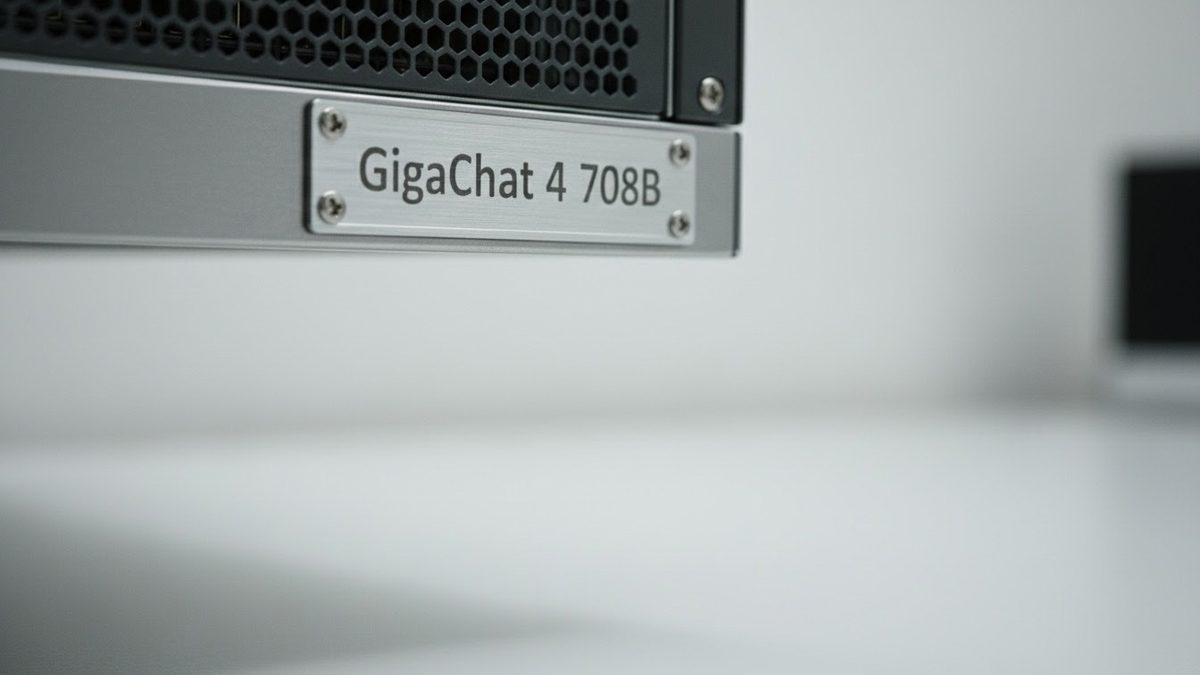
GigaChat 4 708B, launched by Sber on November 26, 2026 under an MIT license, promises 1 million tokens of context and parity with DeepSeek and GLM. An independent analysis published on Habr tells a different story when the numbers are compared to the Artificial Analysis Intelligence Index.
Russian bank Sber (Russia's largest bank) launched the GigaChat 4 line on November 26, 2026, with the flagship model GigaChat 4 708B released under an MIT license on Hugging Face. The proposal is clear: an open-weights model, deployable on-premise, with 1 million tokens of context and native support for tool calling. For those working with open-source LLMs in Brazil, outside Sber's direct sphere of influence, what matters isn't the geopolitical dispute behind the announcement, but what this model actually delivers when placed alongside already-known alternatives like DeepSeek and GLM.
The architecture under the hood
GigaChat 4 708B is a hybrid Mixture-of-Experts model with 708 billion total parameters and about 41 billion active per token. There are 64 layers in total: 48 recurrent Gated DeltaNet (GDN) layers and 16 Multi-head Latent Attention (MLA) layers with DSA (DeepSeek Sparse Attention) sparse attention. Each MoE layer has 256 routable experts (8 chosen per token) plus 1 shared expert, and the fast (Instant) and reasoning (Reasoning) modes coexist in the same checkpoint.
Anyone following the open-model market will recognize the recipe: it's essentially a combination of elements already used by DeepSeek and Qwen, including DSA itself, which DeepSeek introduced in September 2025 in the experimental V3.2-Exp. Sber didn't invent a new architecture; it incorporated, belatedly, techniques already published by Chinese labs.
MIT license and 1 million tokens: what this changes in practice
For teams that need to run models on-premise due to regulatory requirements, an MIT license and open weights mean total freedom for commercial use, fine-tuning, and redistribution, without the restrictions that come with licenses like Llama's. The 1-million-token context puts GigaChat 4 in the range of models capable of processing entire codebases, documentation repositories, or long conversation histories in a single call, without relying on RAG for everything.
In practice, this favors corporate scenarios: internal assistants, RAG pipelines, and automation of regulated requests, where the model needs to follow structured instructions, respect JSON schemas, and call tools correctly. It is precisely in this niche that the model shows strength in the tests cited by Sber itself, such as IFBench, BFCL v4, and CoworkBench.
The problem: the benchmarks used don't appear in current rankings
An analysis published on Habr (a Russian-language tech community and blog platform) by Ivan Mordovets on November 27, 2026 points to a gap between Sber's marketing material and the state of the art in model evaluation. The eight benchmarks cited in the official announcement (AIME 2025, SWE-bench Verified, Terminal-Bench 2.0/2.1, GPQA Diamond, LiveCodeBench v6, among others) are not part of the Artificial Analysis Intelligence Index v5.0.2, the version of the independent ranking in effect since October 2026.
According to the author, a good part of these tests is already saturated, compromised by training data leakage, or abandoned by frontier labs. The current Artificial Analysis index is built on four blocks of 25% each: Knowledge Work, Coding, Science, and General, with greater weight given to closed test sets protected against leakage (such as AA-Briefcase, FrontierCode-AA 2.0, and HLE-Diamond).
Recalculating GigaChat 4's position
Since there's no direct overlap between the two sets of benchmarks, the Habr analysis estimates GigaChat 4 708B's position through cross-calibration, using the tests for which published data exists for both the Russian model and competitors already present in the ranking.
| Model | Estimated position in Intelligence Index | GPQA Diamond | HLE | DeepSWE |
|---|---|---|---|---|
| DeepSeek-V4.1-Flash / GLM-5.3 | 19th-20th (32 points) | 90.4-90.9% | 39.6-43.4% | 67.3-74.3% |
| Mistral Large 4 | 32nd (26 points) | 87.3-90.2% | 30.4% | 62.0% |
| GigaChat 4 708B (estimated) | 43rd-49th (14-18 points) | 82.8% | 23.9% | 35.4% |
In the optimistic scenario, if strong performance on structured instruction carries over to the Knowledge Work basket, the model would reach 19-20 points. In the pessimistic scenario, if the drop in deep reasoning repeats in the closed science tests, the result would fall to 12-14 points, close to much smaller models, such as NVIDIA's Nemotron 3 Ultra 550B.
As long as GigaChat 4 708B hasn't undergone independent evaluation in the Artificial Analysis Intelligence Index and hasn't narrowed the nearly twofold gap in deep reasoning and long-horizon agentic coding, any talk of 'comparability with the world's open leaders' will sound, to put it mildly, ridiculous.
Ivan Mordovets, independent author on HabrПока GigaChat 4 708B не пройдет независимую оценку в Artificial Analysis Intelligence Index и не сократит почти двукратный провал в глубоких рассуждениях и долгосрочном агентном кодинге, все разговоры о «сопоставимости с открытыми мировыми лидерами» будут звучать, мягко скажем, нелепо.
Computational efficiency also matters
Inference cost is another point raised by the analysis: DeepSeek-V4.1-Flash has 552 billion total parameters, but only 8-16 billion active per token. GigaChat 4 spends about 41 billion active parameters per token, 2.5 to 5 times more to process the same input. For those calculating GPU cost per token generated in production, this difference in active parameters has a direct effect on the inference bill, regardless of which model scores better on benchmarks.
Three and a half years of development, in perspective
The Habr report places GigaChat 4 on a longer timeline. The first public version of GigaChat appeared in 2023, the same year DeepSeek and Moonshot AI (the creator of Kimi) were founded from scratch. While Sber prioritized, between 2023 and 2025, a closed product aimed at corporate assistants and the Russian MERA benchmark, DeepSeek released DeepSeek-R1 in January 2025 with RL-based reasoning, and Moonshot AI evolved its open multimodal MoE models up to 2.8 trillion parameters with its own Kimi Delta Attention mechanism.
Sber only released its first model with reinforced reasoning on September 10, 2026, almost two years after DeepSeek-R1 and Kimi K1.5. The opening of GigaChat's weights as an open MoE project only came in November 2025, at the AI Journey conference (a Russian AI conference).
What remains open for those evaluating models
The analysis acknowledges that, for Russian companies and public agencies that need a sovereign, on-premise model with an MIT license, 1-million-token context, and good instruction-following, GigaChat 4 is a functional tool within that scope. The problem pointed out is not the model's practical usefulness, but the gap between the rhetoric of parity with the world frontier and the numbers that back up that comparison.
For those evaluating open-source models outside Russia, the episode reinforces a methodological caution: comparing models using the same benchmarks used in the manufacturer's marketing material, without checking whether those tests still appear in updated independent rankings, can lead to wrong conclusions about which model actually serves which task.
Translated from the Brazilian Portuguese original · Read the original
Google adds context parallelism to MaxText and trains LLMs with up to 14 million tokens on TPU
Google integrated four context parallelism strategies into MaxText, its open-source JAX framework, and reported utilization of up to 70% of TPU compute power even with sequences of millions of tokens.