Google, ChatGPT, and Bing Monetize Generative AI in the Same Week as the November Core Update


- Reading
- 6 min
- Tables
- 1
The rollout of the November core update, a bug in Search Console's AI data, and the simultaneous advance of monetization for AI-generated answers across Google, ChatGPT, and Bing call for careful reading from anyone deciding media budgets and content strategy.
This week, Google began rolling out the November core update, revealed a bug in Search Console's AI data, and, together with ChatGPT and Bing, advanced the monetization of AI-generated answers. For those who decide media budgets and content strategy, the changes call for careful reading before any decision.
This week, Google began rolling out the November core update, revealed a bug in Search Console's AI data, and, together with ChatGPT and Bing, advanced the monetization of AI-generated answers. For those who decide media budgets and content strategy, the changes call for careful reading before any decision.
The November Core Update Starts Rolling Out With Volatility That Began Before It
Google confirmed this Friday (November 13) the start of the rollout of the November 2026 core update. But anyone tracking rank movement had already noticed fluctuations on November 8 and 9, before any official announcement, according to the weekly search news recap by Barry Schwartz, of Search Engine Roundtable. In practice, this means the volatility appeared before the official confirmation of the update.
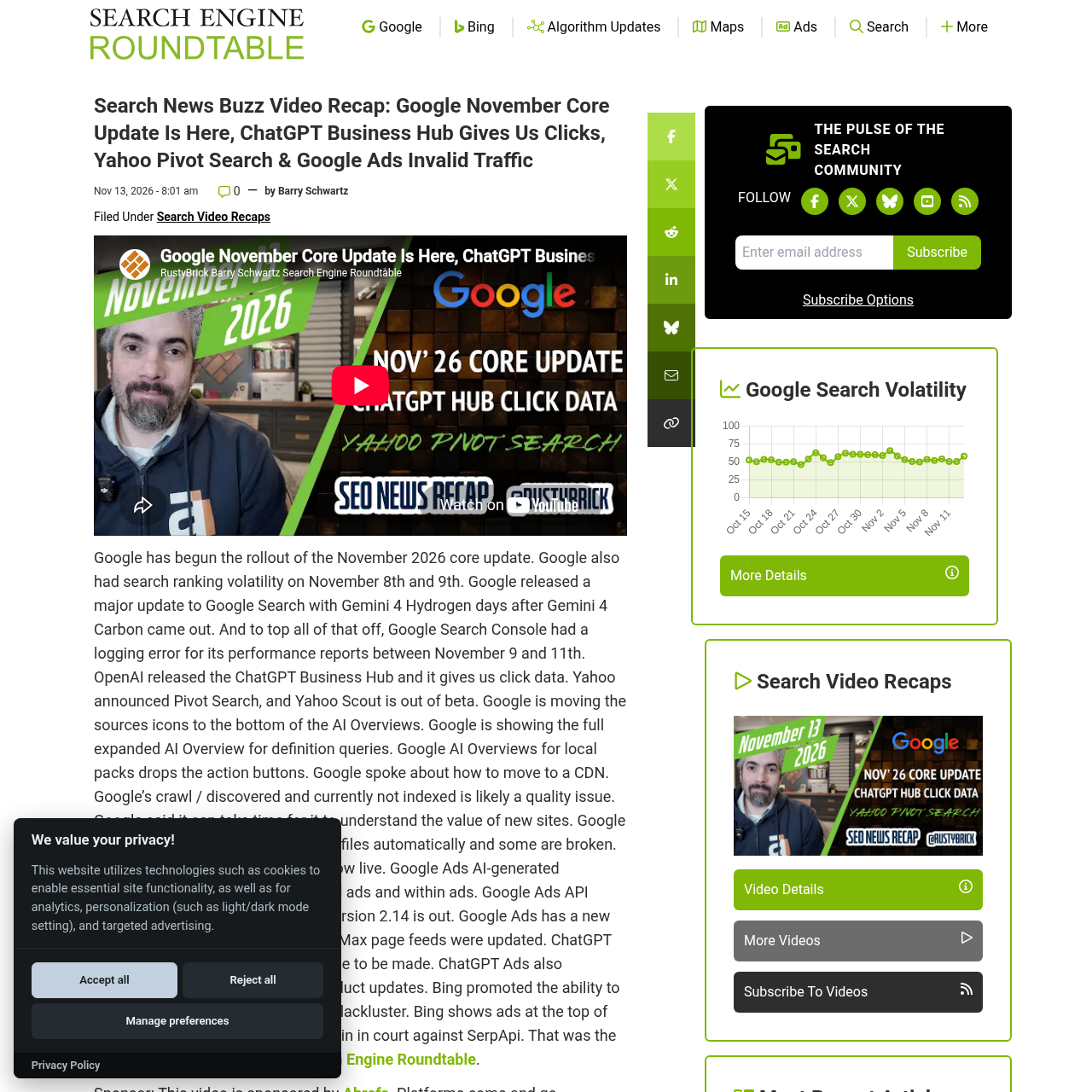
In short: if your ranking dashboard showed a sharp drop or spike before the 13th, don't assume it's a tool error. Google was likely already testing the algorithm before announcing the update publicly, which changes the window you should consider when comparing month-over-month performance.
A Search Console Bug May Have Skewed the AI Data You Looked at This Week
Between November 9 and 11, Google Search Console had a logging error in the Generative AI Performance Report. This means that any budget or content strategy decision based on those three days of data is potentially incomplete.
Teams that reported "AI traffic dropped" to a client or leadership this week need to check whether that number came from this period. The following verification checklist applies:
- Check whether the Search Console Generative AI Performance Reports between 11/9 and 11/11 match other sources, such as GA4 or your rank tracker.
- Reprocess the period manually once Google confirms the bug has been fixed.
- Avoid drawing conclusions about AI Overviews traffic drops or increases using only those three isolated days.
Gemini 4 Hydrogen Replaces the AI Mode Engine Days After Gemini 4 Carbon
Days after putting Gemini 4 Carbon into AI Mode in Search, Google swapped the model behind its answers again, this time for Gemini 4 Hydrogen, according to the Search Engine Roundtable recap. The fast sequence (Carbon, then Hydrogen just days later) shows Google is replacing the models behind Search at a pace that didn't exist in the era of a purely link-based algorithm.
For anyone working in GEO, this is an uncomfortable reminder: optimizing for "the" current AI Mode model means optimizing for a moving target. Tracking how and when answers change, not just whether they change, has become part of the job, because swapping the engine can change which brands the AI Overview cites without any change to the monitored page's content.
ChatGPT Business Hub Starts Showing Clicks, and That's New Attribution Worth Testing
OpenAI launched the ChatGPT Business Hub with click data for businesses, according to the Search Engine Roundtable video. It's the missing piece for measuring, even if in a limited way, how much traffic a presence in a ChatGPT answer actually generates, not just brand mentions.
This brings ChatGPT closer to a dashboard equivalent to Search Console: just as Google offers visibility into how a site appears in results, OpenAI now offers something similar for those who appear in the assistant's answers. Anyone already monitoring brand mentions in language models, part of GEO work, now gets a click number to compare against the mentions.
The Race for Ads Inside AI: Google, ChatGPT, and Bing at the Same Time
This week, the three largest AI search surfaces advanced ad monetization at the same time, according to the recap:
| Platform | What changed | Where it appears |
|---|---|---|
| Google AI Mode | Multiturn ads, tied to follow-up questions, went live | Inside the conversation, after the first answer |
| Google Ads | AI-generated summaries appear above and within ads | Search Network |
| ChatGPT | Ads during the wait for image generation, plus smart bidding, new cost targets, geographic flexibility, and product set filters | Inside the chat |
| Bing | Ads at the top of AI Mode results | AI search results |
For anyone deciding media spend, the message is direct: generative AI has stopped being just an organic discovery channel and has become, across all four platforms at once, a new paid inventory. Testing a small budget in each format before scaling is safer than waiting for a ready-made case study, because these formats still don't have a CPA or CPC benchmark track record.
For teams already running Google Ads, it's worth noting that Google Ads API version 26.2 and Ads Editor version 2.14 also shipped, along with a new asset activity section and an update to Performance Max page feeds. These are operational changes, not strategic ones, but they affect anyone with automation or scripts built on top of the API.
Yahoo Bets on Paying Publishers to Feed AI Answers
Yahoo launched Pivot Search and took the Yahoo Scout app out of beta this week. The most relevant part for publishers: according to Search Engine Roundtable, Yahoo Scout will pay publishers for the use of their content in AI answers, through what the source calls ILC.
It's one more player formalizing payment for content used in AI-generated answers, instead of leaving monetization solely up to referred traffic. For anyone who thinks of content distribution as a growth channel, this raises a practical question: it's worth tracking and negotiating licensing programs when a search platform offers them, rather than relying only on direct clicks to the site.
What to Do This Week
- Flag, in your reports, any Search Console generative AI data that falls between November 9 and 11, since it may be incomplete.
- Treat early November volatility as part of the same core update, not as isolated noise, when comparing month-over-month performance.
- Set aside a small budget test for ads in Google's AI Mode and in ChatGPT before the end of the quarter, since both have new formats with little market benchmark data.
- Track the ChatGPT Business Hub click dashboard as a new GEO attribution metric, even if still limited.
- If the business depends on the local pack, check whether the local AI Overview is hiding action buttons, photos, and reviews that used to appear, because that changes the conversion rate of people who find the business through AI.
It's also worth noting that Google lost another round in its legal dispute against SerpApi over search results scraping. This is relevant for anyone relying on scraping-based rank tracking tools, since the outcome of this kind of case can influence those tools' access in the future.
Source 1: Search Engine Roundtable (https://www.seroundtable.com/video-11-13-2026-42523.html)
Video: "Google November Core Update Is Here, ChatGPT Business Hub Gives Us Clicks, Yahoo Pivot Search & Google Ads Invalid Traffic," by Barry Schwartz, published on November 13, 2026.
Translated from the Brazilian Portuguese original · Read the original
OpenAI separates GPTBot, OAI-SearchBot and ChatGPT-User: how to configure robots.txt without losing citation in ChatGPT Search
OpenAI's documentation shows that allowing citation in ChatGPT Search and allowing model training are two separate decisions in robots.txt. See the rule before and after, and where SEO teams usually get it wrong.