Google details the technical requirements to appear in AI Overviews and AI Mode
Search Central documentation, updated on December 31, 2025, brings together the technical criteria for a page to become a source for AI-generated answers in Search.

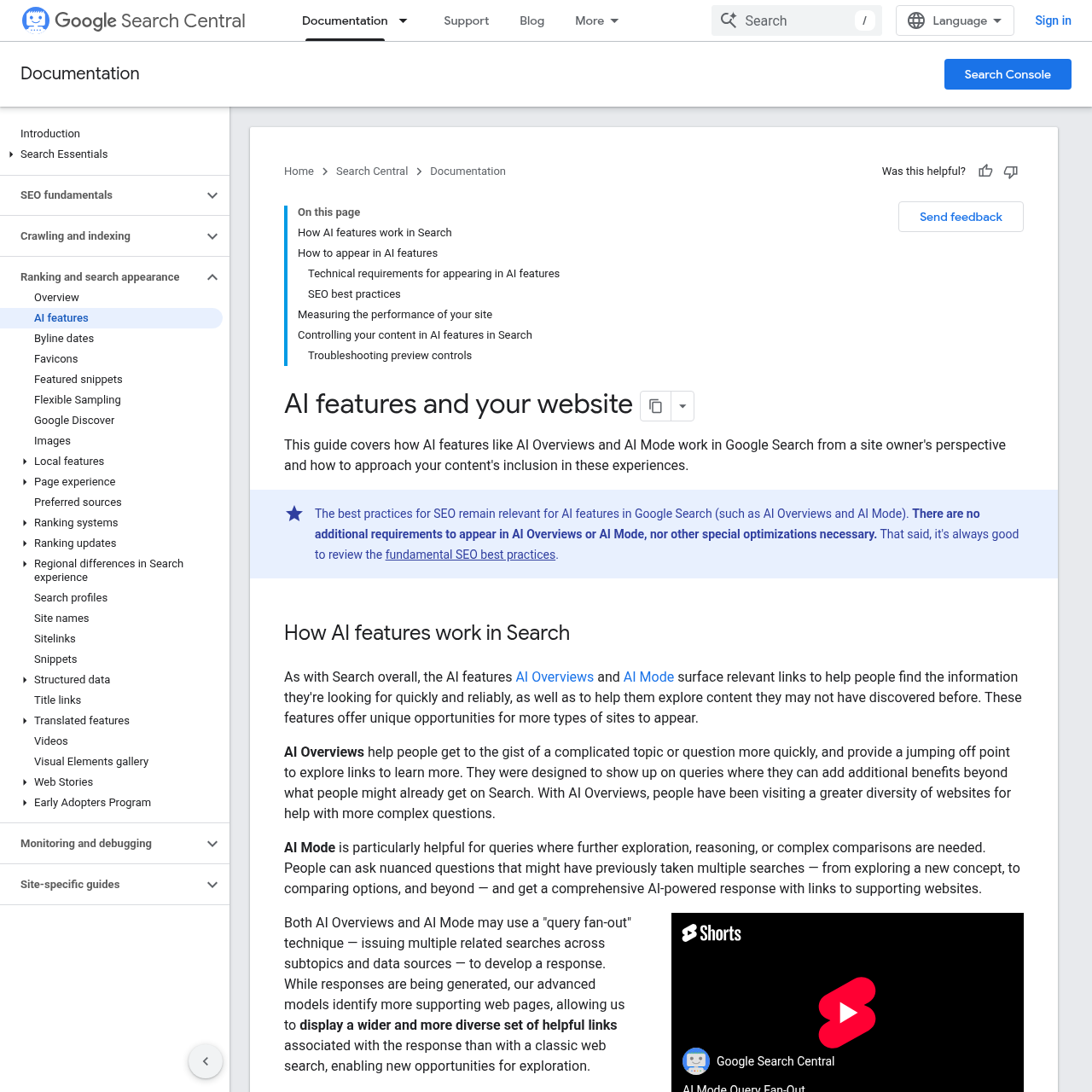
The official Google Search Central documentation on AI features in Search, updated on December 31, 2025, brings together the technical criteria for a page to become a source for AI Overviews and AI Mode.
Google Search Central maintains a page called "AI features and your website," updated on December 31, 2025, which explains how AI Overviews and AI Mode work from the perspective of content publishers. It isn't an announcement of a new product: it's the consolidation, in a single document, of criteria that already applied, scattered across other Google help pages. For those who do technical SEO, it's the closest thing to an official GEO (generative engine optimization) checklist the company has published.
The guide's central message is direct: there's no special optimization to appear in AI Overviews or AI Mode. What exists are the same SEO fundamentals as always, now with one more gatekeeper in front. If a page doesn't pass the basic technical requirements for Search, it structurally doesn't make it onto the list of candidates that feed AI-generated answers.
How it works under the hood: query fan-out and the difference between the two features
The document describes the "query fan-out" technique: when putting together an answer, Google's models fire off parallel searches on subtopics and related sources, and the final answer is composed from that set. This explains why pages that would never appear for a direct query can become a source for an AI Overview: they answer one of the internal subqueries, not the user's literal question.
AI Overviews and AI Mode use different models and techniques, and that changes what each one returns. AI Overviews only triggers when Google's system judges that it adds value over the traditional result, which means most searches still don't get one. AI Mode is geared toward queries that call for comparison, deeper research, or several questions in sequence. Google states that both features can use the query fan-out technique, without detailing whether there's a difference in scope between them.
| Feature | When it appears | Technique used | Extra technical requirement |
|---|---|---|---|
| Traditional Search | Whenever the page ranks for the query | Standard indexing and ranking | None beyond general Search requirements |
| AI Overviews | When the system judges it adds value over the traditional result | Synthesis of indexed content, sometimes with query fan-out | Page indexed and with a snippet shown in Search |
| AI Mode | In queries that call for comparison, research, or several questions | Query fan-out, multiple subqueries | The same: indexing and snippet |
The only technical requirement that really matters
According to the guide, for a page to appear as a supporting link in AI Overviews or AI Mode, it needs to be indexed, show a snippet in Google Search results, and meet the general technical requirements for Search. The text is explicit: there's no additional technical requirement beyond these three points.
In practice, this shifts the focus for those who invest in GEO. Instead of looking for a schema or a meta tag exclusive to AI, which doesn't exist, the work is to make sure the page already performs well in traditional Search. Whoever doesn't appear in normal search results has no chance of appearing in AI-generated answers, because the pipeline uses the same indexing base.
Google's eight-point checklist
The document lists the SEO practices that still apply, which work as the practical GEO checklist cited in the guide:
- Make sure crawling is allowed both in
robots.txtand at the CDN or hosting infrastructure level (a WAF or bot management rule can block Googlebot even with a correctrobots.txt). - Keep content accessible from the site's internal links, without relying only on a sitemap.
- Provide a good page experience (Core Web Vitals, usability, no aggressive interstitials).
- Present important content in text format, not only in image or video.
- Support the text with quality images and videos, when it makes sense.
- Keep structured data consistent with the text that actually appears on the page.
- Keep Merchant Center and Business Profile information up to date, when applicable.
- Verify the site in Search Console to quickly identify and diagnose technical issues.
The item about structured data deserves extra attention: the guide doesn't just ask for the schema to exist, it asks for it to match the visible text. A FAQPage or Product with values that differ from what's written on the page is the kind of inconsistency that can cost presence in both the traditional snippet and AI Overviews.
Measuring the impact: the Search Console "Web" report
Pages that appear in AI Overviews or AI Mode show up in the Search Console performance report filtered by the "Web" search type, together with traditional results. According to the document itself, there's no separate filter just for appearances in AI features within Search Console. Google also states that clicks coming from pages with AI Overviews tend to be of higher quality, with users staying longer on the site.
In practice, this is a measurement limitation worth naming: without native segmentation, anyone who wants to isolate the effect of AI Overviews needs to cross-reference Search Console impressions and clicks with analytics tools that capture time on site and conversion, and infer the pattern from behavior changes (high impressions, low clicks, usually indicates the answer already came ready-made in the Overview itself). It's an indirect reading, not data that Google hands over ready-made.
Controlling what AI shows, or stops showing
Googlebot's access for Search purposes, including AI features, is controlled by the same robots.txt directives as always. To limit what appears in the snippet shown in results, including what feeds AI Overviews, the guide points to the nosnippet, data-nosnippet, max-snippet, and noindex directives. To restrict AI training and grounding in other Google systems outside of Search, the page points to the Google-Extended documentation.
When these directives are implemented and the content still appears in AI features, the guide suggests a three-step roadmap:
- Confirm that Googlebot is actually seeing the directive, using the URL Inspection tool to check the HTML Googlebot captured on the page.
- Allow time for recrawling: Google decides on its own how often to revisit each page, and that can take anywhere from a few days to several months; it's possible to request a new crawl to speed it up.
- If the problem persists even after that, open a post in the Google Search Central help community.
What remains open for those who do GEO
The guide makes clear what Google requires, but it doesn't offer any new lever: there's no tag, schema, or exclusive signal to influence AI Overviews or AI Mode beyond SEO fundamentals. That's good for those who already invest in performance and solid content, and bad for those who were hoping for a specific technical shortcut for GEO.
It also remains unanswered how to separately measure the volume of traffic coming from each AI feature, since everything falls into the same "Web" bucket in Search Console. And the warning about CDN and hosting infrastructure blocking Googlebot regardless of robots.txt is a useful reminder for platform teams: edge security rules, designed to block malicious bots, sometimes take down the very crawler that feeds AI Overviews along with them.
Translated from the Brazilian Portuguese original · Read the original
Schema.org 30.1 changes the vocabulary: what to adjust in your JSON-LD
Schema.org version 30.1, released in September 2026, promoted terms, retired old properties, and opened up new vocabulary. Anyone using JSON-LD for rich results and to appear in AI answers has concrete items to review.