Schema.org 30.1 changes the vocabulary: what to adjust in your JSON-LD
Schema.org version 30.1, released in September 2026, promoted terms, retired old properties, and opened up new vocabulary. Anyone using JSON-LD for rich results and to appear in AI answers has concrete items to review.

Schema.org version 30.1, released in September 2026, promoted terms, retired old properties, and opened up new vocabulary. Anyone using JSON-LD for rich results and to appear in AI answers has concrete items to review.
Schema.org published version 30.1 of the vocabulary on September 16, 2026, according to the project's official release changelog. It's not a dramatic announcement: it's the kind of incremental update that slips by unnoticed in the daily rush, but that decides whether a Product, an Event, or an Offer continue to be read correctly by whoever consumes structured data, from Google's rich results to the systems that feed answers from generative search engines.
The problem with ignoring these changelogs is that schema.org doesn't individually notify you when it deprecates a property your site has used for years. It just marks the term as pending, then as "attic" (retired), and moves on. Whoever doesn't track the release list accumulates JSON-LD with dead fields, which at best are ignored and at worst generate silent validation errors.
What's New in Version 30.1
Version 30.1 concentrated effort on two fronts, according to the changelog: e-commerce and product traceability. For e-commerce, the properties consumerNotice, isOftenBoughtWith, and specification arrived, all for use in Product, along with valueGroup in PropertyValue, itemPopularity in Offer, and minimumOrderValue in ShippingRateSettings. The enumeration value MaximumRetailPrice in PriceTypeEnumeration also came in.
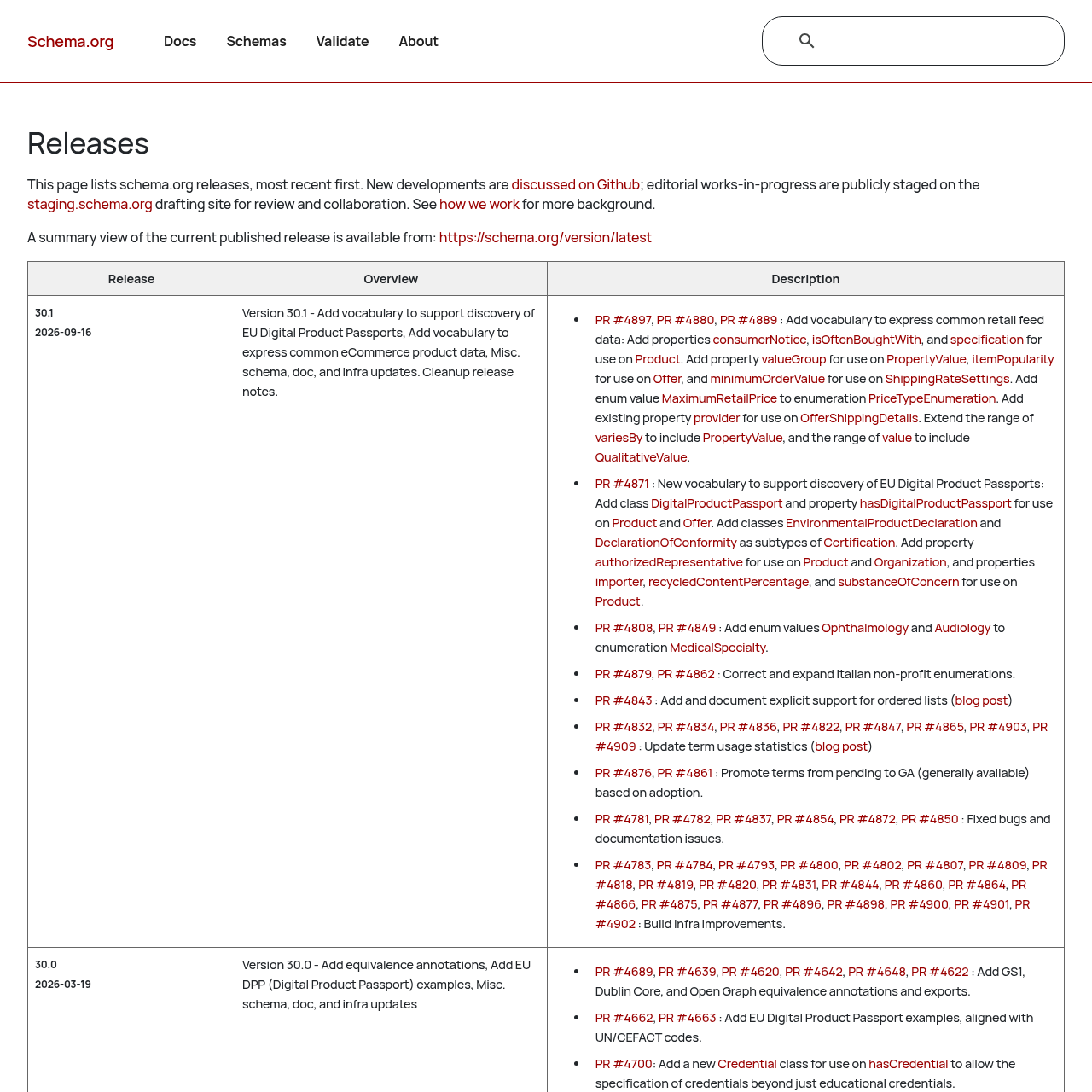
The second front is regulatory: support for discovery of the European Union's Digital Product Passport (DPP). This brought the DigitalProductPassport class and the hasDigitalProductPassport property, usable in Product and Offer, along with EnvironmentalProductDeclaration and DeclarationOfConformity as subtypes of Certification, and properties like authorizedRepresentative, importer, recycledContentPercentage, and substanceOfConcern in Product.
For anyone selling into Europe, this isn't cosmetic: the Digital Product Passport is part of a European Union regulatory agenda focused on product traceability, and marking up this data now in Product is the kind of work that pays off to do ahead of time, while adoption is still low and competitors haven't finished adapting.
Reclassifications: From 'Pending' to GA
The point that goes most unnoticed is the promotion of terms from pending to GA (generally available), recorded in PRs #4876 and #4861 of the changelog. In the Schema.org vocabulary, every new term is born as pending: it exists, it can be used, but it's still under adoption review before becoming a stable part of the specification.
In short: a pending term is a bet, not a guarantee; a GA term already has a track record of real-world use backing the promotion. This matters for whoever decides where to invest markup effort: properties newly promoted to GA in this 30.1 are the ones most likely to remain stable in the coming years, because they passed the adoption threshold that the changelog itself cites as the criterion.
The changelog doesn't individually list which terms migrated status in this specific promotion (it only references the PRs), which is a real transparency gap in the process. In practice, the way to confirm the current status of a specific term is to check its page on schema.org and look for the pending annotation versus its absence.
What Was Deprecated and Needs to Come Out of Your JSON-LD
More important than what came in is what went out. Recent versions of the vocabulary retired types and properties that still show up in older implementations:
| Deprecated Term | Version | Recommended Replacement |
|---|---|---|
DeliveryTimeSettings | 29.0 (Mar 2025) | ShippingConditions |
shippingSettingsLink | 29.0 (Mar 2025) | removed, no direct replacement |
shippingLabel | 29.0 (Mar 2025) | removed, no direct replacement |
transitTimeLabel | 29.0 (Mar 2025) | removed, no direct replacement |
GraphicNovel | 29.4 (Dec 2025) | SequentialArt |
The swap of GraphicNovel for SequentialArt is a textbook example of the kind of reclassification Schema.org has been doing: the new type is a subtype of both VisualArtwork and Book, which better describes the hybrid nature of comics and graphic novels than the old type did. Anyone still marking GraphicNovel in the JSON-LD of a publishing catalog needs to migrate to SequentialArt before the old term drops out of circulation for good.
There's also a less visible structural change: 30.0 (March 2026) altered Quantity to inherit from DataType instead of Intangible. This doesn't break existing markup, but it changes how validators and parsers position the type in the hierarchy, something that affects tools that do type inference by inheritance rather than exact checking.
New Types That Open Up Markup Opportunities
Beyond patches and deprecations, the vocabulary gained entirely new types in the latest releases, worth considering even without regulatory obligation:
ConferenceEvent, a subtype ofEvent, withhasParticipationOfferandhasSponsorshipOffer(29.4, Dec 2025): useful for anyone organizing or promoting technical events who wants to mark up tickets and sponsorship separately from the generic event.PerformingArtsEvent, another subtype ofEvent(29.4): more granular than marking everything as a plainEvent.OperatingSystemandRuntimePlatform, subtypes ofSoftwareApplication(29.4): relevant for anyone documenting software compatibility who today just uses free text inoperatingSystem.MemberProgramandMemberProgramTier(28.0, Sep 2024): for marking up loyalty programs in a structured way, with tiers and benefits viahasTierBenefit.Credential, more generic than the old model restricted to educational credentials (30.0, Mar 2026).
None of these types are mandatory. The decision to adopt them is the same as always in technical SEO: it's worth the effort if the entity being described is central to the business and if direct competitors are already doing richer markup.
The Republication Checklist
For anyone maintaining JSON-LD in production, the checklist after this batch of releases looks like this:
- Run a search of your source code for
GraphicNovel,DeliveryTimeSettings,shippingSettingsLink,shippingLabel, andtransitTimeLabeland replace them with the current types. - Validate the JSON-LD of
ProductandOfferwith a validator that recognizes schema.org 30.1 (Google's Rich Results Test doesn't necessarily track the latest version of the vocabulary in real time). - For catalogs selling into the European Union, consider including
hasDigitalProductPassportahead of the regulatory requirement. - Review whether
Quantityis used in any custom validation that depended on the old hierarchy (Intangible). - Measure, before and after republication, rich results coverage in Google Search Console (enhancements report) and citation rate in AI search tools that expose this metric.
Why This Connects to GEO
The Schema.org changelog doesn't mention generative search engines: it's vocabulary documentation, not ranking documentation. But the logic behind adopting structured data for generative AI is the same as always, just with one extra factor. Systems that summarize the web to answer questions tend to prefer sources where the entity is already disambiguated: a Product with DigitalProductPassport and structured specifications is easier to cite accurately than a free-text paragraph.
This is my own reading, not a statement from Schema.org or Google: the bet that technical SEO practitioners have been making since AI-generated answers started consuming search traffic is that more granular markup reduces the chance of the entity being misread or replaced by a better-structured competing source. There's no public data from Schema.org linking vocabulary version to AI citation rate, so the only way to validate this in your own case is to measure before and after republication, with the same pages, over the same period.
Editor's note: the code in this section was not run in a real environment. Validate before using in production.
Example of updated JSON-LD for a product using the new DPP and e-commerce terms from 30.1:
{
 "@context": "https://schema.org",
 "@type": "Product",
 "name": "Camiseta técnica modelo X",
 "consumerNotice": "Produto sujeito a devolução em até 30 dias",
 "hasDigitalProductPassport": {
 "@type": "DigitalProductPassport",
 "url": "https://exemplo.com/dpp/produto-x"
 },
 "isOftenBoughtWith": {
 "@type": "Product",
 "name": "Short técnico modelo Y"
 }
}
The real payoff of tracking these changelogs isn't staying trendy with the newest vocabulary: it's not carrying deprecated properties for years that stop being interpreted by whoever consumes the data, whether that's a Google rich result or an agent summarizing the page to answer a user.
Source: Schema.org, Release Notes (official vocabulary version changelog): https://schema.org/docs/releases.html
Translated from the Brazilian Portuguese original · Read the original
Search Console Still Doesn't Separate Clicks from AI Overviews: Here's What to Measure in the Performance Report
Official Google Search Central documentation confirms: AI Overviews and AI Mode clicks and impressions remain lumped into the Web search type in the performance report, with no dedicated filter. Here's how to approximate measurement anyway.