Agentic engineering can make viable businesses that software costs used to block

- Reading
- 6 min
Business areas keep making choices based on what they've learned about development timelines and costs. I argue that leadership should set aside time and budget to examine the needs that were left out, especially those that never received an estimate.
A company decides not to launch a new service because the expected return doesn't justify the investment in software. The decision makes sense at that moment. But it loses all the value capture of the following years due to the lack of clarity in turning a real need into a request that decision-makers can actually evaluate.
Other opportunities don't even get as far as receiving an estimate. Business areas know how hard it is to get space in the technology queue and stop proposing what they believe will be too expensive to execute.
This is the invisible backlog: needs that operations notice every day, but that haven't yet taken enough shape to be evaluated as an investment. In it are costs the company has learned to absorb and opportunities it has stopped pursuing.
I see in agentic software engineering a reason to revisit these choices. Artificial intelligence agents are reducing the work needed to specify and develop a solution.
The cost of reaching a decision
Before approving a project, a company needs to make the rules of the work explicit and uncover exceptions that often only appear during execution. It also needs to know which systems the solution will depend on and how much it will cost to keep it running.
This survey work depends on people who already have other priorities. The business area knows the difficulty, but isn't always able to describe it well enough to allow for an estimate. Engineering has to rebuild the context before it can assess viability.
The best-defined demands manage to compete for budget. Others, potentially relevant, get left out because the effort to detail them seems too great. The portfolio that leadership reviews contains only the share of needs that managed to reach it. Much of this is a symptom, not a lack of discipline. See the chart below:
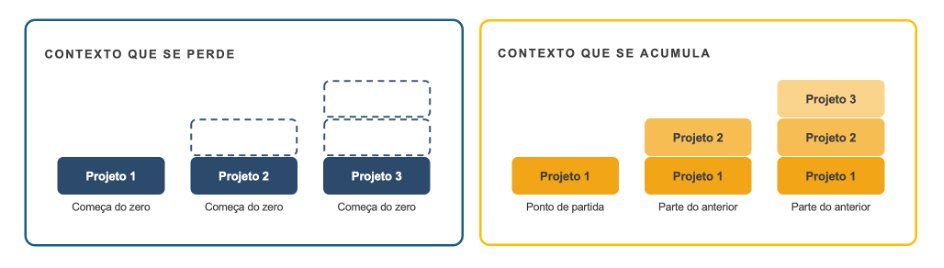
Chart 01 shows the effort involved in getting a new project up and running in most companies. Each project starts from zero, without actually carrying over in a structured way all the context from previous projects. When the project ends or the person leaves the company, what was learned goes with them. In the second case, on the other hand, context accumulates over time. Rules, decisions and tests get recorded, and the next project builds on them.
Agentic engineering amplifies what it finds. With context and method, AI agents carry out parts of the specification and development work, with human validation of decisions and results. A prototype helps whoever works in operations point out a misunderstood rule before the company commits resources to building it. The specification records what was discussed and gives engineering a basis for estimating the work.
The result can be a decision not to build. And that's fine! Finding out early that an integration makes the numbers unworkable saves time and money. The problem is finding out the real cost of that after it has gone into production.
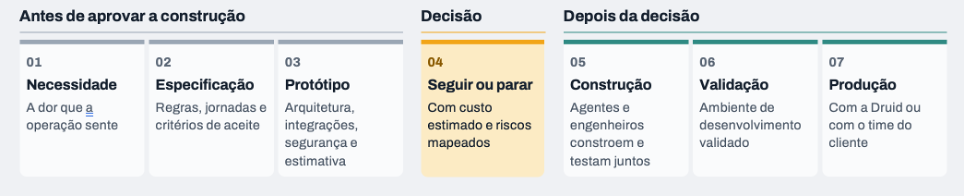
An application built with the support of agents can work with conventional rules. Using artificial intelligence in engineering and embedding it into the product are different decisions.
The change in the math of building software
In the McKinsey survey The state of AI in 2026, 32% of respondents said their organizations decided not to buy at least one piece of software or feature because they could build it in-house, either with the internal team or together with a strategic partner.
My reading is that the build-versus-buy review also needs to reach the needs that were never even evaluated. Right now, the capacity to build is arriving much faster than the capacity to decide, based on what to build. It's worth redoing the math on a project considered too expensive when the effort to specify and develop its solution goes down.
At a telecom carrier served by Druid, customers depended on customer support to top up their accounts, switch plans or block their lines. There was no portal to give them that autonomy. This dependency limited bulk SIM card sales and customer retention. A six-month development estimate kept the portal from moving forward.
If selection criteria stay the same, the company may simply execute the portfolio it already had faster, while leaving these opportunities with no progress.
Buying a ready-made solution can make sense when it meets the need at a cost that would be hard to reproduce in-house. The cost of integrating and maintaining the software needs to be part of that math, from functional specification through to architecture.
Use case: amplification with the right actionable item
In another Druid project, the challenge was turning an archive of nearly 200,000 documents into a searchable database. The files were in various formats, spread across tens of thousands of folders, with no standard and no integration. Simply asking any AI model to catalog them, without method or context, could only multiply the problem.
The documents served to prove compliance with an important regulatory requirement, but every query required locating the file and reading its content by hand. To propose a solution, it would be necessary to know the documents and determine what data to extract and how to validate it. Without that, it was hard to demonstrate the project's return, and the query process remained manual.
Having a clear objective made the work done with the support of agents far more productive. By creating and documenting the entire context, the solution was prototyped with the full knowledge base and triggers for generating actionable items. The team can review processed records and correct fields, with a history of changes. A new automated processing run preserves the corrections made by people and keeps the originally extracted value on record.
That way, whoever has already reviewed a document doesn't need to redo the same correction with every processing run. Delivery into production took place 20 days after the specification was approved.
The invisible backlog on the executive agenda
The investment to automate comes with a value and a timeline. Manual work usually consumes a team that's already been hired. This invisible queue isn't invisible to everyone, since it shows up in the day-to-day for some people and disappears from the company's decision-making and integration agenda. The comparison stays incomplete when a company requires a justification to build, but doesn't estimate the resources it will keep consuming if it keeps the current process.
It's up to the business area to explain the expected effect and take responsibility for delivering it. Engineering should be involved from the start, including the cost of maintaining the new software in that assessment.
The documented rules and tests also remain available for future projects. When a related need comes up, the company can build on what it has already learned.
Business areas keep making choices based on what they've learned about development timelines and costs. I argue that leadership should set aside time and budget to examine the needs that were left out, especially those that never received an estimate. The decision about what deserves to be built needs to take into account current development conditions.
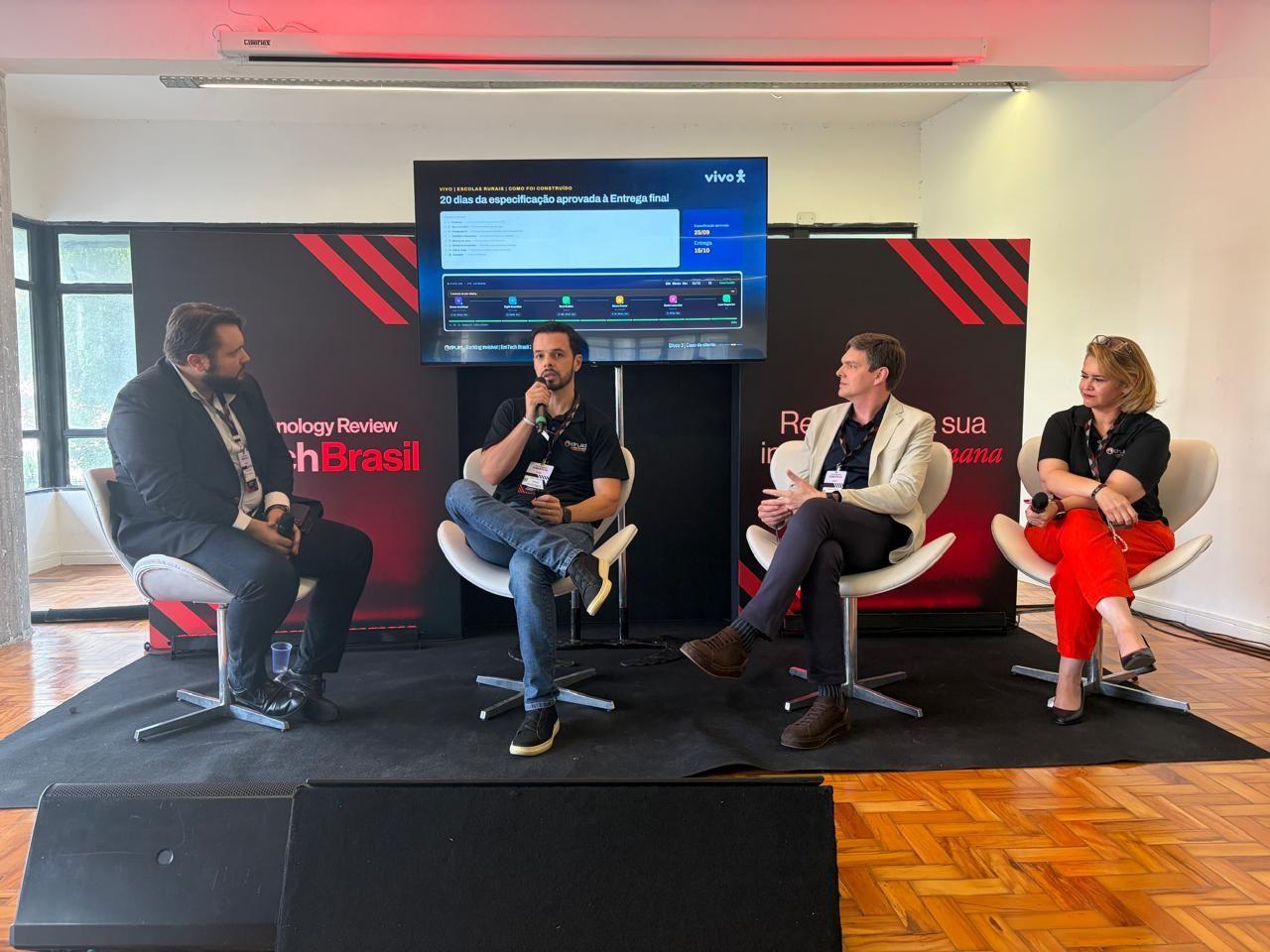
This article builds on the discussion presented by Danilo Fernandes and Michelle Ferreira in the masterclass on the invisible backlog at EmTech Brasil 2026, by MIT Technology Review Brasil.
Translated from the Brazilian Portuguese original · Read the original

This week, it's Anthropic, not Nvidia, that rules the stock market
Wall Street may be changing the address of its biggest bet on artificial intelligence.