

The most common mistake in corporate AI: starting with AI. And how to avoid it?

There's a mistake we see repeated in many corporate AI initiatives: starting with AI.
The company decides it needs GenAI, copilots or agents, and only afterward starts looking for where to fit them in. Dozens of use cases, pilots and technologically interesting demonstrations emerge, but they aren't always connected to the business's most relevant problems.
Here attheGarage IA, an AI-focused consultancy, we do exactly the opposite. We don't start by asking where to put AI. We start by asking where the company needs to improve its results.
And we do this together with the client, not for the client. This is an important principle of our model. The organization itself is the one that deeply knows its strategy, processes, constraints and particularities. Our experience comes in to provoke, structure, challenge assumptions, bring methodology and turn that knowledge into concrete opportunities for improvement.
Our approach draws on decades of experience accumulated by the company and its professionals in business transformation, process redesign, operational optimization and strategic use of technology. Long before the current wave of generative AI, companies already needed to eliminate bottlenecks, reduce rework, integrate systems, organize data, improve decisions and redesign processes.
AI extraordinarily expands the possibilities for intervention. But it doesn't repeal the fundamentals of good business transformation.
That's why we start with strategic alignment. Together with the client's leadership, we understand priorities, competitive challenges, economic and operational objectives, and where the organization intends to go.
From there we do a true X-ray of the main processes. And again, this diagnosis is built with those who live these processes daily. We look for bottlenecks, high costs, manual activities, rework, waiting times, quality problems, scaling difficulties, decisions that could be better, and relevant growth opportunities.
First we find the problem and the potential value. Then we decide whether AI is really the best answer.
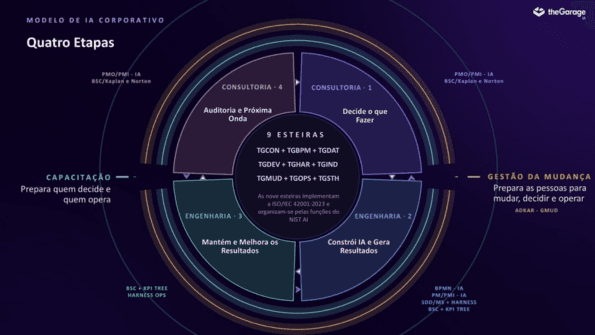
This is the first stage of our model, which helps decide what deserves to be done.
Opportunities are jointly assessed by potential impact, feasibility, data availability and quality, risks, dependencies, complexity, investment and the ability to produce measurable results.
And there's an important point. Not every problem needs generative AI. Much less agents. In certain situations, predictive or classification models, optimization, conventional automation, traditional software or simply process redesign can be more suitable, economical and reliable alternatives.
Technology comes in after the problem is sufficiently understood, not before.
Prioritized initiatives then move on to the second stage, Engineering. This is when the value hypothesis needs to be turned into an operational solution.
Here too we work side by side with the client's teams. We don't simply aim to deliver a ready-made solution and leave. Joint construction allows business knowledge to be incorporated into the solution and, at the same time, develops within the organization the capacity needed to operate, evaluate and evolve what is being built.
This includes architecture, models, data, integrations, systems, security, identity, tools, testing, observability and, when it makes sense, agents and their respective harnesses.
But putting a solution into production doesn't end the work. In practice, another phase begins.
The third stage focuses on maintaining and improving results. Together with the client, we track indicators, costs, quality, behavior, exceptions and process performance.
A pilot can work very well in a controlled environment and lose part of its appeal when it encounters volume, real users, legacy systems, exceptions, latency, inference costs and situations that weren't anticipated in the demonstration.
That's why production isn't simply a bigger pilot. The cycle then reaches the fourth stage, dedicated to auditing results and defining the next wave.
What proved its value can be expanded. What showed potential but encountered obstacles can be redesigned. And what didn't economically justify its continuation should be able to be discontinued.
There's no merit in keeping an AI initiative simply because it uses AI.
At the center of this cycle are the nine tracks of our model, which organize the different disciplines needed to turn isolated initiatives into a corporate AI capability.
Around the entire model there are also two indispensable components. Training, because it's not enough to build technology. Those who decide and those who operate need to be prepared. And change management, because AI doesn't just change systems. It changes processes, responsibilities, competencies, ways of deciding and, in some cases, the very organization of work.
This is also why joint construction with the client is so important. The goal isn't to create dependency on the consultancy, but to leave capability inside the company. Knowledge, methods, governance and experience need to remain in the organization after each initiative ends.
Our approach, therefore, doesn't seek to build a collection of use cases or indiscriminately place agents in every department.
Together with the client, we start from strategy, understand the processes, identify where value exists, choose the appropriate technological approach, build, put into production, measure results, learn and return to the business.
It's a continuous cycle. The experience accumulated over decades of process redesign and business optimization taught us something that remains absolutely valid in the age of AI.
Technology doesn't transform companies on its own. What transforms companies is combining business knowledge, process redesign, people and the right technology to produce better results.
AI enormously expands what we can do. Our job, together with the client, is to discover what really deserves to be done and build the capacity to keep doing it better.
Translated from the Brazilian Portuguese original · Read the original