Kimi K3.1 Pro joins Vercel's Token Pass with 1M-token context for coding agents
Vercel added Kimi K3.1 Pro, from Moonshot AI, to Token Pass, a credit package for running coding agents via AI Gateway in tools like Cline and Command Code.


- Reading
- 5 min
- Tables
- 1
- Code
- 1
Vercel added Kimi K3.1 Pro, from Moonshot AI, to Token Pass, a credit package for running coding agents via AI Gateway in tools like Cline and Command Code.
Vercel updated Token Pass, its credit subscription for coding agents, adding Kimi K3.1 Pro to the list of available models. The announcement is on Vercel's official changelog and credits the addition to Zachary Chen and Jonathan Simcoe. The model comes from Moonshot AI, which already had Kimi K3 in the same package, and arrives as the most capable version of the family for coding and agentic workflows, with support for vision, tool use, and a 1-million-token context window.
For those developing with AI Gateway, this means one more model in the selector, without having to switch integrations, manage a separate API key, or rewrite the system prompt. That's exactly Token Pass's promise: a single billing and access channel for multiple providers, with routing and usage metering handled by Vercel itself.
What Token Pass actually is
Token Pass is an "Early Access" subscription for teams on Vercel's Pro plan. For $30 per team per month, the team receives $150 in monthly credit to spend on coding agents connected to AI Gateway. This covers tools like fx, Pi, Cline, and Command Code, as well as agents built with Vercel's own AI SDK.
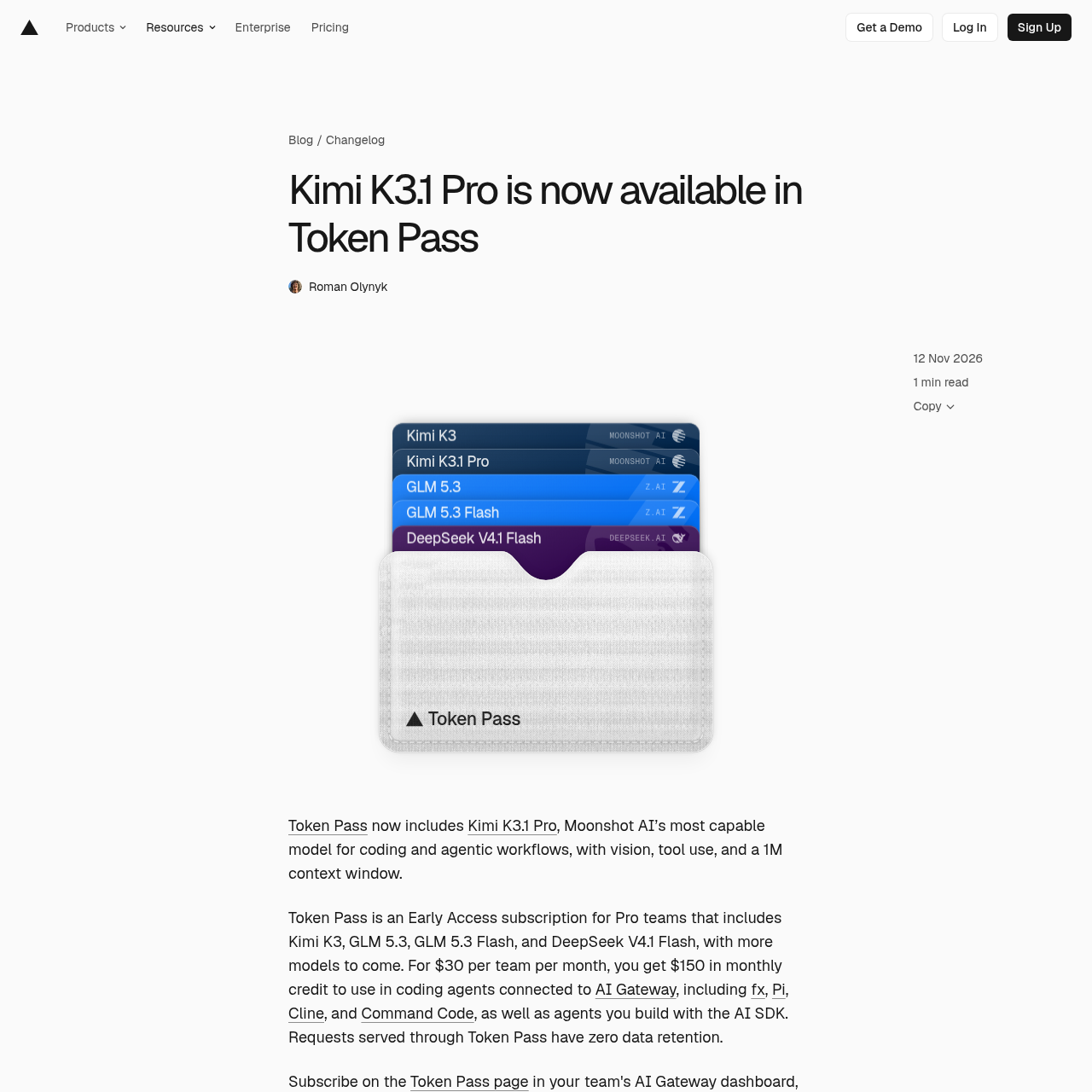
Before Kimi K3.1 Pro was added, the package already included four models:
| Model | Provider | Role in the lineup |
|---|---|---|
| Kimi K3 | Moonshot AI | Base model of the family |
| GLM 5.3 | Z.ai | Main model of the GLM lineup |
| GLM 5.3 Flash | Z.ai | Fast/economical version |
| DeepSeek V4.1 Flash | DeepSeek.ai | Fast/economical version |
Kimi K3.1 Pro slots in right below Kimi K3 and above GLM 5.3 in Token Pass's lineup, according to the changelog's own illustration, which shows the K3.1 Pro card positioned in that order.
Why 1M-token context matters for agents
A coding agent doesn't just read the file you're editing: it needs to load conversation history, tool output (grep output, git diffs, build logs), and, ideally, relevant snippets from the entire repository to decide its next step. The smaller the context window, the sooner the agent starts to "forget" decisions made just a few steps earlier, or has to truncate large files before analyzing them.
A 1-million-token window leaves room to keep almost an entire mid-sized repository in memory, plus the session history and the output of several tool calls, without resorting to intermediate summaries. This matters most for tasks like broad refactoring, security audits across multiple files, or migrating an API used in dozens of places, scenarios where the agent needs to "see" the whole project so it doesn't break something outside the immediate scope.
In practice, this doesn't guarantee reasoning quality: a large context helps the model have information available, but it doesn't replace a good system prompt or curating what actually goes into that context. Tools like Cline already handle part of that work, selecting files and trimming diffs before sending them to the model.
How to select the model in practice
The flow described by Vercel is straightforward: anyone who already has Token Pass subscribes to the offering on the corresponding page, inside the team's AI Gateway dashboard, and then selects the model in the connected agent's selector. The model's identifier in AI Gateway is:
moonshotai/kimi-k3.1-proIn an agent built with the AI SDK, the swap usually comes down to pointing that identifier in place of the previously used model, without changing the rest of the tool integration, since AI Gateway standardizes the call interface across providers. For those using Cline as an editor extension, the swap is even simpler: just choose the model in the extension's selector, which already appears listed once the account is connected to AI Gateway with Token Pass active.
What changes (and what doesn't) for existing AI Gateway users
Zero data retention is the clause that matters most to anyone working with proprietary code: according to Vercel, all requests made through Token Pass have zero retention, meaning the content sent to the model isn't stored for training or later auditing by the provider. This removes one of the main obstacles to using third-party models, especially foreign ones, on company code.
What doesn't change is that the offering remains restricted to teams on Vercel's Pro plan; anyone who needs Kimi K3.1 Pro outside that umbrella would have to contract Moonshot's API directly. The changelog also doesn't provide benchmark numbers, latency, or per-token cost for the model on its own, so comparing performance against competitors like Claude or GPT remains something each team needs to measure in its own workflow before switching default models.
When it's worth a look
It makes sense to test Kimi K3.1 Pro via Token Pass for teams that already pay for the subscription and run agents on tasks that need a wide context window, such as reviewing a large pull request or generating tests for an extensive module. For those with low agent usage or who already have a fixed model well-tuned to their own system prompt, the addition matters less: switching models carries a recalibration cost, and the context gain only shows up when the task really needs it.
It's also worth remembering that "more context" isn't synonymous with "a better answer": filling the window with irrelevant information tends to dilute the model's focus just as much as cutting relevant information does. Fine-tuning which files and history go into each call remains the job of whoever configures the agent, not something automatically solved by window size.
Translated from the Brazilian Portuguese original · Read the original
Why the 12-column grid shouldn't be the automatic default for every layout
A recently published piece on CSS-Tricks argues for modular and compound grids as an alternative to the 12-column standard. For those implementing in CSS Grid, the shift is more technical than it seems.