Gemini 4 Hydrogen arrives as Google's cheapest model, but it still costs 15x more than the competition

- Reading
- 6 min
- Tables
- 1
- Code
- 1
Gemini 4 Hydrogen, launched on November 12, 2026, promises to be the budget option in the Gemini 4 family, but Google's pricing table confuses even those who follow the market closely.
Google launched Gemini 4 Hydrogen on November 12, 2026, positioning it as the cheapest member of the Gemini 4 family. The news came via Simon Willison, who on the same day published version 0.37 of llm-gemini, the plugin that provides access to the Gemini family within the llm command-line tool, which he himself authored. Willison tested the newly launched model and documented something every dev who calculates API cost should read before switching models: Hydrogen's price isn't as low as the name suggests, at least not yet.
The pricing table that confuses everyone
The Gemini 4 family has three models: Carbon, Argon, and Hydrogen. According to Willison's research, the current prices (in dollars per million tokens) are these:
| Model | Effective | Input | Cached input | Output |
|---|---|---|---|---|
| Gemini 4 Carbon | Until Nov 30, 2026 | $2.00 | $0.10 | $10.00 |
| Gemini 4 Carbon | Starting Dec 1, 2026 | $4.00 | $0.20 | $20.00 |
| Gemini 4 Argon | Same price as Carbon, in both windows | same as Carbon | same as Carbon | same as Carbon |
| Gemini 4 Hydrogen | Single price, no announced adjustment | $1.50 | $0.075 | $7.50 |
Carbon and Argon cost exactly the same today, and both are scheduled to double in price on December 1, 2026. Hydrogen, for now, has no announced pricing change.
Why do two flagship models cost the same?
If Carbon and Argon have the same price per token, the obvious question is why Google keeps the two catalogs separate. The answer, according to Google itself, isn't in the price per token, but in total consumption per task.
Argon delivers Gemini 4 intelligence with faster responses and lower token spend per turn compared to Gemini 4 Carbon.
Google, statement about the Gemini 4 family
In practice, this means the price per million tokens is the same, but Argon tends to consume fewer tokens for the same task, which lowers the final bill without changing the price table. It's a detail that only shows up when the dev measures the actual cost per call, not the standalone list price, something that makes a difference in pipelines with a high volume of requests.
Hydrogen's discount only becomes real in December
Hydrogen is sold as the family's entry-level option, but today it represents only a 25% discount compared to Carbon and Argon. That's a modest cut for a model that should be the obvious choice on cost. The math changes when Carbon and Argon's prices double on December 1, 2026: if Hydrogen keeps its current price, the discount becomes 75% relative to the two larger models.
This creates a strange window of almost three weeks in which the lineup's "cheap" model costs almost the same as the flagship models, and only actually becomes advantageous after the other two models' price change takes effect. Anyone drafting an API budget for projects running in production needs to look at the cutoff date, not just the current day's price.
Hydrogen versus Claude Haiku 5.5 and GPT-6 Luna
The contrast becomes clearer when Willison compares Hydrogen to entry-level models from other providers. Claude Haiku 5.5 and GPT-6 Luna charge $0.10 per million input tokens and $0.50 per million output tokens, according to his research. Hydrogen charges $1.50 and $7.50 for the same items.
The math is straightforward: $1.50 divided by $0.10 is 15, and $7.50 divided by $0.50 is also 15. Hydrogen costs 15 times more than Haiku 5.5 and Luna, both on input and output tokens, even though it's presented as Google's budget option. For anyone choosing a model purely by price per token, Willison's conclusion is that Hydrogen's advantage lies elsewhere, not in the price tag.
The pelican test and the cost of savings
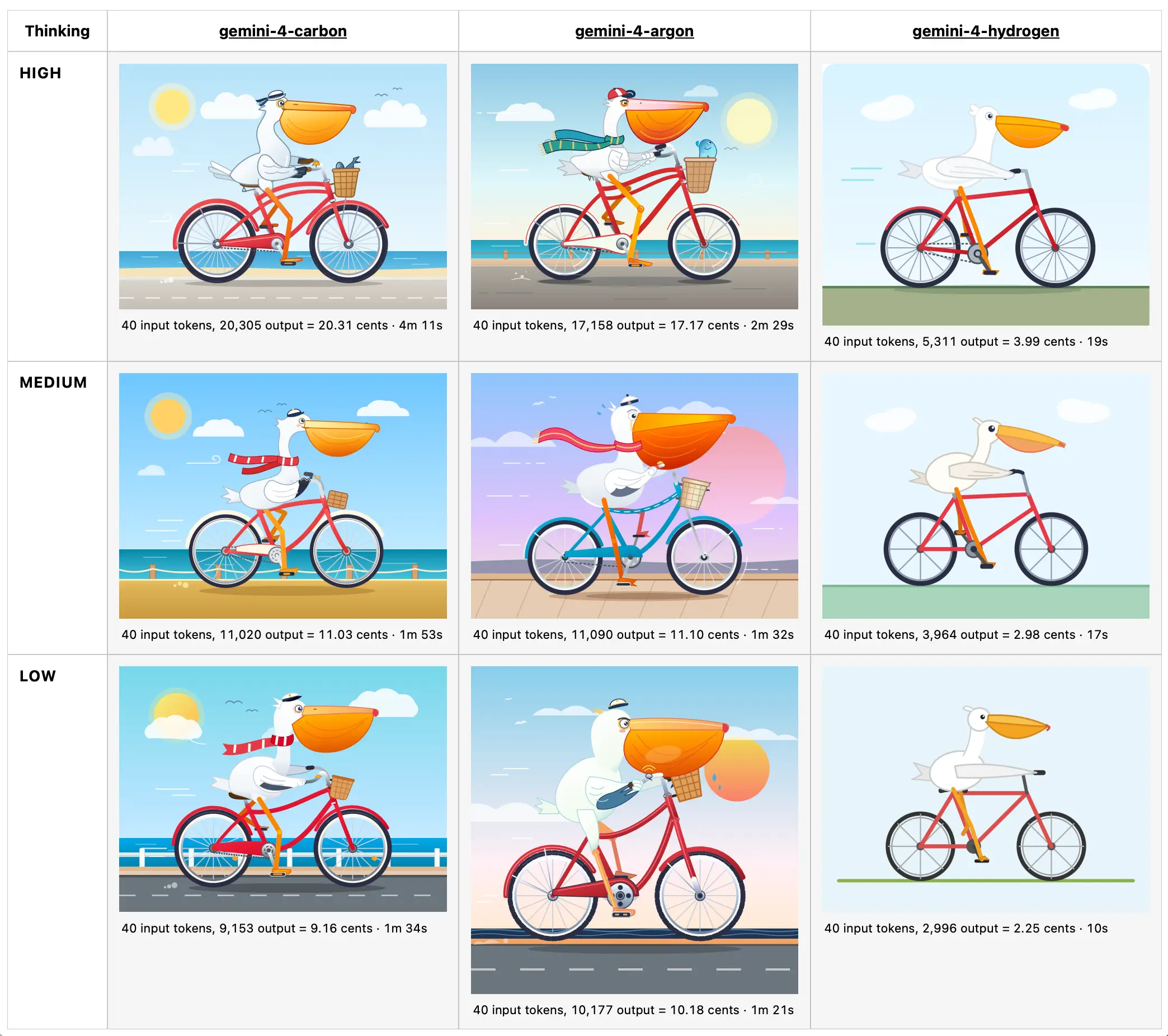
Willison uses a recurring informal benchmark in his posts: asking the model to generate an SVG of a pelican riding a bicycle, a test that doesn't rigorously measure intelligence, but exposes gross differences in capability between models. He ran the test on all three models in the Gemini 4 family, at the three effort levels each supports, and put together a comparative grid.
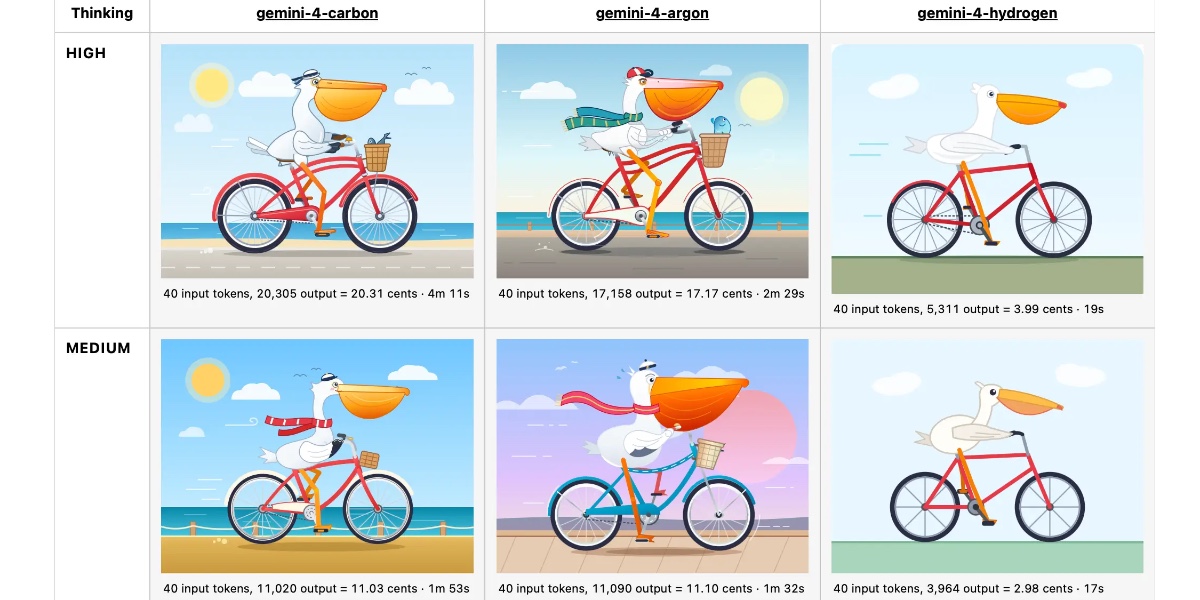
Considering how close they are in price, the difference in pelican quality for Hydrogen is quite stark.
Simon Willison, author of llm-gemini
The practical point: the 25% savings today (or even the future 75%) doesn't come for free. For tasks that require finer judgment, Hydrogen's drop in quality relative to Carbon and Argon showed up visibly in the informal test, even with the price still relatively close.
Where Google wants to position Hydrogen
Google's official positioning for Hydrogen isn't as a direct substitute for the larger models, but as a piece of a multi-model workflow:
In real-world software development, while teams rely on frontier models like Carbon and Argon for deep architectural judgment when designing systems or untangling subtle bugs, they still need a fast, disciplined execution model for writing code, running tests, and verifying changes. Hydrogen is built to stand on its own as a model for everyday work — or to pair with Carbon and Argon as the high-efficiency execution engine in multi-model workflows.
Translating that into a real workflow: Google's bet is that a coding agent uses Carbon or Argon to decide what to do and Hydrogen to execute what was decided, running tests, applying small patches, and verifying output, tasks where the cost per call matters more than depth of reasoning.
Free, but inside Search
The most relevant detail in the source for those who don't pay for API directly is different: Hydrogen is the new model for Google's free tier and also the model that will power the AI features inside Google Search. That changes the scale of the problem: it's no longer a team's budget decision, it's the model running behind the searches of billions of users, which explains why Google needs something cheaper than Carbon and Argon, even if the quality gap shows up in tests like the pelican one.
What to do with llm-gemini 0.37
For those who already use Willison's llm tool, updating to version 0.37 of the llm-gemini plugin already exposes the three models in the Gemini 4 family, including the newly launched Hydrogen. Installation follows the standard pattern for any plugin of the tool:
pip install llm
llm install llm-gemini
llm keys set gemini
llm -m gemini-4-hydrogen "resuma este changelog em três linhas"
Swapping the -m parameter to gemini-4-carbon or gemini-4-argon in the same command lets you compare output and cost side by side without rewriting the project's code, which makes it easier to measure in practice whether Hydrogen's discount offsets the quality loss for the specific task at hand, something Willison recommends doing before switching models in production based solely on the announced price.
What remains open
Google hasn't detailed whether Hydrogen's price will also change in December, nor has it published formal benchmarks confirming the quality gap suggested by the informal pelican test. Until then, the decision to use Hydrogen in production depends on testing the specific task, not on trusting the "cheap model" label: in the current scenario, it still costs 15 times more than Haiku 5.5 and Luna, and only becomes truly competitive after Carbon and Argon's prices double.
Translated from the Brazilian Portuguese original · Read the original

How Resend designs API and documentation for AI agents to choose on their own
Zeno Rocha, CEO of Resend, tells the Latent Space podcast how the company treats agents like Claude Code as a separate developer audience, from markdown documentation to an MCP server with more than 80 tools.