Gondola doubles revenue by building more products with Codex


- Reading
- 6 min
A case study published by OpenAI shows how the Gondola team, a small creator agency, used Codex to let product and business people prototype code directly, without waiting in the engineering queue.
OpenAI published a case study about Gondola, a platform that helps content creators prove the impact of their own work and turn that into new opportunities. The material, published on OpenAI's official website, describes how a small team began using Codex (the company's coding agent) and ChatGPT daily, and credits this change with a jump in productivity and revenue.
The usual caveat applies to this kind of text: it's institutional content, written by OpenAI itself to sell its product. The numbers don't come from an independent audit, and Gondola is a small company that doesn't disclose exact headcount or comparisons with competitors. Even so, the account details concrete workflows worth understanding, because they show a usage pattern that goes beyond what generative AI marketing usually promises.
The problem before Codex
Jared Kleinstein founded Gondola after noticing that social media content creators rarely got credit for the work they did for brands. The platform was created to solve that: cataloging who did what and turning that history into proof of impact.
The bottleneck, according to the account, wasn't a lack of ideas. It was engineering capacity. Any small experiment competed for time with the product's core priorities, and finding information or drafting proposals meant digging through several internal tools before producing anything at all.
Codex Cloud in the hands of non-engineers
The central change the case describes isn't "engineers got faster" (although that happens too). It's that product and business people started using Codex Cloud to explore the source code, prototype an interface or a flow, test hypotheses and, in many cases, reach a first working version before any engineer entered the process.
Jared himself and Jojo Hesketh, the company's creator and client partnerships manager, made their first code contributions this way, already merged into the product's main repository. It's not a minor detail: these are people without an engineering background writing and submitting code that becomes part of the real product.
A product manager doesn't need to stop at a written product requirement anymore. They can bring engineering a working prototype.
Jared Kleinstein, founder and CEO of Gondola
Gondola's engineers continue using Codex via the command line and editor tools to speed up implementation, and also within GitHub to review pull requests. The company connects Codex to its own repositories, development environments and Slack, so that product context feeds the development process. According to the material, architecture, security, data handling and production readiness remain the responsibility of engineers, not of Codex or of whoever prototypes.
Two concrete examples: Programs and the World Cup map
The case cites two projects built this way. The first is Programs, a tool for finding creators, reviewing candidates, managing projects and tracking budget, with future plans to cover contracts and payments. Jojo sponsored the project and prototyped the workflows in Codex before handing the material to engineers to refine and ship.
The team started with GPT‑5.4, did most of the work with GPT‑5.5 and used GPT‑6.1 for later features, optimizations and bug fixes, according to OpenAI. Jared estimates that Codex saved days, possibly weeks, of development, and that Programs launched with fewer bugs than it would have had if written manually.
The Programs feature benefited from our ability to rapidly prototype, throw away things that didn't work, and keep the things that did.
Jared Kleinstein, founder and CEO of Gondola
The second example is the World Cup Creator Map, built this year so brands, agencies and teams could find photographers and videomakers in the World Cup host cities. Before Codex, tight-deadline ideas like this one used to wait in the engineering queue until the window of opportunity passed. This time, the team turned data it already had into an experience ready on time, with Jojo again prototyping the full interface before engineers polished it for launch. Jared describes the process as "incredibly quick", attributing the result to the small, self-contained scope and the event's fixed deadline.
ChatGPT to run the operation with a lean team
The case's second front is more prosaic, but equally revealing of the usage pattern: Gondola uses ChatGPT to prepare proposals, organize schedules, locate information scattered across different systems and automate administrative tasks.
One example cited is a daily report that integrates Google Workspace (Gmail, Calendar, Sheets and Drive), plus Asana, Slack, QuickBooks and even weather information, consolidating everything into a summary that each employee uses to plan their own day. Jared says that putting this report together manually would take "hours and hours of work", but that assembling it via ChatGPT happens quickly. The material stresses that a person still reviews any relevant output before it's sent outside the company or used in a business decision, which is an important governance detail that usually disappears in this kind of account.
The numbers and what they really prove
According to OpenAI, since adopting Codex in early 2026 the monthly output of Gondola's lead engineer has risen by about 50%, measured in merged code changes. Across the whole team, the gain was about 25%, with no increase in engineering headcount. The company also says it's shipping larger changes without pull request review time getting worse, and that revenue more than doubled year over year, with no additional payroll cost or relevant overhead. Gondola also says it has helped brands hire 2.5 times more creators in the same period.
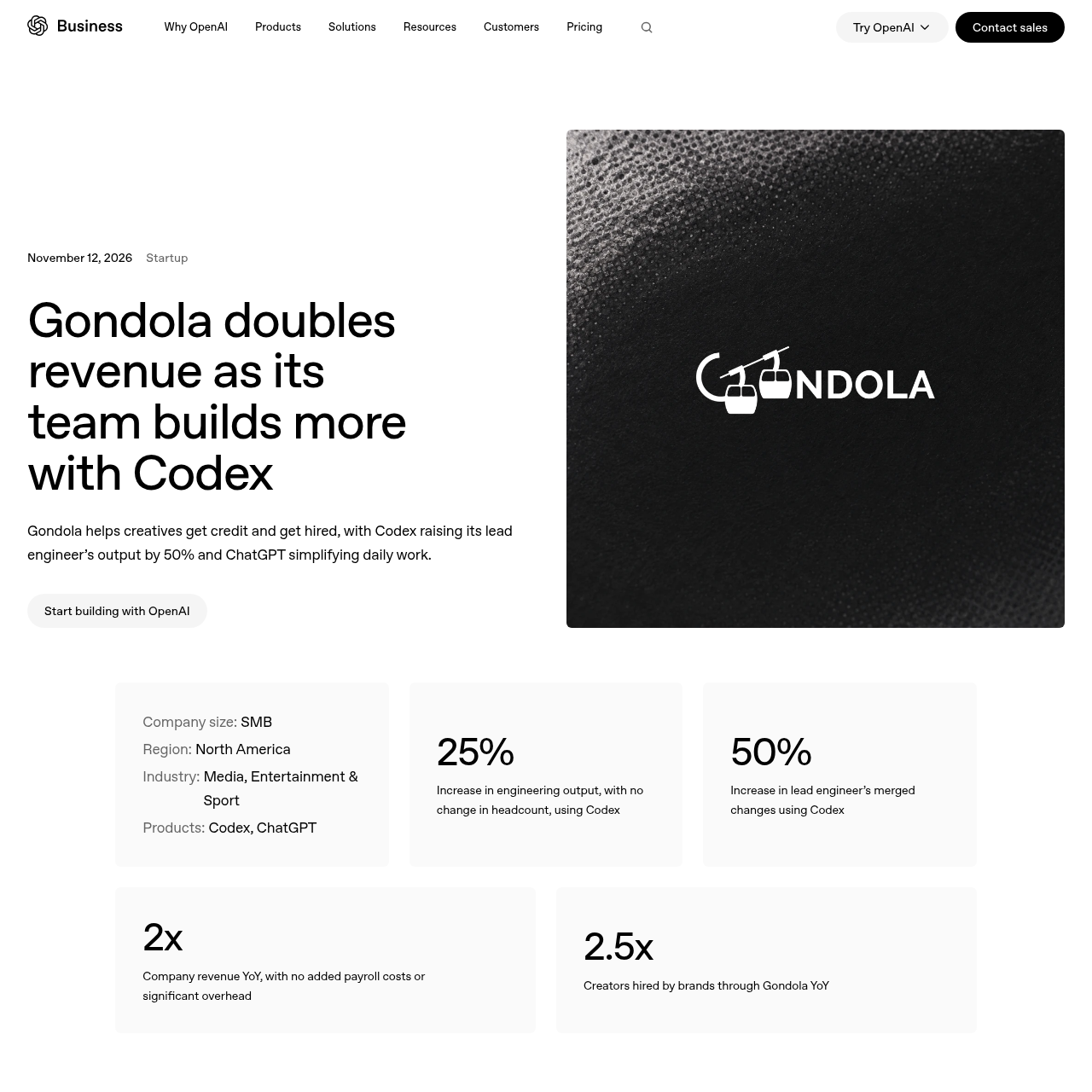
These are impressive numbers, but they need context before becoming a generalizable benchmark. "Merged changes" is a volume metric, not necessarily one of delivered value: it rises when small, automatable changes increase, which is expected when AI tools enter the picture. The correlation between Codex adoption and doubled revenue also doesn't isolate other variables, such as the growth of the creator marketing market itself or the seasonality of an event like the World Cup.
When this approach doesn't apply
Gondola's model works because the company is small, the product has a reasonably contained scope, and the founders themselves take on the risk of reviewing what gets prototyped before it goes to production. In larger teams, with older codebases, regulatory compliance requirements or multiple teams touching the same service, letting product people merge code directly into the main repository raises questions of security, architecture ownership and traceability that the case doesn't even try to answer.
It's also worth noting that the productivity gain described concentrates on prototyping and operational tasks, not on complex systems engineering: the material itself says that architecture, security and data remain with human engineers. For those leading development teams in Brazil evaluating Codex or equivalent tools, the Gondola case is a good indication of where AI-assisted prototyping shortens the cycle (business ideas become prototypes without waiting in queue), but it doesn't replace the technical review discipline that separates a prototype from a production system.
Translated from the Brazilian Portuguese original · Read the original
Gemini Decisions API enters the decision-model race with Jev and OpenAI
Gemini Decision 1 arrives as a multimodal AI option for automating binary, multiple-choice, and score-based decisions, competing for space with Jev and with OpenAI's decision model.