OpenAI details new Codex workflow at AI developer event


- Reading
- 5 min
In a workshop at the AI Engineer Code Summit, OpenAI engineers explained how cloud, voice mode, and the personal assistants called dots are changing the daily routine of Codex users.
Codex, OpenAI's coding agent, got a dedicated workshop on the first day of the AI Engineer Code Summit, an event that brought together leading labs such as OpenAI, Anthropic, and Google DeepMind. The session, titled "New Ways of Working with Codex," was led by two OpenAI Developer Experience engineers, Dominik Kundel and Charlie Guo, and covered three fronts: the maturing of Codex Cloud, the use of voice to control agents, and the still-uncertain role of dots, the company's personal assistants. The coverage comes from the Latent Space website.
Guo opened the presentation by listing everything the team had shipped for Codex since the AI Engineer World's Fair in June 2026. According to him, the list had to be trimmed to fit on the screen. "I think the team has been shipping things at an unbelievable pace," he said. The sheer volume of changes helps explain why part of the user base still gets lost trying to keep up with Codex, Claude, and Antigravity at the same time.
The tricky transition to the cloud
Codex debuted in May 2025 as a cloud-based software engineering agent capable of running multiple tasks in parallel. In practice, that promise took time to hold up. Kundel admitted it took a while for the models and the harnesses (the layer that orchestrates the agent) to mature enough to deliver a genuinely good user experience.
The turning point came after DevDay at the end of September 2026, when OpenAI announced version 2 of Codex Cloud. The announcement summed up the proposal directly: you can close your laptop and let the agent keep working. According to the workshop's official material, published on a ChatGPT Site, this version lets you publish an environment once and run multiple tasks in isolated instances of that same setup.
In short: the user chooses which GitHub repositories the environment will have access to, sets up that environment once, and can share it with the team or keep it personal. From there, each task runs in isolation, with no need to reconfigure anything.
Even so, stitching together local and cloud work still has friction. After the workshop, the article's author told Kundel that he still finds it confusing to move a task that started locally over to the cloud. His response:
We definitely want to have it be easier. Some of it is going to depend on managing the context differences. For example, yesterday what I ended up doing is I was working on something locally, and I just asked Codex to go and hand it off to the cloud.
Dominik Kundel, Developer Experience engineer at OpenAI
Kundel demonstrated this by reopening an existing cloud task and showing that Appshot, a new feature that saves an app experience inside ChatGPT, was still available there. For a task started locally, the flow would be to ask Codex to push a branch and open a new thread in the cloud. The idea, according to him, is for Codex Cloud to become just another background executor: the same local Codex instance can kick off a task in the cloud, and the two instances keep blending together.
Voice as a control layer, not just dictation
During the workshop, Kundel demonstrated live edits on a fictional website for a record label called Blossom Music, using voice dictation to iterate on the design. According to him, this is a fast way to reach a result when you don't yet know exactly what you want to build.
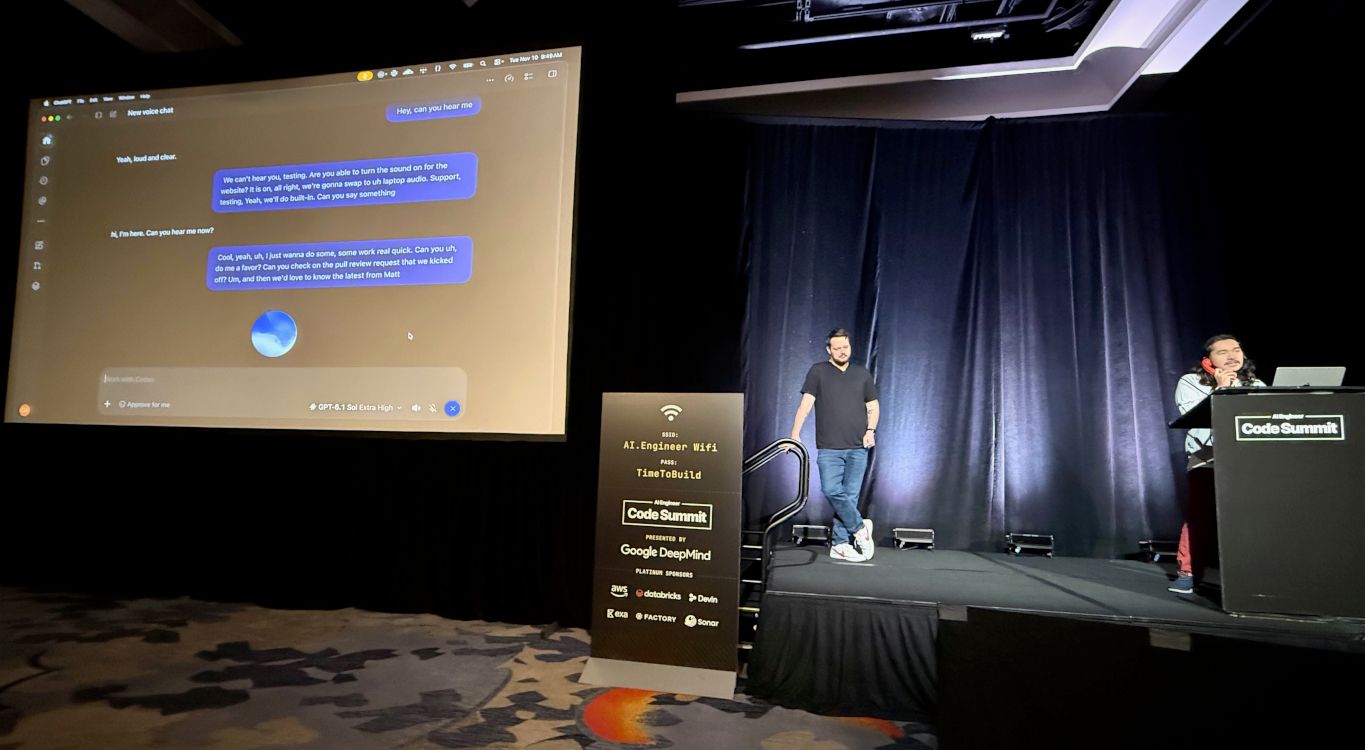
Charlie Guo went further: in his view, most people who use voice with code treat it as just another channel layered on top of their normal workflow. He prefers to use voice as a control layer over the entire codebase, rather than as an isolated mode for a single task.
I don't think about it as saying, here's the one lane of work that I'm doing right now with voice. I think about it as saying, how do I manage my threads? How do I check in on stuff? How do I pull data from other apps on the computer? How do I create new threads in the application? Just using my voice.
Kundel also shared another use case: talking to his own dot on the way to work, to open pull requests that he only reviews once he gets to the office or home.
Dots: useful, but still strange even for daily users
Dots, OpenAI's personal assistants that follow the user across work sessions, got less space in the workshop, and Guo was direct about why: even as an advanced Codex user, he finds dots a bit odd to use, because they represent a new paradigm and are good at different things than the main Codex.
Still, he listed three uses he considers valuable:
- Safety net: the dot flags things that went unnoticed during regular work.
- Delegation point: Guo says he uses this a lot inside Slack, tossing tasks for the dot to handle.
- Omnipresent presence: OpenAI's goal is for the dot to be available everywhere the person works, not just inside Codex.
Kundel reinforced this last point in practice: he starts a good chunk of his own tasks from the dot instead of opening Codex directly, because the assistant already carries the context of where he left off and can push pull requests forward on its own.
What changes for Codex developers
Kundel wrapped up the workshop with a list of practical tips, including lowering the agent's effort level when a task doesn't demand much reasoning, and simply asking the agent itself for help when it gets stuck. But the final takeaway was different: it's not worth getting attached to your current workflow, because everything changes too fast.
For developers in Brazil, the takeaway is concrete. Codex Cloud version 2, released in September 2026, removes much of the friction that kept teams away from cloud execution, with reusable, shareable environments. Voice mode widens the range of people who can control a code agent, useful both for quick prototyping and for managing multiple threads in parallel. Dots, meanwhile, remain at a more experimental stage: OpenAI itself acknowledges that the adoption curve is still uncomfortable, even for people who use Codex all day long.
Translated from the Brazilian Portuguese original · Read the original

Your startup at a giant event: how to leave with conversations and a story to tell, not just a full gallery
How to prepare your startup for a big event, strike up conversations, and capture stories. Brunno Matias's perspective from covering Web Summit Lisboa.