Gemini Decisions API enters the decision-model race with Jev and OpenAI
Gemini Decision 1 arrives as a multimodal AI option for automating binary, multiple-choice, and score-based decisions, competing for space with Jev and with OpenAI's decision model.

- Reading
- 7 min
- Tables
- 1
- Code
- 2
Gemini Decisions API enters the decision-model race with Jev and OpenAI
Gemini Decision 1 arrives as a multimodal AI option for automating binary, multiple-choice, and score-based decisions, competing for space with Jev and with OpenAI's decision model.
Editor's note: the information about supported modalities, pricing, and API response format for each of the three products mentioned in this article comes exclusively from Simon Willison's personal account on his blog. It was not possible to locate official documentation from Google, Jev, or OpenAI independently confirming these details. Keep this in mind before making technical or budget decisions based on this comparison.
What's at stake, and for whom
On November 11, 2026, developer and blogger Simon Willison published an account on his blog about Gemini Decision 1, a model Google launched within a new API category: so-called "decision models." According to Willison, Google now competes in this space alongside two competitors that were already active in it: Jev and OpenAI's decision model, named GPT-6 Luna.
A decision model isn't meant for conversation or for generating long text. It exists for one specific purpose: to take an objective question (yes/no, a choice among options, or a score from 0 to 1 according to a rubric) and return a structured, fast, and cheap answer. It's the kind of component that fits into content moderation pipelines, ticket triage, agent routing, or automatic validation of another model's output.
For those who have already built any of these flows with Jev or with OpenAI's API, the natural question is: is it worth switching to Gemini Decision 1, or should you stay put? This comparison organizes what Willison tested and published to answer that with criteria, not with enthusiasm.
Comparison criteria
| Criterion | Gemini Decision 1 (Google) | Jev | OpenAI (GPT-6 Luna) |
|---|---|---|---|
| Supported modalities | Text, image, audio, video, and PDF | Text and JSON | Text and image |
| Input price (per million tokens) | US$0.10 | US$0.042 | US$0.10 |
| Output price | Free | not disclosed | Free |
| Supported question types | Yes/no, multiple choice, and rubric-based score | Yes/no, multiple choice, and rubric-based score | not disclosed |
| Yes/no response format | Continuous probability (e.g., 0.92) | Binary (1.0 or 0.0) | Binary (1.0 or 0.0) |
| Term used for yes/no question | "Noul" (borrowed from Jev) | "Noul" (original term) | not disclosed |
Analysis by criterion
Modalities: the difference that matters most
Jev was born for text only (and JSON), which already signaled a product choice: speed and predictability above everything else. OpenAI went one step further by accepting image in addition to text. Gemini Decision 1 goes further than both combined: it accepts text, image, audio, video, and PDF in the same endpoint.
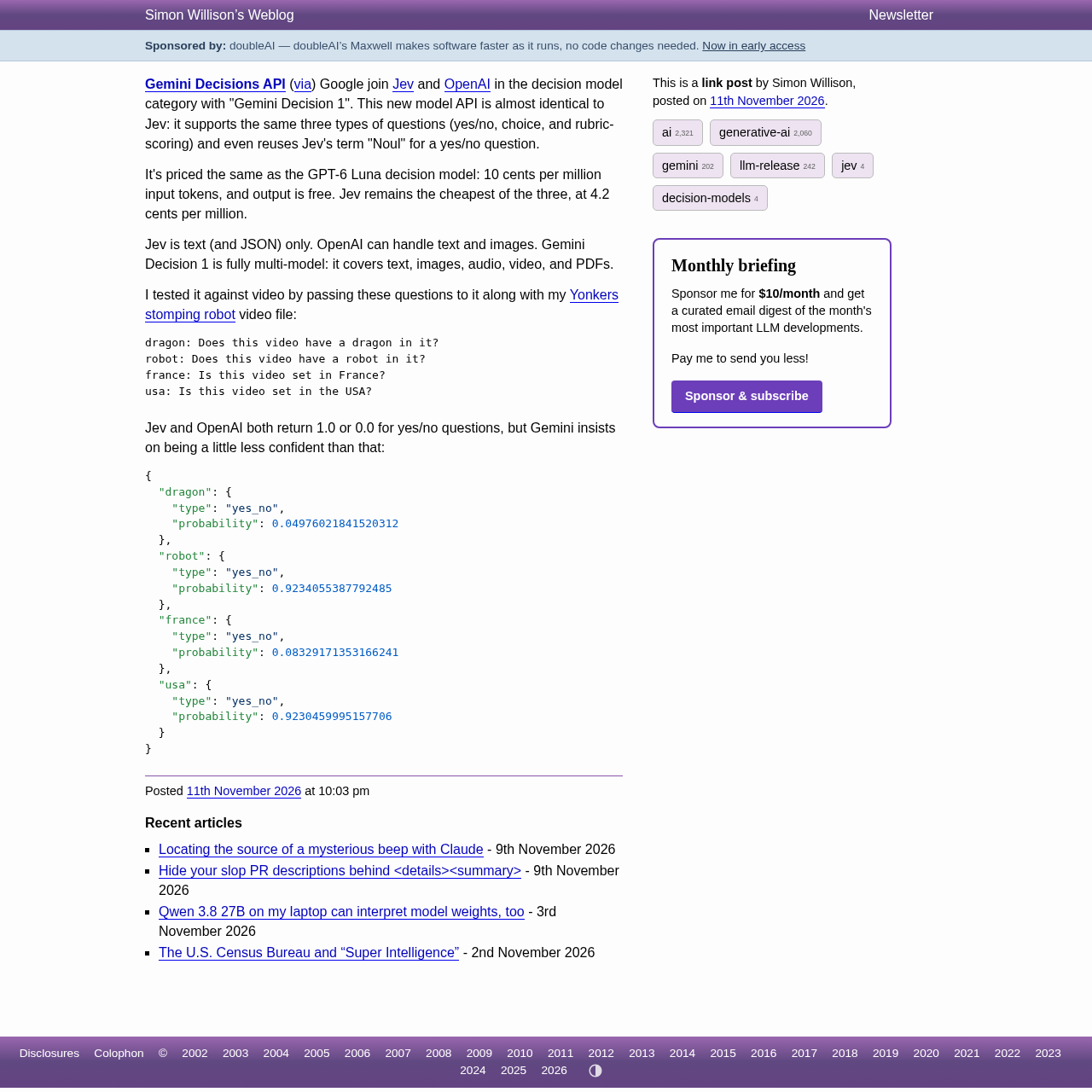
Willison tested exactly this differentiator. He submitted a video file of his own, described by him as "my video of a robot stomping around in Yonkers," along with four yes/no questions:
dragon: Does this video have a dragon in it?
robot: Does this video have a robot in it?
france: Is this video set in France?
usa: Is this video set in the USA?
Neither of the other two models in this comparison would accept this test as-is: Jev would reject the video outright (it only processes text and JSON), and OpenAI, which according to Willison supports only text and image, would have no way to process the video file directly in this test. For anyone who needs to make decisions about audiovisual content (video upload moderation, scanned PDF triage, customer service audio analysis), this takes Gemini Decision 1 out of a pure price comparison and places it in a different capability category.
Price: Jev is still the cheapest, but that's not the whole story
On input, the math is straightforward: Jev charges US$0.042 per million tokens, less than half of what Google and OpenAI charge (US$0.10 each). Willison is explicit: "Jev remains the cheapest of the three." At high volume and with simple text questions, this price difference adds up fast.
But Willison's post doesn't detail Jev's output price, only confirming that both Gemini Decision 1 and OpenAI's GPT-6 Luna have free output. This means that for those using long prompts (an entire PDF, a lengthy audio transcript) but receiving back only a small JSON with the decision, the effective cost per call on Gemini and OpenAI tends to be more predictable: the bulk of the cost is only on input, and it's already known in advance.
Question types and response format: the detail that changes the code
Editor's note: the code in this section was not run in a real environment. Validate before using in production.
Gemini Decision 1 copies Jev's structure almost exactly: the same three question types (yes/no, choice, and rubric-based score) and even the same internal term, "Noul," to identify a yes/no question. This makes migration easier for anyone who already has an integration with Jev: the request shape changes very little.
What really changes is the response shape. Jev and OpenAI return pure binary values, 1.0 or 0.0, for yes/no questions. Gemini Decision 1 returns a continuous probability. In Willison's test, the question about the presence of a robot in the video returned 0.9234055387792485, and the question about the presence of a dragon returned 0.04976021841520312:
{
  "dragon": { "type": "yes_no", "probability": 0.04976021841520312 },
  "robot": { "type": "yes_no", "probability": 0.9234055387792485 },
  "france": { "type": "yes_no", "probability": 0.08329171353166241 },
  "usa": { "type": "yes_no", "probability": 0.9230459995157706 }
}
This difference isn't merely cosmetic. Code that already treats a decision model's response as true/false directly will break, or worse, will silently treat 0.92 as truthy without evaluating how much confidence that represents. Migrating to Gemini Decision 1 requires adding an explicit threshold in the code (for example, probability > 0.8) instead of trusting the raw value as a boolean.
Verdict by use case
There's no single winner here, because the three models optimize for different things:
- Small team, tight budget, text-only decisions: Jev remains the cheapest option (US$0.042 per million input tokens) and already has the most market-tested API shape. Switching to Gemini or OpenAI purely for price doesn't make sense if the flow never leaves text.
- Products that already process video, audio, or PDF at some point in the pipeline: Gemini Decision 1 is, today, the only one of the three with native support for these four modalities in the same endpoint. Extracting a video frame to send as an image to OpenAI, or transcribing audio before sending text to Jev, are workarounds that Gemini eliminates.
- Stack already built on top of OpenAI, with low decision volume: it makes sense to stick with GPT-6 Luna, since the input price matches Gemini's (US$0.10) and the binary response is already integrated into existing code. Switching providers just to gain multimodality the product doesn't use is engineering cost without return.
- Anyone who needs granularity in the decision, not just yes/no: Gemini Decision 1's probability format is a feature, not a bug, for those who want to adjust sensitivity per case (for example, content moderation with different thresholds per risk category). Jev and OpenAI, with fixed binary output, require that sensitivity adjustment happen on the prompt side, not the response side.
- Migrating from Jev to Gemini based solely on similar naming: reusing the term "Noul" helps copy the request structure, but it doesn't eliminate the work of adapting response parsing (from binary to probability) or validating the new input price, which is more than double Jev's.
What still can't be confirmed
Willison's post is a personal usage account, not a formal benchmark: he tested four questions on a single video. There's no accuracy comparison between the three models on the same questions, no latency testing, and no sufficient volume to know whether Gemini's confidence (0.92, for example) is well calibrated or just more conservative by default.
It's also unclear, from the source, what Jev's output price is, or whether OpenAI supports the same three question types (yes/no, choice, and rubric) that Google and Jev share. The post also doesn't detail file size limits for video, audio, or PDF in Gemini Decision 1, nor whether there's support for streaming or only full file upload. These gaps matter for anyone deciding based solely on price and modality, without measuring the accuracy and consistency of their own workload before switching providers.
The material received did not include any image URL from the outlet's media library nor an official video link from the manufacturer or source, which is why this text does not include embedded media.
Translated from the Brazilian Portuguese original · Read the original
AWS launches official Rust emulator to test services without paid credentials
The aws-emulator runs a local clone of AWS services for integration testing, doing away with the need for paid API keys. It was written by a swarm of AI agents and, for now, only works with Docker.