7 min read
NVIDIA opens data and fine-tuning recipe for Nemotron 3.5 Parse, with inference up to 6.86x faster
 Alan AndradeAuthor
- Reading
- 7 min
- Tables
- 2
- Code
- 1
NVIDIA has opened up the synthetic data and training process behind Nemotron 3.5 Parse, its document-reading model for RAG and agents, along with a new inference accelerator that sextuples throughput compared to the previous version.
On November 26, 2026, NVIDIA published, on the Hugging Face blog, a companion package to Nemotron 3.5 Parse: three open synthetic datasets, the full fine-tuning recipe used to train the model itself, and a new speculative decoding mechanism called DFlash2. Parse is a compact model that turns a page image into structured data, designed to feed RAG and agent pipelines that need to read PDFs, forms, and reports without relying on traditional OCR.
For anyone already using or planning to use Parse in their own pipeline, the package changes the equation in two concrete ways: it provides material to adapt the model to a specific domain (a medical form, an invoice, a financial report layout) and it delivers a throughput gain that directly affects the cost of running the model in production.
What Parse extracts from a page
The model reads the page in the correct reading order, classifies each block (heading, paragraph, table, chart), and returns bounding boxes that locate each element. Tables and charts become structured records, not just loose text.
The hardest point, according to NVIDIA, is charts without a marked numeric value: the model has to infer the value by looking at the bar height and the axis scale. Tables are also tricky, because a shifted row or column changes the entire meaning of the structure. These two cases were exactly where the new generation of synthetic data helped the most.
Three synthetic datasets, ready for fine-tuning
NVIDIA has opened the three sets used to train Parse 3.5, each with images, annotations, and generation documentation:
| Dataset | Size | Content |
|---|---|---|
| Synthetic Charts V1 | 9.98 million examples | charts rendered with known category, series, and numeric value |
| Synthetic Tables V1 | 1 million examples | HTML tables with row, column, header, and cell relationships preserved |
| OCR Synthetic Multilingual v2 | 7.9 million examples | multilingual synthetic pages in varied fonts and layouts, in Parse's output format |
These are image/annotation pairs with known ground truth, which allows both retraining Parse from scratch and generating your own variations for a language or document type the model still gets wrong. It's the kind of material a team would normally have to generate internally to fine-tune a serious document model.
SFT teaches the capability, RLVR corrects the behavior
Parse 3.5's training followed two phases. First, supervised fine-tuning (SFT) on text, layout, table, chart, and multilingual documents, establishing the general capability to read a page and represent it.
Then came reinforcement learning with verifiable rewards (RLVR), using Group Relative Policy Optimization (GRPO). Instead of prescribing an exact sequence of tokens, the reward checks whether the extraction recovered the correct series and values from a chart, whether the structure is usable, and whether the model finished without getting stuck repeating the same content.
The controlled comparison published by NVIDIA shows the effect: pages with looping output dropped from 126 to 29 (a drop of about 77%), and outputs that hit the 9,000-token limit dropped from 185 to 35. The overall score rose from 66.24 to 71.38 points, with +5.18 in tables and +4.15 in charts.
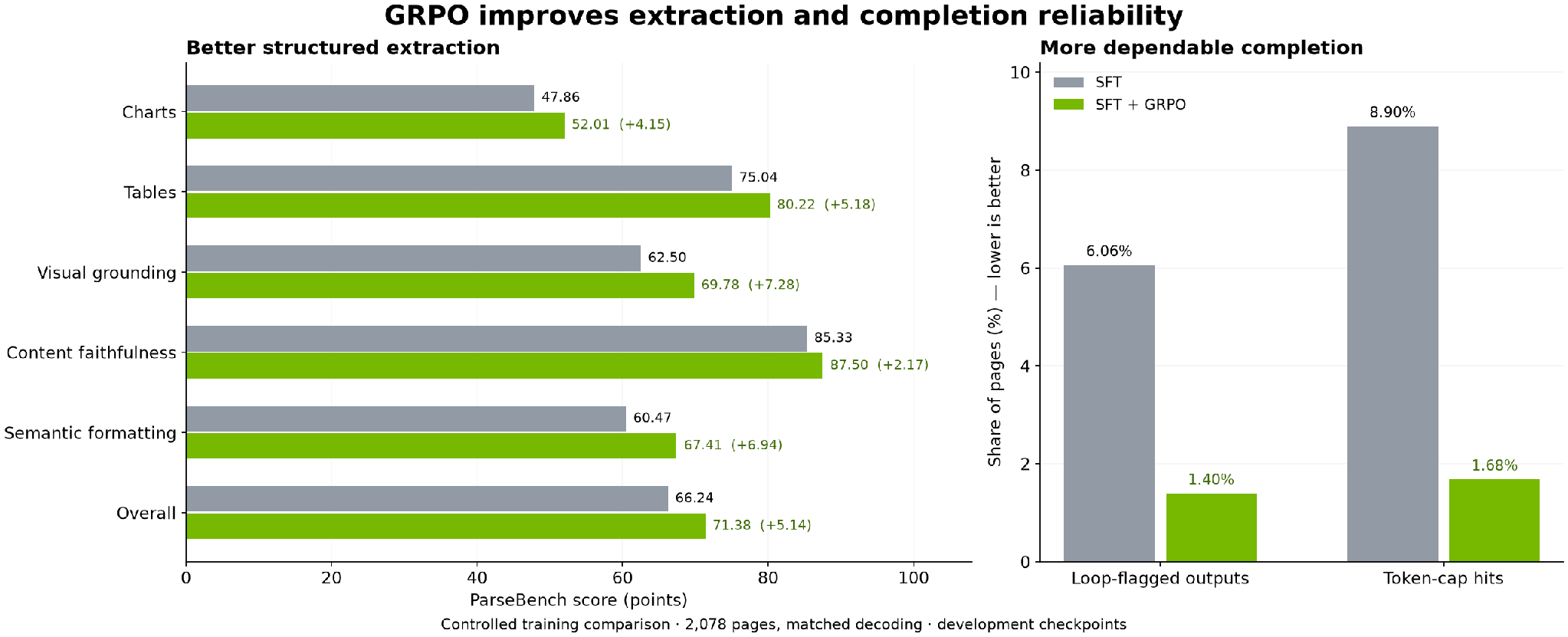
In short: SFT teaches the model to extract; RLVR teaches it to stop at the right time and not get stuck on ambiguous cases, which in practice means less parsing rework and fewer failed calls in production.
New architecture and the DFlash2 speculator
Beyond training, NVIDIA changed how Parse 3.5 processes images and decodes text, compared to Parse 2.0:
| Component | Parse 2.0 | Parse 3.5 |
|---|---|---|
| Page pre-processing | fixed 2048×1664 canvas | NaViT, dynamic rectangular input |
| Image-text connection | cross-attention encoder-decoder | compressed visual tokens as causal prefix |
| Decoder self-attention | multi-head attention | GQA-8 (16 query heads, 8 key/value heads) |
| Speculative decoding | none | 1-token lookahead (MTP); optional DFlash2 |
NaViT adapts the input to the page's actual shape instead of forcing a fixed canvas, and GQA-8 reduces the decoder's attention cache memory. On top of that, DFlash2 uses a small draft model that proposes up to 32 tokens ahead, and Parse verifies the proposals in a block; in the measured 32-token configuration, the average was about 14 draft tokens accepted per step.
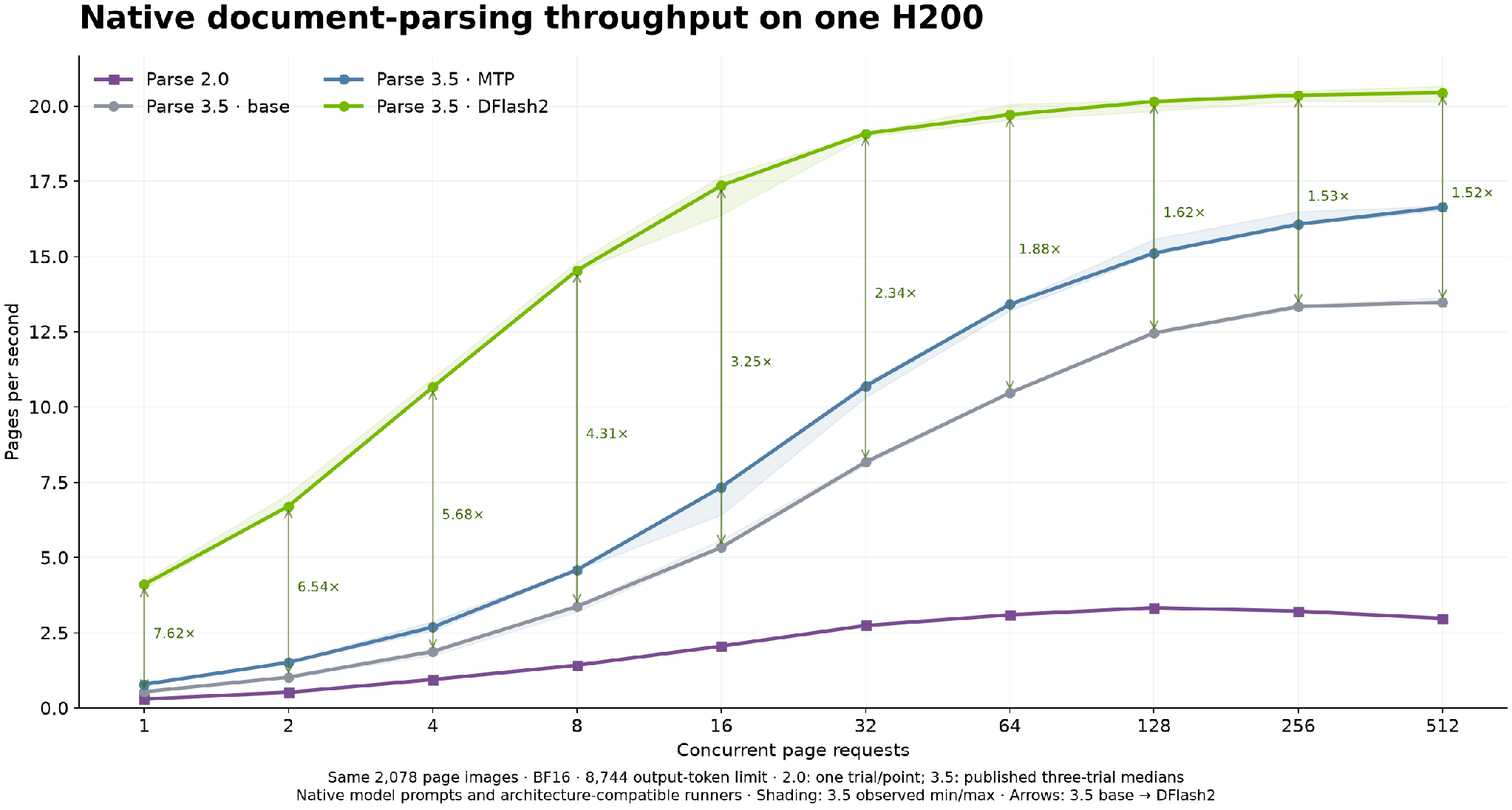
In the single-pass benchmark on an H200, BF16, over the same set of 2,078 pages, DFlash2 brought a 7.62x throughput gain at concurrency 1 and 1.52x at concurrency 512, compared to Parse 3.5 without speculative decoding. At peak concurrency of 512, Parse 3.5 reaches 13.48 pages/s without speculation and 20.44 pages/s with DFlash2, versus 2.98 pages/s for Parse 2.0, that is, 4.53x and 6.86x the previous generation's throughput.
Single, double, or triple pass: throughput versus precision
With faster parsing, NVIDIA proposes spending the time gained reviewing difficult regions instead of just processing more pages per second:
- Single pass: reads the entire page once for text, layout, table, and chart.
- Double pass: crops the already-detected table and chart regions, reprocesses them in more detail, and merges the refinement into the page result.
- Triple pass: runs the model in detection mode to check that no box or text was left out, and only then re-extracts the charts and tables found.
On the reference benchmark (ParseBench), the double and triple passes add +2.18 and +2.46 points over the single pass, respectively. It's an explicit trade-off: each extra pass costs additional requests and time, so the precision gain only pays off in documents where tables and charts carry the critical information, not in plain running text.
Replicating the recipe on your own document
NVIDIA also detailed the fine-tuning pipeline, combining NeMo Automodel for SFT and NeMo RL with GRPO for RLVR, using vLLM to generate candidate responses during reinforcement training. The reference example is a synthetic dental form with an odontogram: before the fine-tuning, Parse read the printed tooth numbers but missed the procedure table associated with each marked tooth.
After SFT, the six rows of the example chart matched the target. Then RLVR reinforced the consistency: the estimated first-attempt success rate (sampled pass@1, with eight samples per page, on 256 synthetic validation forms) jumped from 0.00% in the base model to 95.85% after SFT and 96.58% after RLVR.
The key point for anyone reproducing this on their own document is the verifier: a set of checks that decides whether an extraction is correct. NVIDIA provides ready-made reward components for text fidelity, bounding boxes, tables, chart facts, and completeness, and expects each team to combine the components relevant to its case. A simplified sketch of how this kind of verifier fits into the RLVR loop would look like this:
def reward(extraction, ground_truth):
    score = 0.0
    score += text_fidelity(extraction, ground_truth)
    score += table_structure_match(extraction, ground_truth)
    score += chart_values_match(extraction, ground_truth)
    score -= repetition_penalty(extraction)
    score += completion_bonus(extraction)
    return score
This isn't NVIDIA's code, it's just the structure that the source text describes: each check becomes a reward term, summed and passed to GRPO to guide the policy. Adapting the recipe to your own domain means swapping the ground-truth generators (like the open synthetic datasets) and the verifiers for versions specific to your document type, whether it's an invoice, a medical report, or a contract.
Where this doesn't pay off
The entire recipe assumes it's possible to generate synthetic data with reliable ground truth for the target document type: easy for programmatically rendered charts and tables, much harder for handwritten documents, documents scanned with real-world noise, or documents with highly idiosyncratic layouts, where realistically simulating the variation is the bottleneck, not the training itself.
Similarly, DFlash2's gain is more pronounced at low concurrency (7.62x) and drops to 1.52x at high concurrency: in a batch pipeline already saturating the GPU, the speculator's payoff is much smaller than in a service handling few requests at a time. The community has already extended Parse to Thai, Persian/Farsi, and Arabic, according to NVIDIA, which suggests that the path of adapting language and domain works, but requires a volume of synthetic data equivalent to what NVIDIA itself published to achieve similar results.
Translated from the Brazilian Portuguese original · Read the original

How to train swarms of AI agents to truly cooperate
A practical guide from Hugging Face teaches how to train four agents to share information using reinforcement learning, and the numbers show when cooperation is worth the tokens spent.