3 min read
Ant Group releases multimodal Ling-3.2-air model under MIT license for AI agents
 Redação iMastersNewsroom
- Reading
- 3 min
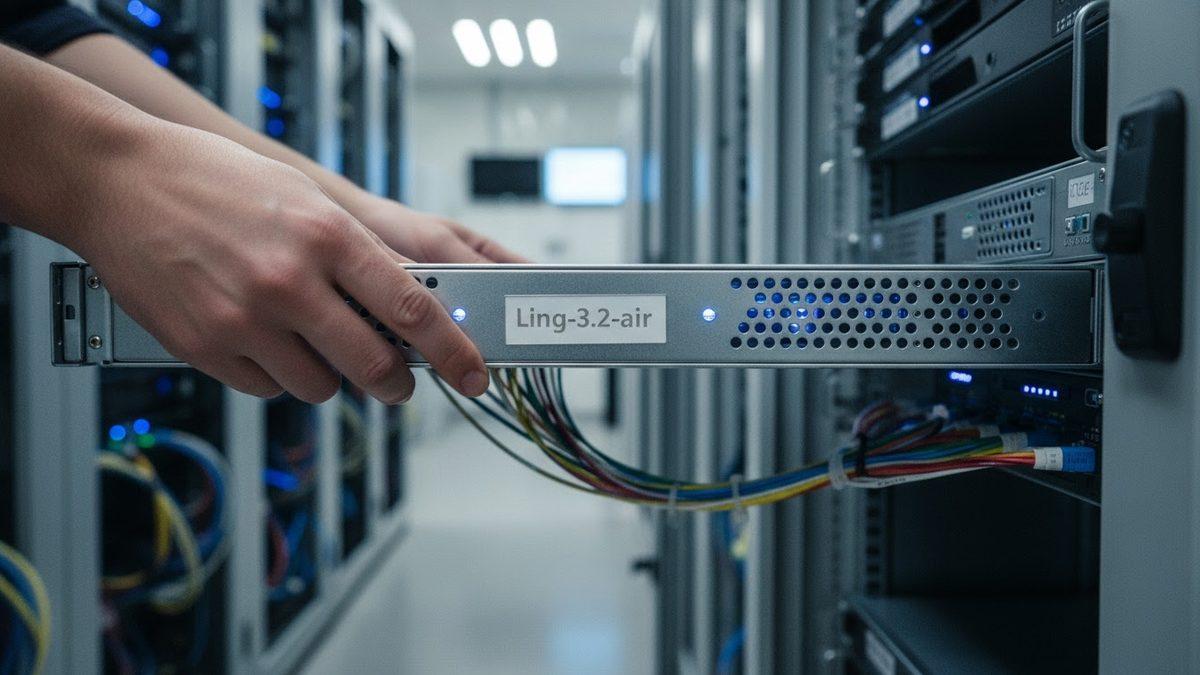
Ant Group published the weights of Ling-3.2-air, a model that processes text, images and video and is geared toward agents that complete tasks using tools. The MIT license allows commercial use and self-hosting.
The model and the license
Ant Group, the financial technology affiliate of the Alibaba group and operator of Alipay, released the weights of Ling-3.2-air under the MIT license this Tuesday (November 24). The model processes text, images and video, and its development was geared toward agents that use tools to complete professional workflows, not just answer chat questions.
The MIT license is permissive: any developer can download the weights, run them on their own infrastructure and adapt the model for commercial products, without royalties or mandatory clauses to share improvements. It's the same license category used by much of the open source software ecosystem, something still uncommon among cutting-edge models released by large AI companies.
Architecture: hybrid MoE with linear attention
Ling-3.2-air uses a hybrid architecture that combines linear attention with mixture-of-experts (MoE). The language component has 124 billion parameters in total, but activates only 5.5 billion per processed token.
This difference between total parameters and activated parameters is what makes the model viable to run outside giant data centers. In practice, fewer activated parameters per inference means less GPU memory and lower computational cost per request, even with a total capacity of 124B parameters available for more complex tasks.
Ready to run: SGLang and vLLM
The release already includes deployment instructions for SGLang and vLLM, two of the most widely used inference frameworks for serving language models in production. This reduces the work for anyone who wants to put Ling-3.2-air into production: instead of writing the serving layer from scratch, the infrastructure team follows Ant Group's documentation and deploys the model on its own cloud or on-premise servers.
Combined with the MIT license, this deployment documentation makes it easier for scenarios where a company doesn't want to (or, due to data regulation, can't) depend on a closed third-party API to run AI agents.
The numbers behind the jump in automation
Ant Group reports gains for Ling-3.2-air over Ling-3.0-flash-VL, the family's previous version, especially in document production, office software use and web page navigation. On the company's own benchmark, called AutomationBench-AA, the task completion rate rose from 15.7% to 61%.
In short: the numbers come from an evaluation published by Ant Group itself, with no independent validation so far. The company also reports improvements in PDF file generation and in end-to-end execution of professional tasks, reinforcing the model's positioning around work completed through tools, not just conversational answers.
What changes for those building agents in Brazil
For Brazilian teams already working with AI agents, Ling-3.2-air arrives as another multimodal open-weight option, alongside families like Qwen and DeepSeek. The combination of hybrid MoE with low activation per token (5.5B out of 124B) is what matters most day to day: it means running a high-capacity model on fewer GPUs than an equivalent dense model would require.
This changes the cost equation for companies that currently pay per token on closed APIs to automate office tasks, document generation or agent-driven web navigation. With the weights released and deployment documentation ready for SGLang and vLLM, infrastructure teams in Brazil gain the option to host the model internally, which also addresses data residency issues in regulated sectors such as finance and healthcare.
What's still unknown
The improvement numbers on AutomationBench-AA come from an evaluation conducted by Ant Group itself, with no independent benchmark published so far. In its announcement, the company did not detail the composition of the training data or the model's performance in Portuguese, which remains a point of attention for anyone planning to use Ling-3.2-air in products aimed at the Brazilian market.
There is also, so far, no direct comparison of Ling-3.2-air with Western competitors of similar weight and activation, such as the open models from the Llama or Mistral families. For teams evaluating which open-weight model to adopt in an agent pipeline, the way forward is to test Ling-3.2-air on their own use case before switching their current stack.
Translated from the Brazilian Portuguese original · Read the original

Dell fine-tuned open-source embedding model to fix RAG search broken by internal terms
In a presentation at QCon AI, Distinguished Engineer Rachel Shalom detailed how Dell's internal search team diagnosed and fixed RAG retrieval failures on internal acronyms and products by fine-tuning an open-source embedding model.