5 min read
Aviator CEO shows data on the end of line-by-line code review
At QCon San Francisco 2026, Ankit Jain, CEO of Aviator, presented figures from studies by Microsoft, Google, and Faros to argue that traditional code review has become theater, and proposed a six-layer model to replace it.
 Redação iMastersNewsroom

- Reading
- 5 min
At QCon San Francisco 2026, Ankit Jain, CEO of Aviator, presented figures from studies by Microsoft, Google, and Faros to argue that traditional code review has become theater, and proposed a six-layer model to replace it.
Closing out the Engineering the Developer Experience track at QCon San Francisco 2026, on November 26, Ankit Jain, co-founder and CEO of Aviator, argued that line-by-line code review is already dead in practice at most teams. Before getting into the data, he disclosed that he has a commercial interest in the topic, since Aviator sells a review automation tool, and asked the audience to be skeptical of him.
The talk revisited an essay Jain wrote for Latent Space in March 2026, proposing a five-layer trust model to replace traditional review. Eight months later, he said, the model's mechanics had held up, but the original text completely ignored human judgment. That is where the layer missing from the original version came from.
The numbers that dismantle traditional code review
Jain opened with a 2013 Microsoft survey: 44% of reviewers said finding defects was their motivation for reviewing code, but only 14% of the comments they actually wrote were about defects. A 2018 Google study, covering more than nine million reviews, arrived at an almost identical split between stated motivation and actual practice.
Jain's conclusion is that code review was never really about hunting bugs: it was about sharing knowledge between the person who wrote the code and the person who read it. He quoted developer Addy Osmani to sum up the problem that AI code generation has created:
We made writing cheap, and understanding stayed exactly as expensive as it has always been.
Addy Osmani
A Faros study published in September 2026, covering more than 4,000 teams, found that more than 75% of pull requests today are merged without any human review. Average PR size has grown, and redo work is up 67% year over year. Earlier research had already shown that review quality drops sharply above 400 lines, and the median PR size today is 640 lines.
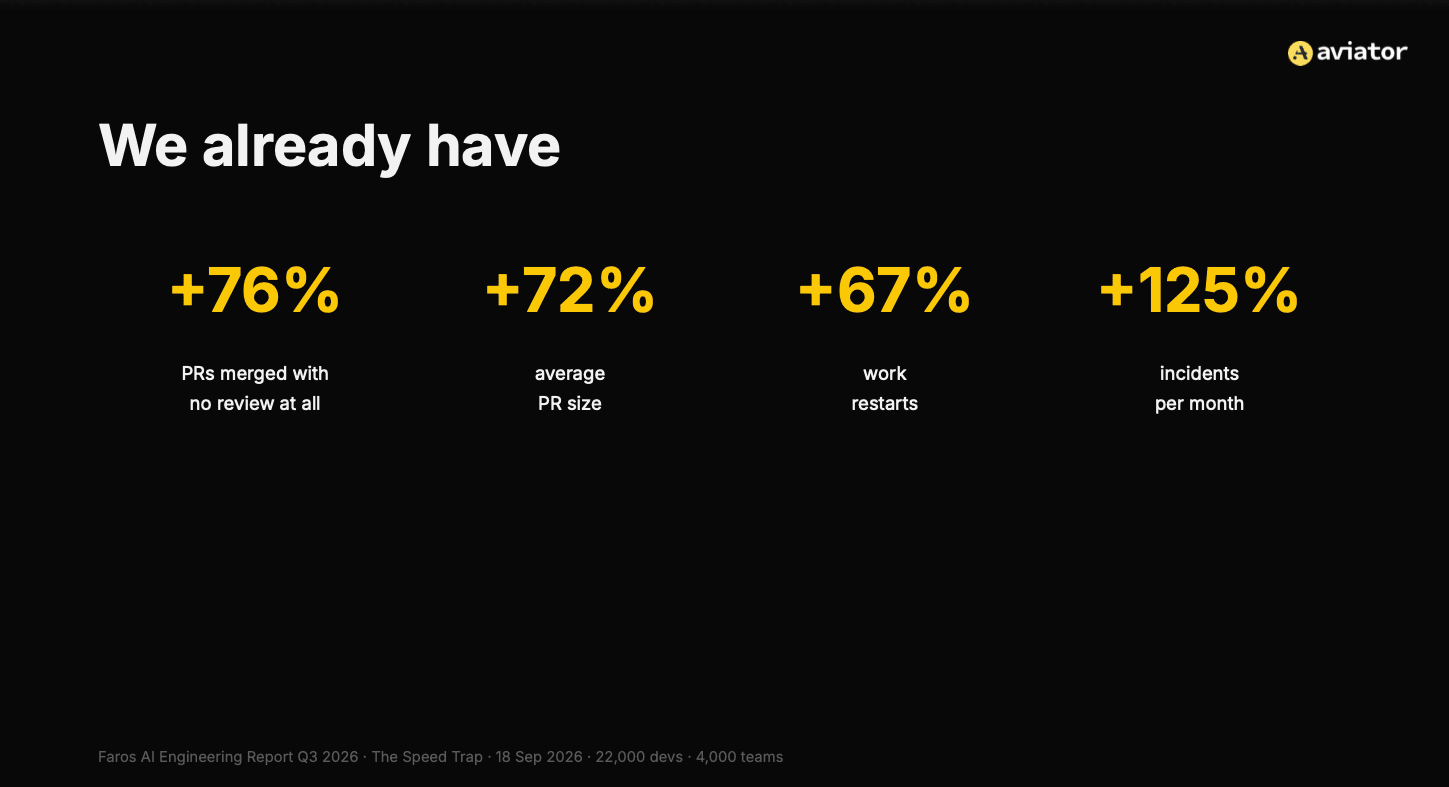
In short: teams are approving bigger PRs, with fewer people actually reading them, and paying for that redo work later. Jain called this theater review: agents write, another AI reviews, the agents fix, and a human just skims and approves. He cited a Reddit post from an experienced developer refusing to review AI-generated PRs, which got more than 1,900 upvotes, as an illustration of the unease:
We are reviewing the code, but we are rubber stamping it.
Ankit Jain, CEO of Aviator
The six-layer model he proposes instead
To replace single-pass review, Jain presented six layers that, he said, cover what traditional review tried to do manually and in a poorly distributed way:
- Argue: agents debate the change locally before the PR exists, and only what they disagree on gets escalated to review.
- Capture: intent and acceptance criteria, in the style of behavior-driven development (BDD), are recorded during the coding session and attached to the PR instead of being discarded.
- Codify: recurring review comments become invariants, permanent rules with a defined scope, origin, verification method, and an owning team. Aviator itself mined 11,000 internal review comments and produced 64 invariants.
- Prove: evidence replaces the green CI checkmark, screenshots, DOM snapshots, recorded requests, latencies, and database logs, since the same agent that wrote the code likely also wrote its unit tests.
- Debate: humans discuss decisions, not line-by-line diffs.
- Own: responsibility for quality shifts from the individual author and reviewer to the teams that own each codified rule.
The less humans read code line by line, the more the structure needs to ensure they understand the decision behind it. That is Jain's bet: trading diff reading for debate over rules and evidence.
What happened when Jain's team applied this
Jain reported that his own team, of nine engineers, now merges four times as many pull requests as it did a year ago and still approves every one of them. Reverts fell by about 40% over the same period, he said.
He also shared a failure of the model: a change passed through every automated filter and caused 18 minutes of instability due to an unindexed database query. In the post-mortem, the question the team asked was not who approved that PR, but which invariant was missing from the rule system.
Even while championing automation, Jain left explicit caveats: critical areas such as security, authentication, and billing still get line-by-line human review on his team. The six-layer model, it seems, is not proposed as a universal replacement, but as a standard for the volume of code that today passes too shallowly before human eyes.
The talk ended with a line that sums up the central argument:
You can outsource your thinking. You cannot outsource your understanding.
Ankit Jain, CEO of Aviator
What remains open for those who review code in Brazil
The figures Jain presented come mostly from older academic studies (Microsoft 2013, Google 2018) and a recent market survey from Faros, plus the experience of a small, nine-person team inside the very company that sells the solution. The available sources contain no equivalent data from larger teams or other industries applying the full six-layer model.
For those leading squads in Brazil, the practical takeaway from the talk is narrower than the general thesis suggests: growing lines of code, dwindling review, and rising redo work are measurable symptoms today, even without adopting Aviator's framework. Auditing how many of your team's PRs go through without human review, and their average size, is one possible first diagnosis before deciding which layer of Jain's proposal, if any, is worth copying.
Translated from the Brazilian Portuguese original · Read the original

Dell fine-tuned open-source embedding model to fix RAG search broken by internal terms
In a presentation at QCon AI, Distinguished Engineer Rachel Shalom detailed how Dell's internal search team diagnosed and fixed RAG retrieval failures on internal acronyms and products by fine-tuning an open-source embedding model.