Black Forest Labs launches Flux 3 Image Klein, open weights image model with 5.6B parameters
Black Forest Labs released the weights of Flux 3 Image Klein, an image generation and editing model that runs on consumer GPUs with 8 GB of VRAM. For those paying for APIs in dollars, the math changes.

Black Forest Labs (BFL) launched Flux 3 Image Klein, an image generation and editing model with 5.6 billion parameters released as open weights. It's the second open release in the Flux 3 family, after Flux 3 Action, a 7B model geared toward robot control. According to BFL, more releases in the family are on the way.
Klein handles text-to-image, image editing, and multi-reference generation with up to 10 simultaneous reference images. It inherits features from the full Flux 3 Image model: native 4K generation, pixel-perfect editing, and bounding boxes that control where an element is placed or limit editing to a specific area of the image.
A smaller model that learned from video and audio
Flux 3 Image Klein was trained on the shared learning across image, video, and audio that underpins the entire Flux 3 family. Images contribute spatial detail, video adds motion and physical dynamics, and audio provides context for events and interactions. According to BFL, this combination helps the model generate images that are more coherent with the real world, even though it's the smallest open model in the comparison the company published.
The numbers BFL published
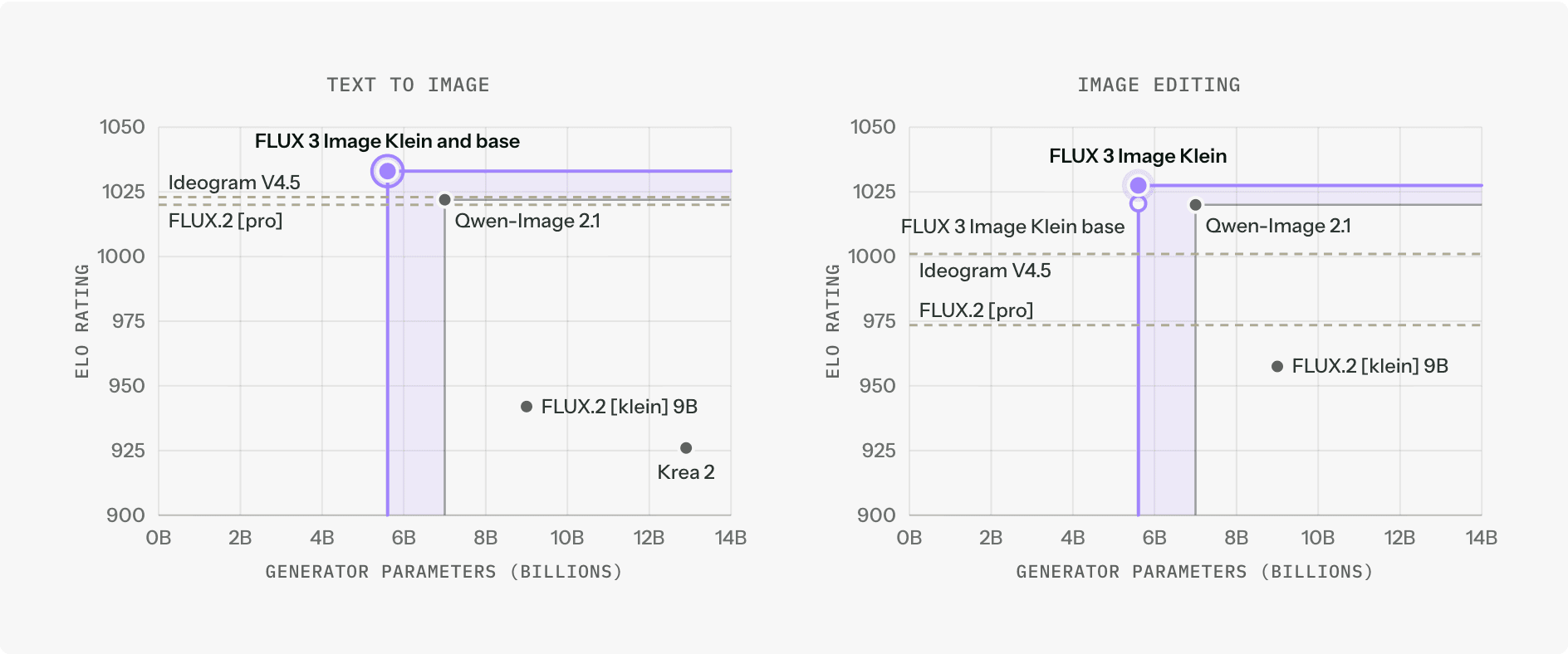
In internal evaluations, BFL says Flux 3 Image Klein ranks first in text-to-image, multi-reference generation, and image editing, ahead of larger open models as well as closed models such as Ideogram V4.5 and Flux.2 [pro]. Context matters here: these are numbers measured by the company itself, with no independent benchmark published so far.
| Model | Parameters | BFL's note |
|---|---|---|
| Flux 3 Image Klein | 5.6B | 1st place in internal tests |
| Flux.2 [klein] | 9B | predecessor; Klein gains 91 Elo in text-to-image and 70 in editing, with 38% fewer parameters |
| Qwen-Image 2.1 | 7B | open weights, cited as a reference |
| Krea 2 | 12.9B | open weights, the largest in the compared group |
Running on an 8 GB GPU
The point that matters most for developers is the hardware requirement. The generator's weights take up 11.2 GB in BF16 and 5.6 GB in FP8. With the INT8 version, the model runs on GeForce RTX GPUs with just 8 GB of VRAM, via ComfyUI or Hugging Face Diffusers, extending what Flux.2 [klein] had already started doing for even more modest hardware.
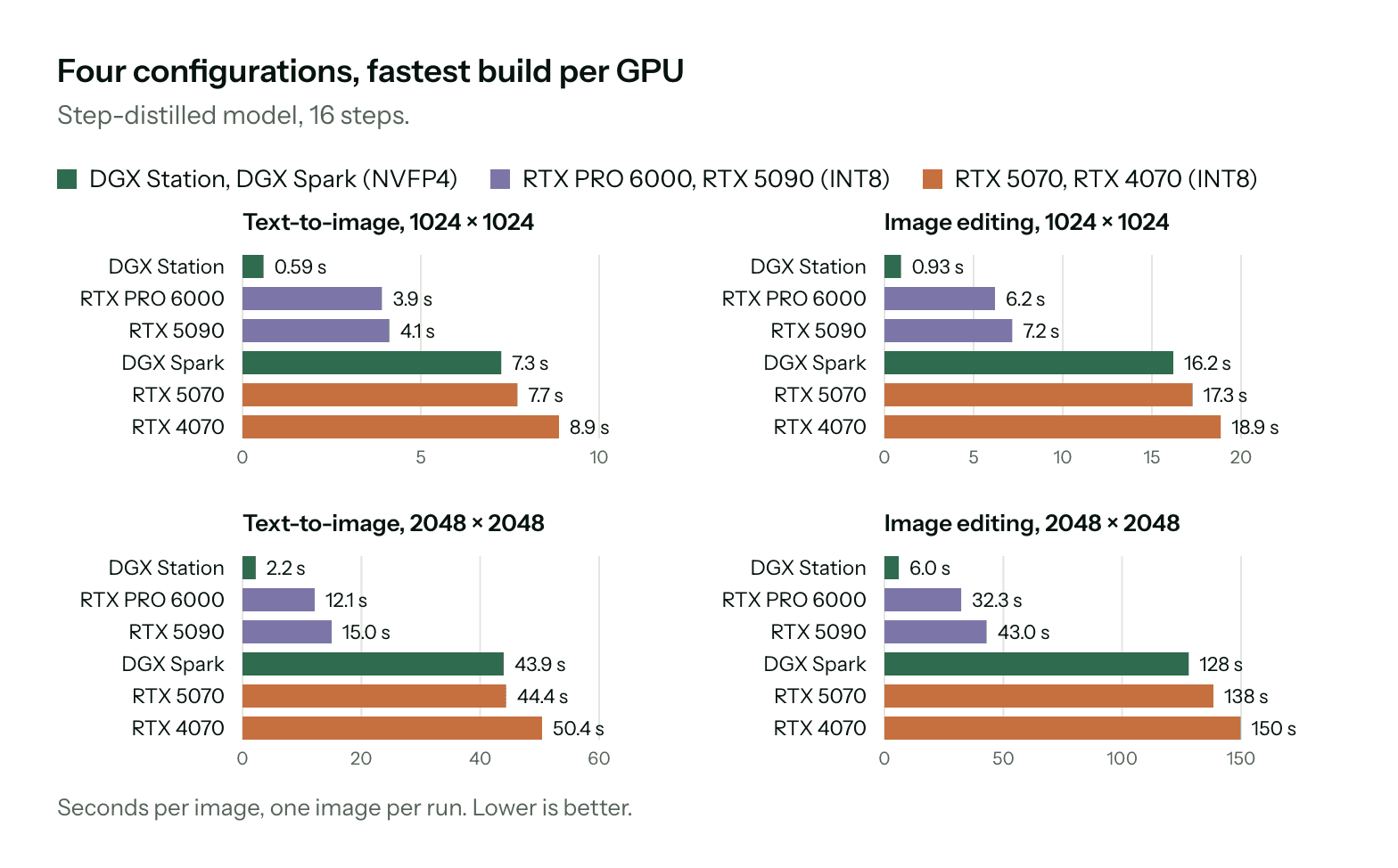
In speed figures published by NVIDIA, the distilled model combined with the INT8 build generates a 1 MP image in about 4 seconds on an RTX 5090 and in less than 9 seconds on an RTX 4070, both via ComfyUI, with 16 inference steps. At the top of the scale, on an NVIDIA GB300 GPU using NVFP4, the same generation takes less than 0.6 second; serving a LoRA adds about 5% to the generation time.
Paid API and dollar pricing
In addition to the open weights, BFL also offers the model as a service, identified as flux-3-image-klein in its own API. The hosted version includes prompt upsampling and pixel restoration, a feature that preserves exactly the unedited regions of an image during an edit. Pricing starts at US$0.009 per image generated at 1K resolution, billed in dollars, as is customary for APIs of this kind.
What changes for developers in Brazil
Here's the angle that sets this release apart from just another image model: the license. The Flux Kommunity License allows free commercial use for individuals and companies with annual revenue below US$5 million, plus research and non-commercial use with no size restriction. Larger organizations need to negotiate self-hosted licensing or use BFL's paid API.
In practice, this means that most startups and product squads in Brazil qualify to download the weights and run the model for free, within their own infrastructure. This has three concrete effects:
- An end to per-call API billing in dollars, replaced by the fixed cost of a GPU (starting with an RTX with 8 GB of VRAM for the INT8 build);
- Customer images processed locally, without leaving the company, which makes conversations about LGPD (Brazil's data protection law) easier with legal and security teams;
- The possibility of fine-tuning with LoRA on top of the base checkpoint, training the model with the brand's own visual style without depending on an external vendor.
Integration: what's already supported
The base checkpoint was designed for fine-tuning: Diffusers and Ostris's AI Toolkit support LoRA training from day one, and NVIDIA's NeMo AutoModel brings ready-made recipes that work directly from the released checkpoints. There's day-one support in ComfyUI, Hugging Face Diffusers, TensorRT-LLM, SGLang Diffusion, and vLLM-Omni, covering both those who build visual pipelines in a graphical interface and those who prefer serving the model via code.
Safety, with numbers BFL doesn't disclose
The company says it implements filters on the pre-training dataset to limit exposure to harmful content, along with targeted post-training fine-tuning to suppress harmful behaviors. Before launch, the checkpoints went through internal red teaming and evaluation by external partner Cinder, which, according to BFL, found "substantially fewer vulnerabilities" than other popular open weights. The company didn't disclose the numbers behind this comparison or Cinder's full report.
What remains open
All quality and speed benchmarks come from evaluations done by BFL itself or from tests commissioned to NVIDIA; so far, there's no independent comparison published. The company also doesn't detail the composition of the training dataset. For anyone evaluating whether to swap a paid API for a local pipeline, the sensible path is to test the model with the product's own prompts before deciding to migrate, comparing quality and generation time on the available GPU against the current dollar cost.
Translated from the Brazilian Portuguese original · Read the original

Amazon acquires DuckLabs and brings DuckDB inside Aurora PostgreSQL
Amazon acquired DuckLabs, the company behind the DuckDB analytical database, and integrated the tool into Aurora PostgreSQL to combine transactional data with historical data on S3 without ETL pipelines.