Caixa Vida e Previdência confirms data leak affecting 7.6 million customers

- Reading
- 5 min
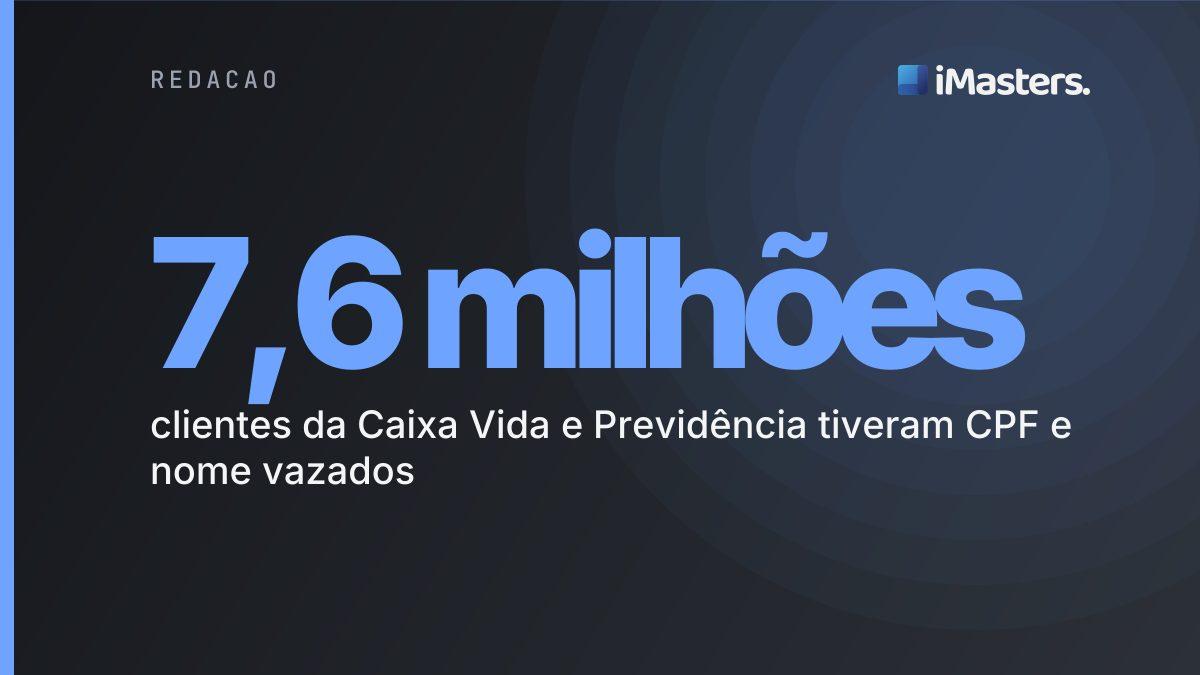
The insurer linked to Caixa reported a cybersecurity incident to the ANPD (Brazil's data protection authority) that exposed names and CPFs (Brazil's national taxpayer ID numbers) across its entire active customer base. The case reignites the debate over how Brazilian financial institutions protect (or fail to protect) registration data.
Incident timeline
Caixa Seguridade Participações, the parent company of insurer Caixa Vida e Previdência (CVP), released a market disclosure on November 12, 2026, reporting a cybersecurity incident at the subsidiary. The document, signed by CFO and Investor Relations Officer Edgar Vieira Soares, details a sequence of events that began days before the public disclosure.
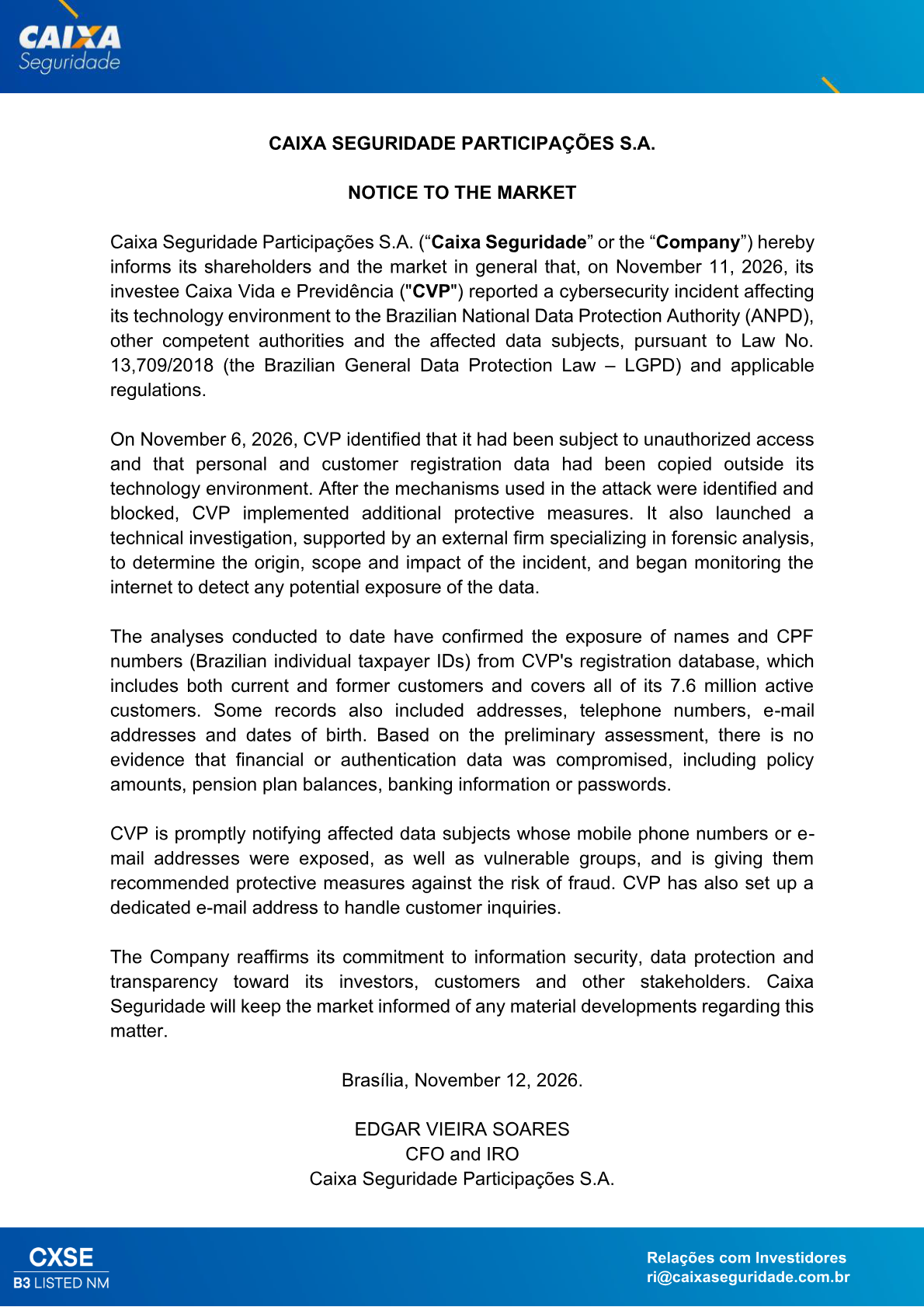
- November 6, 2026: CVP identifies unauthorized access to its technology environment and determines that customers' personal and registration data was copied out of the company's environment.
- Following this, the company blocks the mechanisms used in the attack and implements additional protective measures, in addition to hiring an outside firm specialized in forensic analysis to determine the origin, scope and impact of the incident.
- November 11, 2026: CVP formally reports the incident to the National Data Protection Authority (ANPD) and other competent authorities, as well as notifying the affected data subjects, as required by the Lei Geral de Proteção de Dados (LGPD), Brazil's data protection law.
- November 12, 2026: Caixa Seguridade, as the publicly listed parent company, formalizes the market disclosure.
What was exposed, and what hasn't been confirmed yet
According to the analyses carried out up to the release of the disclosure, names and CPF numbers were confirmed as exposed across CVP's entire customer registration database: 7.6 million active customers, in addition to former customers also present in the database. In part of the records, the exposure also included addresses, phone numbers, emails and dates of birth.
The company's preliminary assessment has not found, so far, evidence of compromise of financial or authentication data. That includes policy values, pension plan balances, banking details and passwords. It's an important distinction: the leak hit the registration records, not the vault.
Why a CPF and a name are already enough to open the door to fraud
In Brazil, the CPF functions as an almost universal identifier: it's used to open a bank account, take out credit, access government services and verify identity on dozens of private platforms. In many verification flows, full name plus CPF is still treated as sufficient proof of identity, even without further confirmation.
It's exactly this combination, name and CPF, that was confirmed as exposed for all 7.6 million CVP customers. Even without leaked passwords or banking details, this pair alone is direct raw material for fraudulent account openings, loan requests taken out in someone else's name, and social engineering scams that cite real data to appear legitimate. When the leak also includes phone number and email, as happened in part of the records, the risk of targeted phishing rises even further.
The duty to notify under the LGPD
The Lei Geral de Proteção de Dados (Law No. 13,709/2018) requires data controllers to notify the ANPD and the affected data subjects of a security incident that may cause relevant risk or harm, within a reasonable timeframe. Caixa Seguridade's disclosure explicitly frames the notification made by CVP as falling under this legal provision.
In practice, the company says it's directly notifying data subjects whose phone numbers or emails were exposed, as well as groups considered vulnerable, guiding them on measures to protect against fraud. A dedicated email channel was also created for customer questions. The text of the disclosure reinforces the institutional commitment in these terms:
The Company reaffirms its commitment to information security, data protection and transparency toward its investors, customers and other stakeholders.
Edgar Vieira Soares, CFO and Investor Relations Officer at Caixa Seguridade Participações
What this means for people building systems in the financial sector
For those who design or maintain systems that store CPF numbers, names and registration data at scale, the CVP case is a concrete reminder of architecture decisions that turn into business risk when they fail:
- Data minimization and segmentation: full registration databases of millions of customers, accessible from a single compromised point, widen the blast radius of any breach. Separating what is identification data (name, CPF) from what is financial data (balance, policy) limits the damage even when one side is breached.
- Access control and auditing: the disclosure doesn't detail the attack vector, but it describes unauthorized access to the technology environment followed by copying of data out of it. This is the classic exfiltration pattern that access logging and monitoring for anomalous volumes of database reads/exports exist to detect before it turns into a public incident.
- Incident response that's tested, not just documented: CVP managed to identify, block and investigate within a few days, with support from an outside forensic firm. Having that playbook ready before the attack, rather than assembling it during one, is what separates a fast response from a prolonged crisis.
- Notification as part of the product: under the LGPD, building the flow for notifying data subjects (who was affected, through which channel, with what message) isn't a separate legal task: it's an engineering piece that needs to exist before the incident, with data segmented enough to know exactly who to notify.
What's still unresolved
The disclosure doesn't detail the technical attack vector, nor whether it involved phishing, a leaked credential, an application vulnerability or third-party access. The forensic investigation is still ongoing, and Caixa Seguridade has committed to keeping the market informed about material developments in the case. As of this writing, there is no public report of confirmed exploitation of the exposed data, but the universe of 7.6 million exposed CPFs is large enough that following the case remains relevant for anyone handling sensitive registration data in Brazil.
Translated from the Brazilian Portuguese original · Read the original
Global outage takes down Outlook and Microsoft 365 for nearly two days
A global outage affected Outlook, Microsoft 365, Teams, SharePoint Online and Copilot over nearly 48 hours. Microsoft says there was no attack and no AI involved: the cause was a network capacity change in Azure.