Google open-sources AQuA to hunt silent failures in AI agents

- Reading
- 5 min
AQuA runs alongside the agent in production, clusters failures that slip past traditional monitoring, and points to the likely culprit line of code or prompt.
On November 13, 2026, Google open-sourced a reference implementation called AQuA (Ambient Quality Agent), according to a report by InfoQ. The tool analyzes sessions from AI agents already in production, checks for recurring failure patterns, and investigates root cause by comparing the observed behavior against the version of the code that was deployed at the time of the error.
The target is what are known as silent quality regressions: an agent that ignores a user preference or skips a mandatory tool call, but still returns a response that looks successful. This kind of failure doesn't show up in infrastructure metrics like latency or error rate, because the pipeline technically ran start to finish without an exception.
The problem traditional monitoring doesn't see
Conventional APM and logging were designed to detect breakage: timeout, exception, status 500. An agent that delivers a correctly formatted response, but ignored the user's vegan diet or skipped the available-seat check, generates no error signal in those systems.
In short: AQuA was built to fill that gap, acting as a separate layer of behavioral quality diagnosis, not infrastructure health monitoring.
How it works: a sidecar outside the production path
AQuA runs alongside the agent on Google Cloud, outside the request path, reading telemetry from Cloud Trace, Cloud Logging, or BigQuery. It samples up to 1,000 recent sessions per run and processes that batch in five stages:
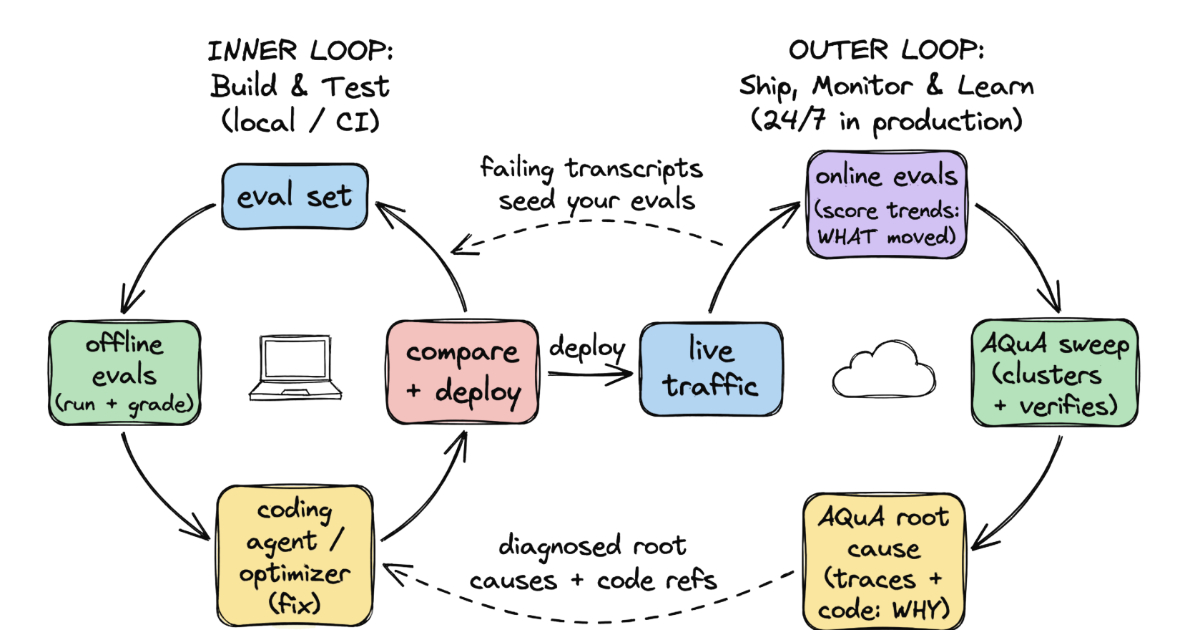
- Sampling of recent sessions
- Review of each session for problematic behaviors
- Clustering of findings into recurring patterns
- Verification of candidate clusters against full transcripts
- Continuous tracking of identified issues
Teams can configure domain-specific quality criteria in a goal.md file and add their own deterministic metrics. The run can be scheduled, triggered after a deploy, or launched on demand.
Root cause: comparing against the deployed code snapshot
For root-cause analysis, AQuA compares failed sessions against an immutable snapshot of the code captured at deploy time. The diagnostic agent identifies the relevant code or instructions, cites the specific file and lines, and proposes changes when the cause lies in the repository.
It can also attribute failures to external dependencies, handoffs between tools, or data retrieved from external sources. AQuA doesn't apply fixes or open pull requests automatically: the decision to fix remains a human one.
The reference test: a travel agent that forgot the vegan diet
Google evaluated 32 sessions of a multi-agent travel application, identifying 42 findings grouped into nine candidate clusters. The verifier rejected three clusters for lack of support, checking up to three full transcripts per candidate cluster, leaving six confirmed problems.
Two of those problems were recurring: the agent skipped the seat-availability check and lost the traveler's vegan preference during handoff between agents. After developers adjusted the prompts and reran the sessions, seat-selection bypass cases dropped from 15 to two sessions, dietary-preference omissions went from seven to zero, and sessions that passed every check rose from five to 13.
It's worth flagging the limit of this result: the numbers came from a controlled replay, not real production traffic.
"Citations, not self-assessed confidence"
Google's post about AQuA highlights why each finding comes tied to traceable evidence instead of a confidence score generated by the model itself:
An insight is its citations, not a self-reported confidence score.
Google, official Google Developer Blog post
In practice, every finding is linked to the traces that support it, and every proposed root cause must reference valid lines from the deployed snapshot. Findings are tracked with status NEW, RECURRING, or RESOLVED (the latter automatically, after 14 days without recurrence).
Limitations Google itself acknowledges
Sampling up to 1,000 sessions can miss rare failures, and the replay doesn't always faithfully reproduce external state (such as the actual availability of a seat in a third-party system at the original moment). Google lists these two restrictions as known limitations in the project's documentation.
Reacting to the launch on LinkedIn, Dmytro Aprelenko, engineering manager at Redcore, summed up the need the tool is trying to address:
Agent orchestration definitely needs better continuous diagnosis to catch these loops early.
Dmytro Aprelenko, engineering manager at Redcore
Where AQuA fits in the agent observability ecosystem
AQuA isn't the only piece in this space. Google's own Agent Platform evaluation service covers regression testing and continuous production quality monitoring, while Arize Phoenix, an independent open source project, offers tracing and evaluation for models and agents.
AQuA's focus is specific: clustering production failures into verified patterns and linking every confirmed finding to a line of code in the deployed snapshot, with auditable citations instead of a confidence score.
What changes for teams running agents in production
For teams already using Google Cloud with agents exposed to real users, AQuA arrives as a reference implementation, not as a managed product ready to point and run. That means integration work: writing the goal.md file with the domain's quality criteria, wiring up the right telemetry sources, and manually validating the first clusters before trusting automatic tracking.
The most practical point is that it doesn't replace human review: even when the root cause points to a specific line of code or prompt, the fix and the deploy remain a decision for whoever maintains the agent. For Brazilian teams that put AI agents into production without this layer of behavioral diagnostics, AQuA is a concrete way to stop discovering preference and tool-calling failures only when the user complains.
Translated from the Brazilian Portuguese original · Read the original

Fake job offer hides malware in a Git repository inside a ZIP
A Russian developer documented how a supposed recruiter used Git hooks and filters to run malicious code with nothing more than a git status, without requiring the execution of any suspicious file.