Figma lança editor de design para guiar agentes de IA no Config India
At the first edition of Config in India, Figma introduced Figma Specs, a Markdown-based editor that documents design rules for teams and for the agents already operating on the canvas, in addition to taking the prototype's code feature out of its closed testing phase.


A brand manual so AI doesn't make things up
Figma used the first edition of Config in India, on October 14, 2026, to announce a set of features that attempts to solve a concrete problem for those who already use AI to design products: the agent that creates a beautiful screen, but outside the brand's visual standard. The answer is called Figma Specs, a Markdown-based editor for documenting a company's design language, according to TechCrunch.
The idea isn't just documentation for humans to read later. The Specs file serves as a reference for both teams and agents, Figma's own and third-party ones, that operate within the platform. In practice, it's Figma's attempt to reduce AI's non-deterministic nature: giving the agent a clear set of rules to follow instead of leaving generation unchecked.
What you can do with Figma Specs
The document can exist as a standalone file within Figma or sit alongside a project's canvas, which changes where the design team will keep this reference day to day. Besides working as a plain text editor, Specs lets you reference other elements already created in the tool.
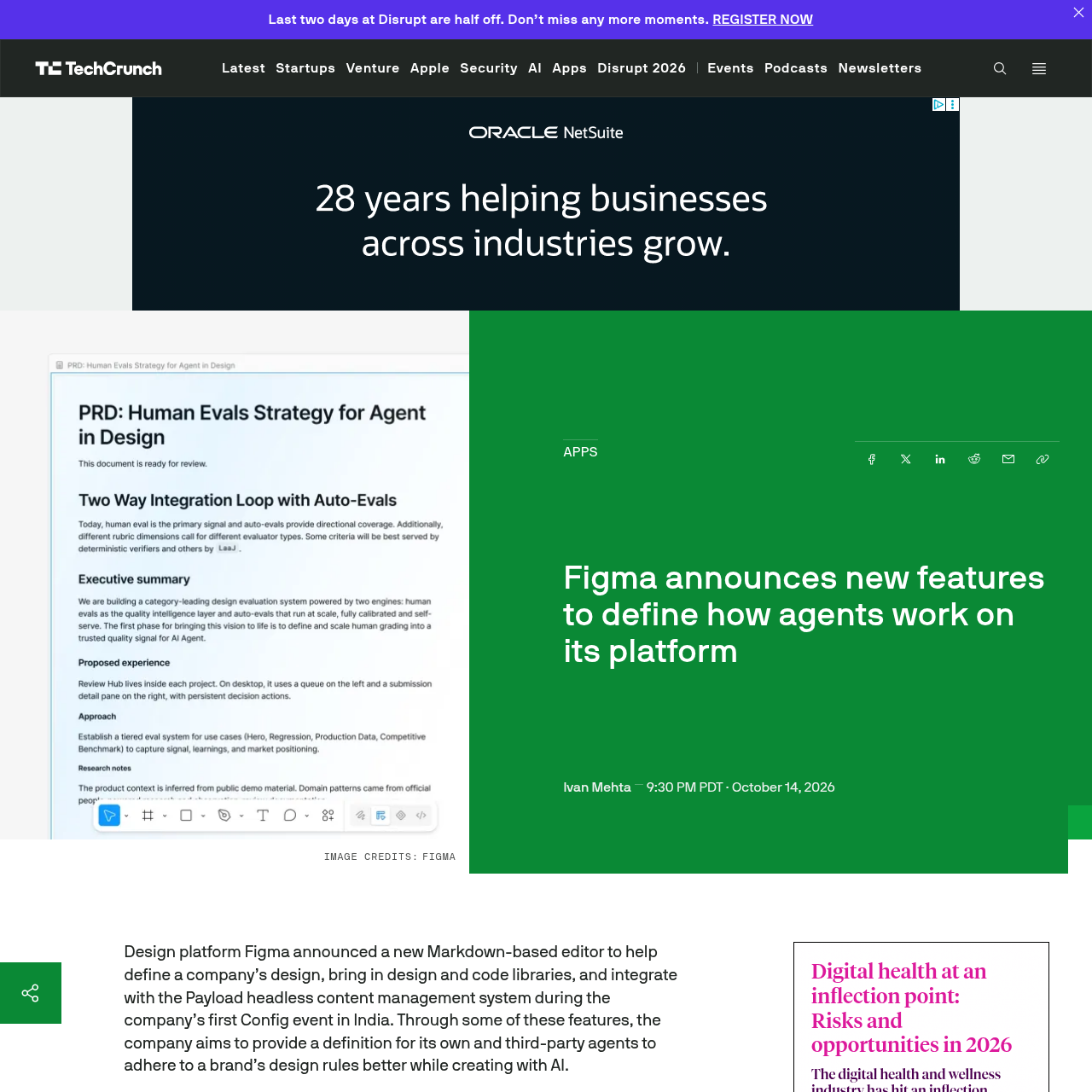
This includes:
- Existing elements on the canvas, to point directly to the component that illustrates the rule;
- FigJam diagrams embedded in the document;
- Code layers and complete designs as a live example of the rule being described.
Add to that the ability to bring design libraries, code libraries, and guidelines into a centralized context system. It's this system that agents now consult to adhere to brand rules when generating a screen or a flow.
Code layers exits closed beta
The code layers feature, which adds code to screens designed on the canvas to create more interactive prototypes, had been in private beta since June 2026. At this week's event in India, Figma opened the feature to public beta, expanding access for more users to test it. With it, you can ask the agent to turn a design into code or to change part of the already generated code to iterate on the prototype, without leaving the visual flow.
This launch comes alongside another recent move: in the week before Config India, Figma had already expanded access to its canvas agent to a larger user base. Together, the two announcements outline the company's strategy: first, put the agent within reach of more people; then, give that agent a set of rules to follow.
The design director's take on why all this matters
Figma's design director, Loredana Crisan, explained to TechCrunch why the company is investing in predictability for AI instead of just generating more code.
We see Figma as the place where software teams come to decide what they build and ship. And so for that, I think one of the key things to keep in mind about what AI has changed and what it made available is the ability to build. There are 17-times more lines of code being produced today than in the past. But when you're looking at releases, only 1.3-times more releases. A lot of that code actually is not necessarily built to ship, but really built to discover what the product is. It's built to design.
Loredana Crisan, Chief Design Officer at Figma
The statement helps explain Figma's framing: for the company, much of the code generated by AI today isn't production code, it's discovery code, a way to prototype ideas faster before deciding what goes into the final release. That's exactly the space code layers and Figma Specs are trying to occupy: not replacing the product decision process, but speeding up exploration within limits the brand has already defined.
MCP grows and Payload joins Figma Make
Figma also announced support for more than 20 new tools via MCP (Model Context Protocol), including Open Code, Dia, Grok Bot, and Indian AI startup Sarvam. It's a sign that the company wants to be the design context hub for agents that run outside its own platform, not just within it.
Another piece of the announcement came from Payload, the open-source headless CMS that Figma acquired in 2025. It's now being integrated into Figma Make, the company's product for generating dynamic sites, allowing content to be managed directly there. According to Figma, Payload downloads have grown sixfold over the past 12 months, which helps justify the investment in integrating it deeper into the creation workflow.
Why India matters in this announcement
Figma opened its first office in India in late 2025, with sales, partnerships, go-to-market, and product support functions. The company says the country is its largest market by user count outside the United States, and that the platform is already used by 40% of the top 100 companies listed on the Bombay Stock Exchange (BSE). Config India isn't just another event on the calendar: it's the first time the company has brought its product event to a market that now weighs as much as the US in user volume.
What changes for product designers in Brazil
For those leading design systems in Brazilian squads, the practical takeaway is direct: brand documentation stops being just a static Figma reference and potentially becomes the contract the AI agent reads before generating any screen. It's worth testing Figma Specs as a governance layer before rolling out the canvas agent to the whole team, instead of relying only on loose prompts.
Code layers in public beta also changes the calculation for those who currently outsource the interactive prototype to the front-end team right from the start. If the agent can turn design into navigable code inside Figma itself, part of the flow validation that today requires a development sprint can happen during the discovery phase, closer to whoever decides what gets built.
What remains open, and TechCrunch doesn't detail, is to what extent third-party agents (via MCP) will actually respect the rules written in a Figma Specs document when operating outside the Figma environment. The company is building the governance vocabulary; it remains to be seen whether the whole ecosystem will speak that language.
Translated from the Brazilian Portuguese original · Read the original

40 trillion tokens of data show why teams stall when adopting AI agents
A QCon AI presentation using real-world usage data from Kilo Code identifies four trust stages in AI agent adoption, and the first point where adoption most often fails.