
Google Open-Sources AX, a Kubernetes-Inspired AI Agent Orchestrator
AX treats autonomous agents as stateful actors, not as microservices or batch jobs, and uses Kubernetes-style CRDs to suspend and resume tasks in under a second.

Google has open-sourced AX, a declarative orchestrator and runtime licensed under Apache 2.0 designed to run autonomous AI agent workloads at scale. The project is hosted at agentexecutor.io and in the google/ax repository, and runs on top of a layer called Agent Substrate, according to the announcement covered by InfoQ. The central premise is easy to state and hard to solve well: autonomous agents don't behave like microservices or like batch jobs, and traditional container infrastructure charges a steep price for that difference.
The problem: an agent is neither a microservice nor a batch job
A classic microservice responds to a request and returns an answer in milliseconds. A batch job runs to completion deterministically. An autonomous AI agent does something else: it has state, it's "bursty" (intense CPU spikes during reasoning, tool execution, and local code evaluation) interspersed with long idle periods while it waits for a model's response, an external API's return, or human intervention.
On a conventional Kubernetes cluster, keeping a dedicated sandbox alive during these waits wastes computing capacity. On the other hand, if you tear down the sandbox to save resources, the cold start of a regular container runtime introduces latency that breaks the agent's interactive loop. According to Google's materials, it's exactly this operational friction point that motivated AX's design.
How it works: stateful actors and four declarative primitives
AX runs on top of Agent Substrate, an execution runtime built specifically for dense actor multiplexing. Each agent session becomes an isolated actor sandbox, with strict CPU and memory limits. When the agent enters an idle state (waiting for an inference provider or a tool call), the platform checkpoints the execution and suspends the process. AX promises to resume suspended actors at sub-second intervals, with no cold start, multiplexing dozens of tasks across the same workers to conserve resources.
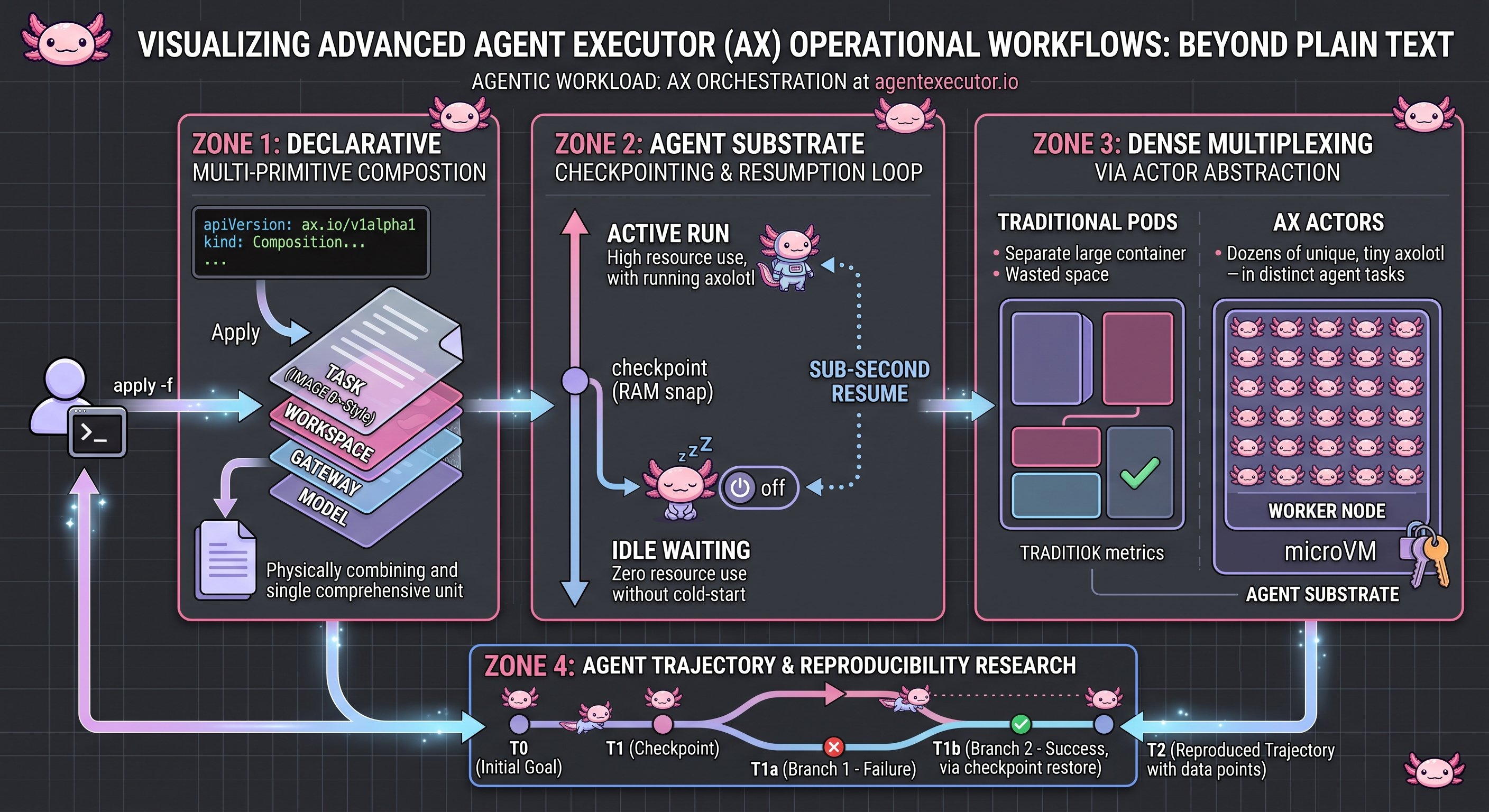
The control plane exposes four Kubernetes-style declarative primitives, defined under the ax.io/v1alpha1 API group:
- Task: defines the execution lifecycle, the sandbox's resource limits, and references to supporting infrastructure.
- Workspace: sets up the environment before execution. You can declare Git repositories, MCP servers (Model Context Protocol), install skill packages, or even provide natural-language goals that a bootstrap agent executes to prepare the toolchain and dependencies before the task begins.
- Gateway: manages outbound network security policies, restricting sandboxed agents to explicit allowlists of hostnames and ports, and injecting credentials into outbound requests.
- Model: centralizes LLM provider parameters, runtime settings, and secrets stored in Kubernetes itself.
Anyone who has ever written a Deployment or a NetworkPolicy will recognize the pattern immediately: these are CRDs (Custom Resource Definitions) applied with kubectl apply (or, in AX's case, with its own command-line tool).
The CLI and deployment: ax, ko, Redis, and kubectx
Interaction with the system happens through the ax tool, written in Go. Platform operators deploy the control plane on Kubernetes using ko and Redis, inside the ax-system namespace, connecting via existing kubectx contexts.
In day-to-day use, developers run commands such as:
ax applyto register manifests (Task, Workspace, Gateway, Model);ax watchto follow phase and condition changes for tasks in real time;ax sshto access sandbox environments interactively for debugging;ax suspendandax resumeto manually control a task's execution state.
The project is positioned both for production agent deployment and for research environments that need to run sandboxed trajectories, reinforcement-learning loops, and agent benchmark evaluations at scale.
The community's mixed reception
The material reported by InfoQ paints a picture of mixed reception, gathered from discussions on Hacker News and Reddit. On one hand, infrastructure engineers praise AX for solving the prohibitive cost of idle agents waiting on a model API response or human input, which on conventional clusters means paying for an idle sandbox. On the other hand, developers criticized the promise of "ergonomic workflows," arguing that the operational overhead of maintaining Kubernetes clusters, container registries, and custom CRDs via ko is anything but simple for someone who just wants to run an agent.
On Reddit, the cross-discussion reinforces a positioning point: AX is a foundational execution runtime, not a high-level application orchestrator like LangGraph or CrewAI. In other words, it doesn't compete directly with frameworks that define an agent's logical flow; it addresses the layer below, where and how that agent runs.
In security and systems channels, practitioners highlighted the value of blast-radius containment from gVisor-isolated sandboxes, but also pointed out maturity issues typical of a newly opened project: dropped connections in the egress proxy and still-rudimentary secrets management. The conclusion emerging from these discussions, according to InfoQ, is that AX is not a quick-start framework for someone testing a hack alone, but rather an infrastructure primitive designed for companies managing fleets of long-running agents at large scale.
What this changes for builders
For platform teams already operating Kubernetes and trying to put autonomous agents into production, AX offers a specific declarative vocabulary for a problem that today is usually solved the hard way: custom queues, dedicated VMs, or homegrown checkpointing solutions. Having Task, Workspace, Gateway, and Model as standardized CRDs means less glue code and a more auditable surface, which matters for anyone dealing with cloud cost governance and outbound network security (Gateway declaratively solves a problem many people today handle with loose firewall rules).
On the other hand, the community's own debate already signals the adoption filter: if your team doesn't operate Kubernetes today, adopting AX means importing all the operational complexity of a cluster, ko, and CRDs just to gain sub-second agent suspension. For those who already have that foundation, or for companies with fleets of agents running 24/7 and a cloud bill that suffers from idle sandboxes, the calculation is different. It's worth following the GitHub repository to see how the community resolves the maturity issues already reported, such as secrets management and egress proxy stability, before putting this into a critical pipeline.
Translated from the Brazilian Portuguese original · Read the original
Microsoft says AI agents are like insider threats and launches Guardian Agents
The company launched a system to monitor the very AI agents it sells, arguing that not even the market's most advanced models deserve full trust inside the enterprise.