Nobel-Winning Chemist Uses Generative AI to Create Molecules That Don't Exist in Nature
David Baker, who shared the 2024 Nobel Prize in Chemistry for computational protein design, now leads AI BioDesign, a project that combines generative models and large-scale testing to design biomolecules outside evolution's repertoire.

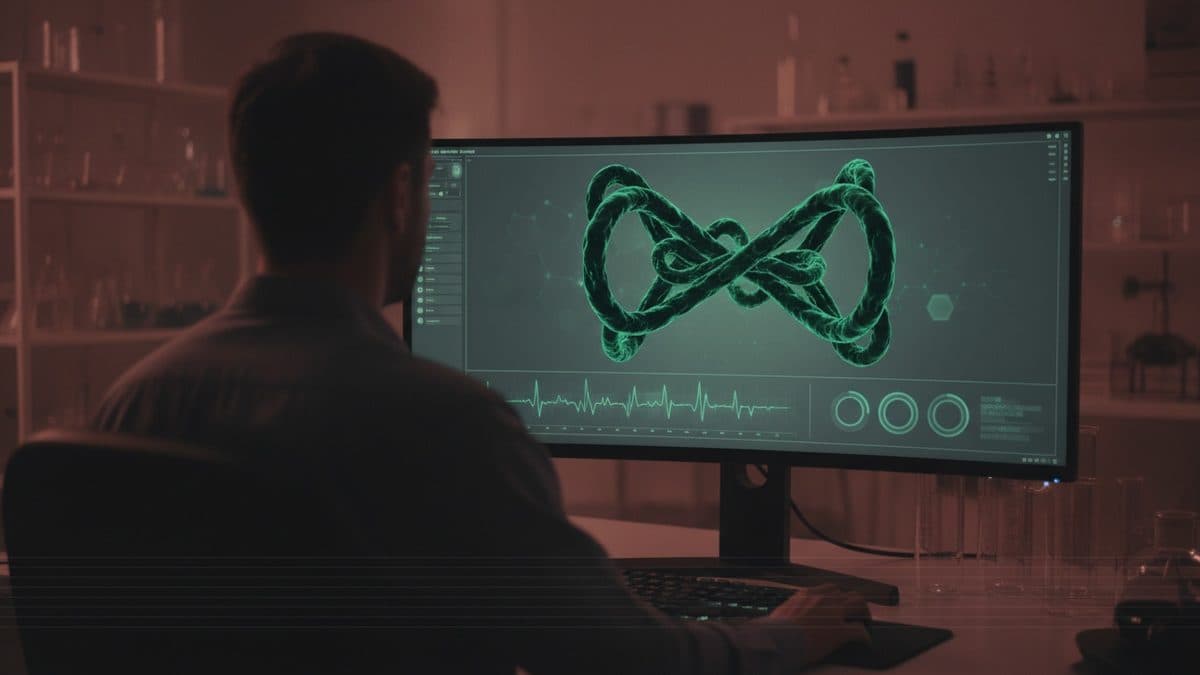
The 2024 Nobel Prize in Chemistry was split between David Baker, John Jumper and Demis Hassabis for two sides of the same problem: predicting a protein's shape from its sequence (the work of Jumper and Hassabis with AlphaFold, at Google DeepMind) and doing the reverse, designing sequences that fold into a desired shape (Baker's work, at the Institute for Protein Design at the University of Washington). Two years later, Baker took the next step: in an interview with WIRED en Español, he detailed AI BioDesign, a project that brings together the Allen Institute, UW itself, and the Fred Hutchinson Cancer Center to design molecules that evolution never produced, but that are physically and chemically possible.
The sentence that sums up the bet is Baker's own: "nature has only explored a fraction of what is physically and chemically possible". The central idea behind AI BioDesign is to use AI models to map this unexplored space and produce databases, models and tools that serve as "seeds" for drugs, enzymes and materials that today have no way of existing because no organism ever needed them: enzymes that break down plastic in the ocean, molecules for neurodegenerative diseases, systems that extract critical minerals from waste.
From Prediction to Design: Why This Is a Technical Leap
For those following the field closely, the post-AlphaFold decade solved a prediction problem: given a sequence of amino acids, what is the resulting 3D structure. The work that earned Baker the Nobel tackles the opposite, generative problem: given a desired shape or function, generate a sequence of amino acids that folds into that shape. It's the same kind of inversion that separates an image classifier from a diffusion model that generates images from scratch, and it's no coincidence that Baker's lab published RFdiffusion, a diffusion model adapted to generate protein backbones, now open source and used by research groups in various parts of the world alongside other tools from the same lab, such as ProteinMPNN and RoseTTAFold.
It's this generative toolkit that underpins AI BioDesign: instead of scanning the finite catalog of proteins that evolution has already produced, the models propose novel structures within the space of what is chemically viable, and the lab tests which of them actually work.
Computational Screening Before Any Synthesis
The obvious question for anyone who builds AI systems is: how do you contain the risk of generating something dangerous when the search space includes everything that is chemically possible, not just what exists? Baker's answer is operational, not philosophical: "the advantage we have today is that computational design allows us to assess many of these risks before a molecule is even synthesized. We can filter designs computationally, test them extensively in controlled laboratory settings, and subject them to increasingly realistic experimental validation before considering any real-world application".
In practice, this describes a pipeline with gates similar to what any ML engineer recognizes: massive candidate generation by the model, computational filtering (structure prediction, stability, interaction with living systems), then an increasingly narrow funnel of validation in a closed lab before anything leaves the building. The difference is that here the "production environment" is living biology, and the cost of a false positive that escapes the funnel isn't a bug, it's a real biological risk.
The Model Still Doesn't Understand What It Generates, and Baker Admits It
A point that interests anyone working with applied AI, not just biologists, is Baker's answer about mechanistic understanding. Asked whether AI could eventually design functional molecules that scientists themselves don't fully understand, he was direct: "science tends to advance in stages, and we see that reflected in how machine learning has advanced protein design. The first step is usually observing that something works, and often only afterward do we understand why. Machine learning is very good at that first stage, it has greatly improved our ability to observe patterns that can be leveraged for biological design". For Baker, strong experimental evidence already justifies moving forward with projects, but deeper understanding remains an important goal, not a prerequisite.
It's the same debate that runs through any ML system in production: the model works, but explainability comes later, if it comes at all. The difference is that, in synthetic biology, the cost of operating an opaque system is higher than in content recommendation.
Where Programmers Come In, Not Just Those Who Pipette
AI BioDesign isn't a closed lab: part of its promised value is precisely the database and open tools it's supposed to produce. The ecosystem around the Institute for Protein Design has operated this way for years, with models and weights published in open repositories, reproducible notebooks, and papers with released code, the kind of material that today fuels biotech startups and academic bioinformatics groups, including in Brazil, where the historical barrier to entering protein design was access to expensive crystallography and magnetic resonance equipment, not the availability of compute. An engineering team that today maintains MLOps pipelines has, in theory, much of the conceptual toolkit to operate this kind of flow: generation, screening, validation, model versioning. What changes is the application domain and the safety bar for what leaves the notebook and enters the physical world.
What Remains Open: Governance for Synthetic DNA
The part without a ready answer is regulatory. Asked about limits, Baker argued that decisions should be guided by a balance between benefit and potential harm, and proposed something concrete: monitoring and recording all synthetic DNA manufactured, keeping the sequence and the identity of whoever ordered it. It is, in practice, a proposal for an audit and traceability system for a supply chain that today is fragmented among dozens of DNA synthesis suppliers worldwide, without a single ledger. Baker explicitly compares the need to frameworks that already exist for other powerful technologies, but acknowledges that governance still needs to evolve alongside technical capability, not after it.
For those who build software, this is the kind of gap that eventually becomes a product: tracking, verification and compliance systems for synthetic biology are, today, as open an engineering problem as the scientific problem AI BioDesign is trying to solve.
Translated from the Brazilian Portuguese original · Read the original

Microsoft says AI agents are like insider threats and launches Guardian Agents
The company launched a system to monitor the very AI agents it sells, arguing that not even the market's most advanced models deserve full trust inside the enterprise.